



HIV
Human immunodeficiency virus
HIV (Human immunodeficiency virus) is a lentivirus (a subgroup of retrovirus) that causes the acquired immunodeficiency syndrome (AIDS), a condition in humans in which progressive failure of the immune system allows life-threatening opportunistic infections and cancers to thrive. Infection with HIV occurs by the transfer of blood, semen, vaginal fluid, pre-ejaculate, or breast milk. Within these bodily fluids, HIV is present as both free virus particles and virus within infected immune cells. HIV infects vital cells in the human immune system such as helper T cells (specifically CD4+ T cells), macrophages, and dendritic cells. HIV infection leads to low levels of CD4+ T cells through a number of mechanisms, including apoptosis of uninfected bystander cells, direct viral killing of infected cells, and killing of infected CD4+ T cells by CD8 cytotoxic lymphocytes that recognize infected cells. When CD4+ T cell numbers decline below a critical level, cell-mediated immunity is lost, and the body becomes progressively more susceptible to opportunistic infections.
HIV Isoform Specific Products
All Product Categories
-
HIV Inhibitors
(1220)
View all products
-
HIV Antagonists
(4)
View all products
-
HIV Activators
(19)
View all products
-
HIV Modulator
(1)
View all products
-
HIV Inducers
(2)
View all products
-
HIV Degrader
(1)
View all products
-
HIV Controls
(4)
View all products
-
HIV Ligand
(1)
View all products
-
HIV Proteins
(27)
View all products
-
HIV Related Products (1392)
Related Products (1392)

-
Recombinant Proteins (27)
-
Antibodies (6)
-
HIV Isoform Comparison
-
(Rac)-Efavirenz-d4
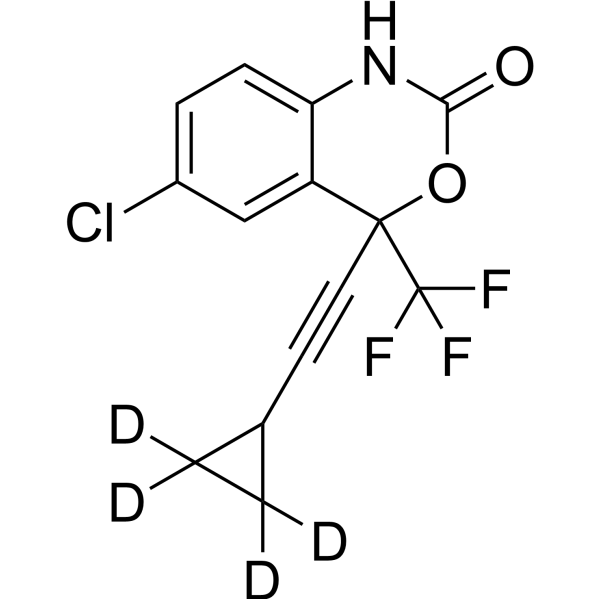 0 ImagesCat. No.: HY-10572BSCAS No.: 1246812-58-7(Rac)-Efavirenz-d4 is a labelled racemic Efavirenz. Efavirenz (DMP 266) is a potent inhibitor of the wild-type HIV-1 reverse transcriptase with a Ki of 2.93 nM and exhibits an IC95 of 1.5 nM for the inhibition of HIV-1 replicative spread in cell culture. (Rac)-Efavirenz-d4 is a click chemistry reagent, it contains an Alkyne group and can undergo copper-catalyzed azide-alkyne cycloaddition (CuAAc) with molecules containing Azide groups.
-
CK147
 0 ImagesCat. No.: HY-182690CAS No.: 1883356-12-4CK147 is a Sec61α translocase inhibitor that blocks the co-translational translocation of proteins by binding to and inhibiting the Sec61 protein translocation channel on the endoplasmic reticulum membrane. CK147 exhibits potent CD4 downregulation activity with an IC50 of 0.04 µM. CK147 prevents HIV entry into host cells and shows significant cytotoxicity. CK147 can be used in studies related to HIV infection.
-
PMEDAP (Standard)
 0 ImagesCat. No.: HY-106382RCAS No.: 113852-41-8PMEDAP (Standard) is the analytical standard of PMEDAP (HY-106382). This product is intended for research and analytical applications. PMEDAP is a potent inhibitor of human immunodeficiency virus (HIV) replication. PMEDAP has anti-murine cytomegalovirus (MCMV) activity. PMEDAP is a very potent inhibitor of Moloney murine sarcoma virus (MSV)-induced tumor formation and associated mortality.

-
Nevirapine-d8
 0 ImagesCat. No.: HY-10570S2CAS No.: 1051418-86-0Synonyms: BI-RG 587-d8; NSC 641530-d8; NVP-d8Nevirapine-d8 (BI-RG 587-d8) is deuterium labeled Nevirapine. Nevirapine is a non-nucleoside inhibitor of HIV-1 reverse transcriptase used to treat and prevent HIV/AIDS; with a Ki of 270 μM.
-
RM-5038
 0 ImagesCat. No.: HY-107142CAS No.: 1349090-91-0RM-5038 is a thiazolide antivirus agent. RM-5038 can induce innate immunity and reduce HIV replication.
-
DLC27-14
 0 ImagesCat. No.: HY-117472CAS No.: 1360869-92-6
-
TNK-651
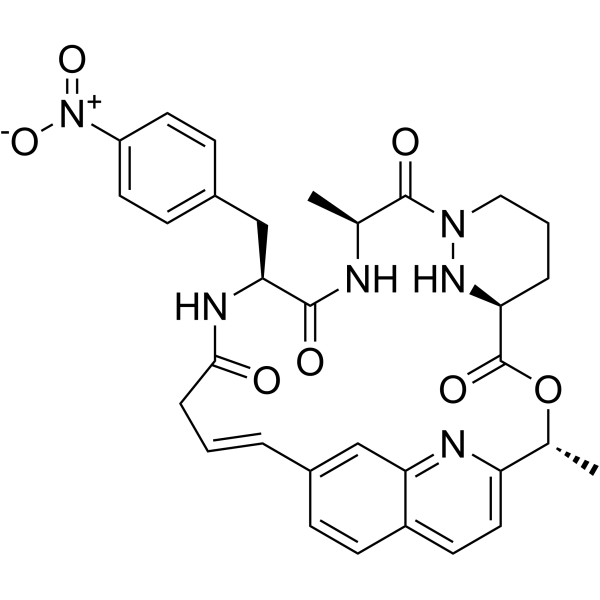
 0 ImagesCat. No.: HY-10893CAS No.: 175739-42-1TNK-651 is a non-nucleoside HIV-1 reverse transcriptase inhibitor. TNK-651 exhibits inhibitory effects on both the HIV-1 SF33 strain and the NNRTI-resistant HIV-1 A17 strain. TNK-651 can be used for the study of HIV-1 infection.
-
Chloroquine dihydrochloride (Standard)
 0 ImagesChloroquine (dihydrochloride) (Standard) is the analytical standard of Chloroquine (dihydrochloride). This product is intended for research and analytical applications. Chloroquine dihydrochloride is an antimalarial and anti-inflammatory agent widely used to treat malaria and rheumatoid arthritis. Chloroquine dihydrochloride is an autophagy and toll-like receptors (TLRs) inhibitor. Chloroquine dihydrochloride is highly effective in the control of SARS-CoV-2 (COVID-19) infection in vitro (EC50=1.13 μM)[1][2][3][4].
-
Fostemsavir (Standard)
 0 ImagesSynonyms: BMS-663068 (Standard)Fostemsavir (Standard) is the analytical standard of Fostemsavir. This product is intended for research and analytical applications. Fostemsavir (BMS-663068) is the phosphonooxymethyl prodrug of BMS-626529. Fostemsavir (BMS-663068) is a novel attachment inhibitor that targets HIV-1 gp120 and prevents its binding to CD4+ T cells.
-
Lenacapavir (Standard)
 0 ImagesCat. No.: HY-111964RCAS No.: 2189684-44-2Synonyms: GS-6207 (Standard)Lenacapavir (Standard) is the analytical standard of Lenacapavir (HY-111964). This product is intended for research and analytical applications. Lenacapavir (GS-6207) is an HIV-1 capsid inhibitor. Lenacapavir binds to the interface between capsid hexamers and CA monomers, disrupts capsid assembly and viral maturation, inhibits nuclear translocation of HIV-1 DNA, interferes with CA-mediated protein-protein interactions, reduces the formation of 2-LTR circles and pre-integration proviruses, induces aberrant capsids, and decreases the production of mature HIV-1. Lenacapavir exhibits activity against a variety of HIV-1 subtypes and clinical isolates. Lenacapavir is applicable to research related to human immunodeficiency virus type 1 (HIV-1) infection.
-
Elvitegravir-13C6
 0 ImagesCat. No.: HY-14740S2Synonyms: GS-9137-13C6 ; JTK-303-13C6 ; D06677-13C6Elvitegravir-13C6 (GS-9137-13C6) is 13C labeled Elvitegravir. Elvitegravir (GS-9137; JTK-303; D06677) is an HIV integrase inhibitor for HIV-1IIIB, HIV-2EHO and HIV-2ROD with IC50 of 0.7 nM, 2.8 nM and 1.4 nM, respectively.
-
ddATP lithium
 0 ImagesCat. No.: HY-128036DSynonyms: 2',3'-Dideoxyadenosine 5'-triphosphate lithiumddATP (lithium) (2',3'-Dideoxyadenosine 5'-triphosphate (lithium)) is an active metabolite of 2',3'-dideoxyinosine and a DNA polymerase chain elongation inhibitor. ddATP (lithium) is used in Sanger DNA sequencing and in research related to viral infection[1][2][3][4][5].
-
Saquinavir-13C6
 0 ImagesCat. No.: HY-17007S2Synonyms: Ro 31-8959-13C6Saquinavir-13C6 (Ro 31-8959-13C6) is 13C labeled Saquinavir (HY-17007). Saquinavir (Ro 31-8959) is an orally active HIV protease inhibitor that can be used in the research of AIDS. Saquinavir also has anti-inflammatory activity and can induce apoptosis of human red blood cells.

-
HEPT
 0 ImagesCat. No.: HY-10892CAS No.: 123027-56-5HEPT is a potent and selective anti-HIV-1 agent.
-
Cobicistat (Standard)
 0 ImagesSynonyms: GS-9350 (Standard)Cobicistat (Standard) is the analytical standard of Cobicistat. This product is intended for research and analytical applications. Cobicistat is a potent and selective inhibitor of cytochrome P450 3A (CYP3A) enzymes with IC50s of 30-285 nM. Cobicistat is a pharmacokinetic enhancer which increases the overall absorption of several HIV medications.
-
12-Methoxydodecanoic acid
 0 ImagesCat. No.: HY-W787717CAS No.: 92169-28-312-Methoxydodecanoic acid, a heteroatom-containing analog of myristic acid, possesses anti-viral activity against HIV, with an IC50 of 6.8 μM. 12-Methoxydodecanoic acid inhibits moloney murine leukemia virus (MoMLV).
-
HIV-IN-14
 0 ImagesCat. No.: HY-184492CAS No.: 3069129-78-5HIV-IN-14 is an agent that binds to the HIV-1 reverse transcriptase p66 domain (monomeric GAG-POL), and also acts as a selective cytotoxic agent. HIV-IN-14 promotes GAG-POL dimerization, which in turn leads to premature activation of intracellular viral protease. HIV-IN-14 selectively kills HIV-infected cells expressing GAG-POL without exerting cytotoxicity on non-HIV-infected cells. HIV-IN-14 can be used in the research of HIV infection, acquired immunodeficiency syndrome (AIDS) or AIDS-related complex (ARC).




