



IFNAR
Interferon-α/β receptor; Interferon-alpha/beta receptor
The interferon-α/β receptor (IFNAR) is composed of two subunits, IFNAR1 and IFNAR2, encoding transmembrane polypeptides. Type-I IFNs, interferon α (IFN-α) and interferon β (IFN-β), act through a shared receptor complex, IFNAR. Binding of type-I IFN to IFNAR1 will robustly activate Janus activated kinase-signal transducer and activator of transcription (JAK-STAT) signaling pathway. Aberrant activation of the type-I IFN response results in a spectrum of disorders called interferonopathies.
Type-I IFN response occurs when IFN-α/β binds to their receptor complex, IFNAR. The ligand-receptor complex is phosphorylated, presumably by pre-associated Janus activated kinases (JAKs) namely tyrosine kinase 2 (TYK2) on IFNAR1 and JAK1 on IFNAR2. The phosphorylated receptors are docking sites for signal transducers and activators of transcription (STAT) factors that dimerise and translocate to the nucleus. STATs 1, 2, 3, 4, and 5 are activated by type-I IFNs in many cell types. Other kinases (e.g., mitogen-activated protein kinases) and transcription factors (e.g., nuclear factor-κB) can also be activated in response to type-I IFNs. Multiple pathways and IFN-regulated genes are activated by IFNs, many of which remain unknown.
All Product Categories
-
IFNAR Inhibitors
(123)
View all products
-
IFNAR Agonists
(11)
View all products
-
IFNAR Antagonists
(6)
View all products
-
IFNAR Activators
(84)
View all products
-
IFNAR Modulators
(4)
View all products
-
IFNAR Inducers
(23)
View all products
-
IFNAR Degrader
(1)
View all products
-
IFNAR Control
(1)
View all products
-
IFNAR Ligand
(1)
View all products
-
IFN-α/β Receptor Proteins
(16)
View all products
-
IFN-alpha/beta R2 Proteins
(6)
View all products
-
IFNAR Related Products (325)
Related Products (325)

-
Recombinant Proteins (16)
-
Antibodies (14)
-
TLR7/8 agonist 13
 0 ImagesCat. No.: HY-177300CAS No.: 1402802-45-2TLR7/8 agonist 13 is an orally active dual agonist of TLR7 (lowest effective concentrations (LEC) [hTLR7] = 1.6 μM) and TLR8 (LEC [hTLR8] = 1.6 μM). TLR7/8 agonist 13 exhibits agonistic activity against human peripheral blood mononuclear cells (hPBMCs) (LEC [hPBMC] = 0.5 μM). TLR7/8 agonist 13 induces endogenous IFNα, activating myeloid dendritic cells and monocytes toward a TH1 phenotype in mice and cynomolgus monkeys. TLR7/8 agonist 13 reduces viral load and HBV surface antigen expression in a mouse model of chronic AAV-HBV infection. TLR7/8 agonist 13 has the potential to indirectly induce IFNγ, which may promote HBV antigen-specific CD8 T cell-mediated responses. TLR7/8 agonist 13 can be used to study hepatitis B virus.
-
Roquinimex (Standard)
 0 ImagesSynonyms: Linomide (Standard); FCF89 (Standard); ABR212616 (Standard)Roquinimex (Standard) is the analytical standard of Roquinimex (HY-13743). Roquinimex (Linomide) is an orally active immunomodulator with antineoplastic, anti-inflammatory, and antiangiogenic activity. Roquinimex suppresses TH1 lymphocyte cytokines (IL-2, IFN-γ), promotes TH2 lymphocyte cytokines (IL-4, IL-10), increases NK cell, activated monocyte, and T cell activity. Roquinimex blocks macrophage TNF-α production and suppresses IL-1/IL-6 secretion. Roquinimex exhibits in vivo antitumour activity, suppresses rodent autoimmune disease signs, and ameliorates murine colitis and psoriasis. Roquinimex can be used for the research of leukemia, inflammatory bowel disease, multiple sclerosis, and psoriasis.
-
Matairesinol monoglucoside
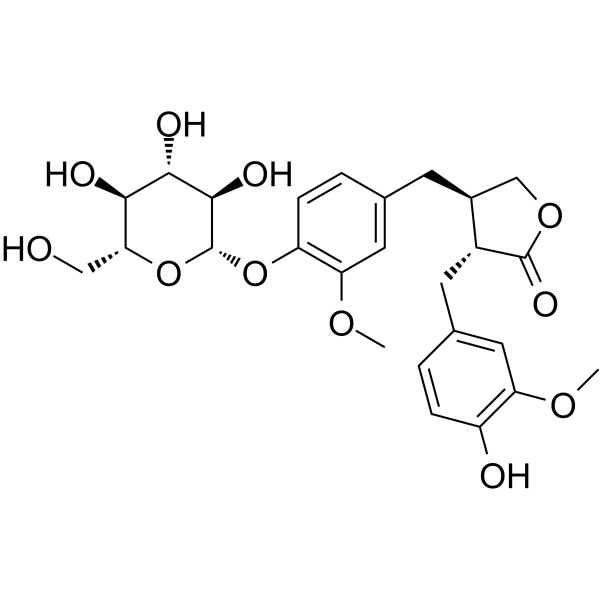 0 ImagesMatairesinol monoglucoside is a STING activator. Matairesinol monoglucoside modulates the STING-TBK1-IRF3 signaling axis, promotes STING transcriptional expression, increases TBK1 and IRF3 phosphorylation. Matairesinol monoglucoside induces IFN-α and IFN-β production, reduces HBV DNA, HBsAg, and HBeAg expression. Matairesinol monoglucoside can be used for the research of hepatitis b virus (hbv) infection.
-
Inact-dIRF4-2
 0 ImagesCat. No.: HY-185697ACAS No.: 3136609-65-6Inact-dIRF4-2 is an inactive control compound of dIRF4-2 (HY-185697). Inact-dIRF4-2 lacks IRF4-binding activity and IRF4-dependent cytotoxic activity. Inact-dIRF4-2 can be used in the research of multiple myeloma.
-
Calcium propionate, meets analytical specification of E282 (Standard)
 0 ImagesCat. No.: HY-B1580ARCAS No.: 4075-81-4Synonyms: Bioban-C, meets analytical specification of E282 (Standard)Calcium propionate, meets analytical specification of E282 (Standard) (Bioban-C, meets analytical specification of E282 (Standard)) is the analytical standard of Calcium propionate, meets analytical specification of E282 (HY-B1580A). This product is intended for research and analytical applications. Calcium propionate, meets analytical specification of E282 is a calcium salt of Propionic acid with oral activity, which can be hydrolyzed into propionate and calcium ions. Calcium propionate, meets analytical specification of E282 elevates intracellular ROS levels in tumor cells, depletes GSH, reduces mitochondrial membrane potential, and thereby induces tumor cell apoptosis. In mouse colitis models, Calcium propionate, meets analytical specification of E282 modulates inflammatory factors such as IFN-γ, calprotectin, and Pglyrp3, ameliorating intestinal inflammation and metabolic disorders. In ruminants, Calcium propionate, meets analytical specification of E282 serves as a gluconeogenic precursor, regulating rumen fermentation and microbial diversity; in high-fat diet rats, it alters gut microbiota composition and affects blood biochemical parameters. Calcium propionate, meets analytical specification of E282 is commonly used as a food and feed additive, and is also used in research related to hypocalcemia, dyslipidemia, colitis, and lung cancer.




