



Nav1.8
NaV1.8, encoded by SCN10A, is a tetrodotoxin-resistant voltage-gated sodium channel expressed by dorsal root ganglion sensory neurons associated with C-fibres[1]. It supports nociceptor excitability because its sodium current contributes to action-potential generation in sensory neurons activated by tissue damage[1]. Mechanistically, inflammatory signaling can increase tetrodotoxin-resistant sodium current through the cyclic AMP-protein kinase A pathway, linking NaV1.8 function to peripheral sensitization[2]. In pain models, reducing NaV1.8 expression or blocking NaV1.8 attenuated neuropathic or inflammatory pain behaviors in rats[3][4]. Compared with NaV1.7, which strongly determines inflammatory pain thresholds, NaV1.8 is distinguished by sensory-neuron selectivity and tetrodotoxin resistance[1][5]. For experimental applications, A-803467 selectively blocked human NaV1.8 and reduced mechanical allodynia or thermal hyperalgesia in rat pain models[4]. Clinically, the oral selective NaV1.8 inhibitor VX-548 reduced acute postoperative pain at the highest tested dose in phase 2 trials[6].
References:
- [1]. Akopian AN, et al. A tetrodotoxin-resistant voltage-gated sodium channel expressed by sensory neurons. Nature. 1996 Jan 18;379(6562):257-62. [Content Brief]
- [2]. England S, et al. PGE2 modulates the tetrodotoxin-resistant sodium current in neonatal rat dorsal root ganglion neurones via the cyclic AMP-protein kinase A cascade. J Physiol. 1996 Sep 1;495 ( Pt 2)(Pt 2):429-40. [Content Brief]
- [3]. Mikami M, et al. Short hairpin RNA-mediated selective knockdown of NaV1.8 tetrodotoxin-resistant voltage-gated sodium channel in dorsal root ganglion neurons. Anesthesiology. 2005 Oct;103(4):828-36. [Content Brief]
- [4]. Jarvis MF, et al. A-803467, a potent and selective Nav1.8 sodium channel blocker, attenuates neuropathic and inflammatory pain in the rat. Proc Natl Acad Sci U S A. 2007 May 15;104(20):8520-5. [Content Brief]
- [5]. Nassar MA, et al. Neuropathic pain develops normally in mice lacking both Na(v)1.7 and Na(v)1.8. Mol Pain. 2005 Aug 22;1:24. [Content Brief]
- [6]. Jones J, et al. Selective Inhibition of NaV 1.8 with VX-548 for Acute Pain. N Engl J Med. 2023 Aug 3;389(5):393-405. [Content Brief]
All Product Categories
-
Nav1.8 Related Products (43)
Related Products (43)

-
Ceratotoxin-1
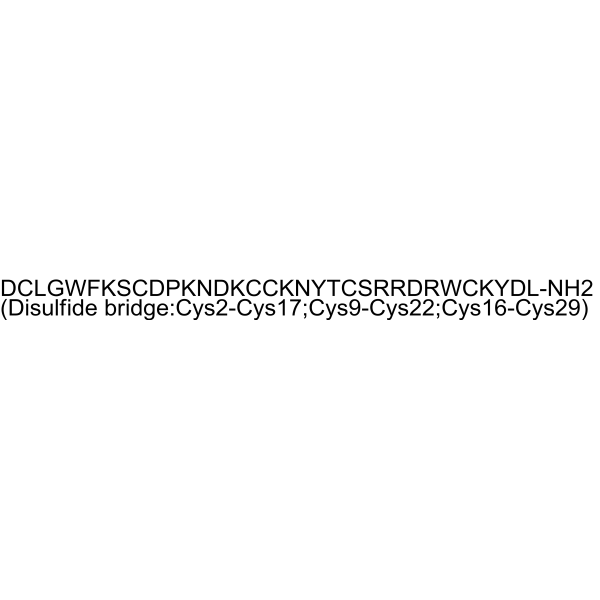 0 ImagesCat. No.: HY-P5811Synonyms: CcoTx1; β-TRTX-cm1aCeratotoxin-1 (CcoTx1), a peptide toxin, is an voltage-gated sodium channel subtypes inhibitor. Ceratotoxin-1 inhibits Nav1.1/β1, Nav1.2/β1, Nav1.4/β1, and Nav1.5/β1 with IC50 of 523 nM, 3 nM, 888 nM, and 323 nM, respectively. Ceratotoxin-1 also inhibits Nav1.8/β1.
-
Nav1.8-IN-19
 0 ImagesCat. No.: HY-172999CAS No.: 3003829-05-5Nav1.8-IN-19 (Compound 122) is a Nav1.8 inhibitor with an IC50 of 0.44 nM in HEK cells. Nav1.8-IN-19 can be used for the study of pain.
-
Suzetrigine N-oxide
 0 ImagesSuzetrigine N-oxide (the third compound in P57) is a derivative of Suzetrigine (HY-148800). Suzetrigine N-oxide is an inhibitor of voltage-gated sodium channels (Nav1.8) and can be used for research on the treatment of pain, especially neuropathic pain.



