



Endonuclease
Endonuclease
Endonucleases are a class of enzymes that can cleave phosphodiester bonds within nucleic acid molecules. According to the substrates they act on, endonucleases can be classified into DNA endonucleases and RNA endonucleases. According to their structural and functional characteristics, endonucleases can be divided into restriction endonucleases, non-specific endonucleases, and site-specific endonucleases. Endonucleases play an important role in the fields of DNA repair, RNA processing, and genetic engineering. Mutations in the genes encoding endonucleases can lead to genetic diseases, such as xeroderma pigmentosum. Abnormal expression or altered activity of endonucleases may promote tumorigenesis, be involved in the pathological processes of neurodegenerative diseases, and at the same time, endonucleases are also potential targets for the treatment of diseases such as tumors[1][2].
References:
All Product Categories
-
Endonuclease Related Products (45)
Related Products (45)

-
Antibodies (1)
-
Endo-β-N-acetylglucosaminidase F3
 0 ImagesCat. No.: HY-E70134CAS No.: 37278-88-9Synonyms: Endo F3Endo-β-N-acetylglucosaminidase D (Endo F3) cleaves free or Asparagine-linked triantennary oligosaccharides or α1-6 fucosylated biantennary oligosaccharides, as well as triamnnosyl chitobiose core structures.
-
Endo-β-N-acetylglucosaminidase F2
 0 ImagesCat. No.: HY-E70133CAS No.: 37278-88-9Synonyms: Endo F2Endo-β-N-acetylglucosaminidase F2 (Endo F2), a highly specific endoglycosidase, cleaves within the chitobiose core of asparagine-linked complex biantennary and high mannose oligosaccharides from glycoproteins and glycopeptides. Endo F2 cleaves biantennary glycans at a rate approximately 20 times greater than high mannose glycans. The activity of Endo F2 is identical on biantennary structures with and without core fucosylation. Endo F2 is not active on hybrid or tri- and tetra-antennary oligosaccharides.
-
PNR-3-80
 0 ImagesPNR-3-80 is an endonuclease G (ENDOG) inhibitor with an IC50 of 0.67 μM. As a non-competitive binder to the ENDOG-substrate complex, PNR-3-80 specifically inhibits the endonuclease activity of ENDOG. PNR-3-80 reduces cell death induced by Cisplatin (HY-17394) and Docetaxel (HY-B0011), and inhibits DNA damage and autophagy (autophagy) induced by Etoposide (HY-13629). PNR-3-80 can be used in studies related to cell injury.
-
T5 Exonuclease
 0 ImagesCat. No.: HY-E70580CAS No.: 2266626-22-4T5 Exonuclease is a DNA exonuclease that has 5′-3′ exonuclease activity on both single- and double-stranded DNA. T5 Exonuclease also has single-strand endonuclease and 5′-flap endonuclease activity.
-
PNR-3-82
 0 ImagesPNR-3-82 is a highly selective inhibitor of endonuclease G (EndoG) with an IC50 value of 0.61 μM against EndoG. As a non-competitive inhibitor, PNR-3-82 blocks EndoG-mediated DNA fragmentation. PNR-3-82 enhances the in vivo delivery efficiency of plasmid DNA and exhibits bioprotective effects against drug-related injuries and other cell/tissue damages. PNR-3-82 can be used in studies related to prostate cancer.
-
MU1409
 0 ImagesMU1409 is an inhibitor of MRE11 nuclease with an IC50 of 12.1 μM. Additionally, MU1409 also inhibits FEN1 and EXO1, with IC50 values of 24.2 and 176.4 μM, respectively. MU1409 affects DNA repair in cells, preventing the degradation of stalled replication forks in BRCA2-deficient cells, making it a promising candidate for research on BRCA2 mutation-induced cancers.
-
AV5116
 0 ImagesAV5116 is a cap-dependent endonuclease inhibitor (CENI) that binds to the active site of the cap-dependent endonuclease (CEN) located in the N-terminal domain of the polymerase acidic. AV5116 exhibits potent inhibitory activity against influenza viruses (influenza A, B, and C viruses). AV5116 can be used for the study of influenza virus infections.
-
Endonuclease IV
 0 ImagesCat. No.: HY-E70577CAS No.: 63363-78-0DNA repair enzyme. Endonuclease IV has endonuclease activity at AP sites, 3' phosphodiesterase activity that can remove a variety of ligation-blocking lesions from the 3' end of DNA, endonuclease activity on oxidative DNA lesions, and 3' to 5' exonuclease activity.
-
Cusculine
 0 ImagesSynonyms: FAC21Cusculine (FAC21) is an oropouche virus (OROV) endonuclease inhibitor with an IC50 of 1.4 μM. Cusculine strongly interacts with OROV endonuclease, possibly limiting viral RNA interaction with other proteins, intercalates into double-stranded RNA (a viral replication intermediate), and efficiently inhibits OROV viral replication in vitro. Cusculine can be used for the research of oropouche fever.
-
O-Glycoprotease
 0 ImagesCat. No.: HY-E70565O-Glycoprotease is an O-glycoprotein-specific endoprotease that catalyzes the hydrolysis of peptide bonds directly adjacent to the O-polymer in native mucin-type O-glycosylated proteins. O-Glycoprotease sequence is from Akkermansia muciniphila, recombinantly expressed in E.coli, with a 6×His tag at the C-terminus.
The enzyme maintains high activity between pH 5.5-7.5 and is resistant to 1M NaCl, but is highly sensitive to EDTA (0.5 mM EDTA) and can be inhibited by Zn2+.
-
AD16
 0 ImagesCat. No.: HY-157329CAS No.: 311315-04-5AD16 (Acetamide) is a LINE-1 retrotransposon endonuclease inhibitor with the IC50 of 4.7 μM. AD16 (Acetamide) reduce LINE-1 retrotransposition, L1-induced DNA damage, and inflammation reinforced by L1 in senescent cells.
-
MU876
 0 ImagesCat. No.: HY-175812CAS No.: 1208829-24-6MU876 (Compound 32) is a MUS81 inhibitor with an IC50 of 0.5 μM. MU876 effectively inhibits MUS81-dependent homologous recombination (HR) and break-induced replication (BIR) pathways. MU876 sensitizes cancer cells to DNA-damaging agents, such as Cisplatin (HY-17394), through impairing their ability to repair DNA lesions. MU876 can be used for cancers chemotherapy research.
-
Recombinant endoglycoceramidase II assisted by activator II
 0 ImagesCat. No.: HY-E70283Synonyms: rEGCase II assisted by Activator IIRecombinant endoglycoceramidase II assisted by activator II is a biocatalyst and a key enzyme in new biocatalyst technology. Enzyme engineering focuses on enhancing enzyme reaction kinetics, substrate selectivity, and activity under harsh conditions such as low or high pH. By introducing stimulus responsiveness to these enzyme modifications, dynamic control of activity is also possible.
-
RNase A, Bovine Pancreas DNase & Protease Free
 0 ImagesCat. No.: HY-129046BCAS No.: 9001-99-4Synonyms: Ribonuclease A DNase & Protease FreeRNase A (Bovine pancreatic RNase) is a widely used Endonuclease in DNA purification by specifically hydrolyzing cytosine or uracil residues of RNA. RNase A degrades the RNA in the RNA/DNA duplex. RNase A catalyses the breakdown of 3',5'-phosphodiester linkages of single stranded RNA. RNase A family members in organisms are tightly involved in various physiological and pathological processes including cell growth and development, proliferation, differentiation and migration. Dysregulation of RNase A activity or expression level is closely related to pancreatic, ovarian, bladder and thyroid cancer. RNase A has tumor cell-killing ability. RNase A, Bovine Pancreas (DNase & Protease Free) is RNase A derived from bovine pancreas and does not contain DNase or protease.
-
Cyclic tri-AMP
 0 ImagesCat. No.: HY-137721CAS No.: 54447-85-7Cyclic tri-AMP is a component of the cyclic oligonucleotide-based anti-phage signaling system (CBASS), and acts as the second messenger in the immune response against viral infection. Cyclic tri-AMP binds to and activates DNA endonuclease NucC, results in cell death and exhibits antiviral activity.
-
RNase A, Recombinant Protease & DNase free, animal free
 0 ImagesCat. No.: HY-129046HCAS No.: 9001-99-4RNase A (Bovine pancreatic RNase) is a widely used Endonuclease in DNA purification by specifically hydrolyzing cytosine or uracil residues of RNA. RNase A degrades the RNA in the RNA/DNA duplex. RNase A catalyses the breakdown of 3',5'-phosphodiester linkages of single stranded RNA. RNase A family members in organisms are tightly involved in various physiological and pathological processes including cell growth and development, proliferation, differentiation and migration. Dysregulation of RNase A activity or expression level is closely related to pancreatic, ovarian, bladder and thyroid cancer. RNase A has tumor cell-killing ability. RNase A, Recombinant (Protease & DNase free, animal free) is recombinant RNase A that does not contain protease and DNase and does not contain animal components.
-
RNase A DNase & Protease Free, Recombinant
 0 ImagesCat. No.: HY-129046ECAS No.: 9001-99-4Synonyms: Ribonuclease A DNase & Protease Free, RecombinantRNase A (Bovine pancreatic RNase) is a widely used Endonuclease in DNA purification by specifically hydrolyzing cytosine or uracil residues of RNA. RNase A degrades the RNA in the RNA/DNA duplex. RNase A catalyses the breakdown of 3',5'-phosphodiester linkages of single stranded RNA. RNase A family members in organisms are tightly involved in various physiological and pathological processes including cell growth and development, proliferation, differentiation and migration. Dysregulation of RNase A activity or expression level is closely related to pancreatic, ovarian, bladder and thyroid cancer. RNase A has tumor cell-killing ability. RNase A (DNase & Protease Free), Recombinant is recombinant RNase A, which does not contain DNase and protease.
-
dsDNase
 0 ImagesCat. No.: HY-E70381dsDNase is a highly specific double-strand DNA (dsDNA) endonuclease that quickly and efficiently removes contaminating DNA from PCR master mixes.
-
CGCG/CGG ligand 1
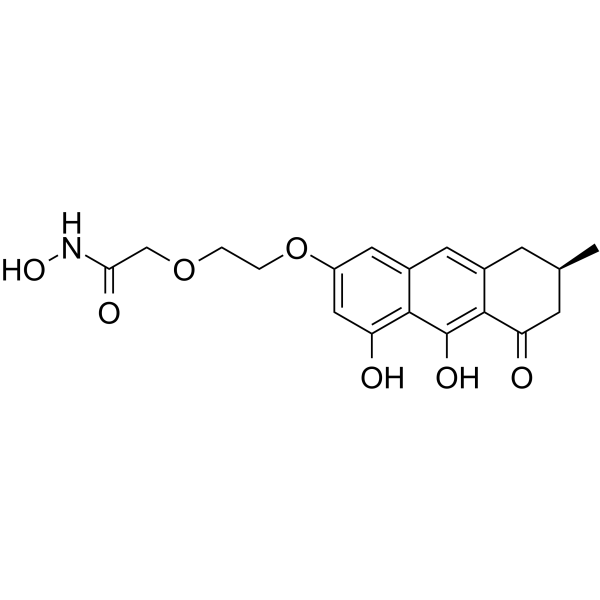 0 ImagesCat. No.: HY-146125CAS No.: 2488185-65-3CGCG/CGG ligand 1 (compound 10), an anthracenone derivative, is a CGCG or CGG short spacer-ligand. CGCG/CGG ligand 1 can protect cleavable sites of DNA with the multiple CGCG or continuous CGG sites from the restriction enzyme.
-
RNase B Glycoprotein Standard
 0 ImagesCat. No.: HY-129046JRNase B Glycoprotein Standard is a substrate containing PNGase F and can be used to determine PNGase F activity. RNase B Glycoprotein Standard can be used as a glycoprotein standard.




