



Fluorescent Dye
Fluorescence is a phenomenon of photoluminescence in luminescence. When an atom is irradiated by light, some electrons around the nucleus jump from their original orbitals to higher energy orbitals under the influence of light energy, i.e., from the ground state to the first or second excited single-line state, etc. Due to the instability of the first or second excited singlet state, the electron returns from the excited singlet state to the ground state accompanied by released energy, resulting in fluorescence.
Fluorescent dyes can be covalently bound or physically adsorbed in the structure of the substance. The fluorescence properties allow for the characterization, localization and quantitative analysis of the labeled object. Fluorescent dyes have shown great potential for the detection of proteins, nucleic acids, cells, and immunoassays, attributed to the advantages in non-radioactive contamination, simple experimental operation and easy observation.
Fluorescent dyes have penetrated many fields such as pharmacology, physiology, environmental science, and information science, as well as functional studies of proteins and drug screening.
All Product Categories
-
Fluorescent Dye Related Products (4891)
Related Products (4891)

-
Antibodies (4)
-
Sambucus Nigra Lectin-AF405
 0 ImagesCat. No.: HY-NP080BSynonyms: SNA-AF405Sambucus Nigra Lectin-AF405 (SNA-AF405) is a phytohemagglutinin labeled with AF405, which can be used as a probe to specifically bind to biomolecules (such as polysaccharides and peptides). Sambucus Nigra Lectin-AF405 precisely locates the distribution of glycan chains on the cell surface through stable fluorescence signals, and can be used for glycobiology research (Ex/Em = 405/435 nm).

-
MMBC
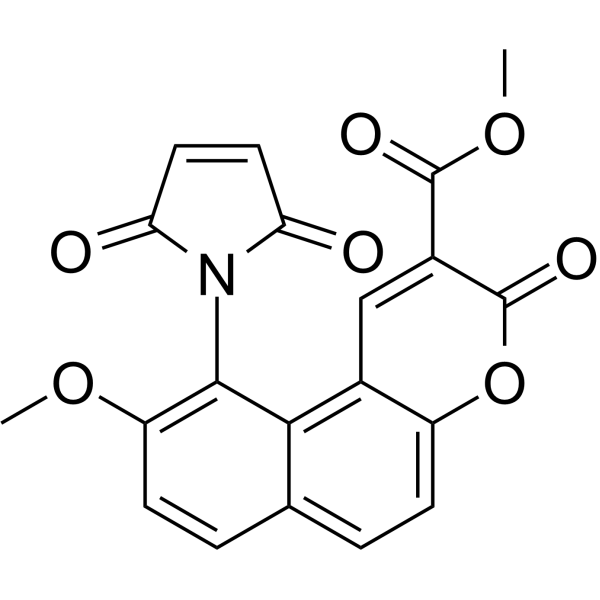 0 ImagesCat. No.: HY-137791CAS No.: 137350-66-4MMBC is a sulfhydryl-sensitive fluorophore.
-
ATTO 514 azide
 0 ImagesCat. No.: HY-D2033ATTO 514 azide is an azide derivative of ATTO 514 with excitation/emission maxima at 511/531 nm. ATTO 514 azide is a click chemistry reagent, it contains an Azide group and can undergo copper-catalyzed azide-alkyne cycloaddition reaction (CuAAc) with molecules containing Alkyne groups. It can also undergo strain-promoted alkyne-azide cycloaddition (SPAAC) reactions with molecules containing DBCO or BCN groups.


-
TPE-Cy
 0 ImagesCat. No.: HY-D3164CAS No.: 1380316-56-2TPE-Cy is a fluorescent probe with both aggregation-induced emission (AIE) property and pH-dependent luminescent behavior. TPE-Cy exhibits significant luminescent differences under different acidic and alkaline conditions: it shows moderate to strong red emission with linear variation with pH in acidic environments and within the pH range of 5-7, weak or even no emission within the pH range of 7-10, and switches to blue emission under alkaline conditions. TPE-Cy possesses excellent cell permeability and biocompatibility, enabling accurate ratiometric pH sensing and imaging monitoring in living cells via confocal microscopy, ratiometric analysis and flow cytometry.

-
Rhodamine-PEG550
 0 ImagesCat. No.: HY-D2892ARhodamine-PEG550 a fluorescent PEG derivative composed of Rhodamine B (HY-Y0016) and PEG. Rhodamine-PEG550 can be used for fluorescent labeling and imaging (Ex/Em=546/610 nm).
-
Plant Cell Acidity Indicator Solution (Neutral Red Method)
 0 ImagesCat. No.: HY-DY2042Plant Cell Acidity Indicator Solution (Neutral Red Method) is a basic vital stain solution using neutral red, used to indicate plant cell acidity. Plant Cell Acidity Indicator Solution (Neutral Red Method) accumulates in vacuoles via the ion trap mechanism in empty cell saps and exhibits distinct color changes based on cell sap type and pH.
-
meso-Benzothiazole-BODIPY 505/515
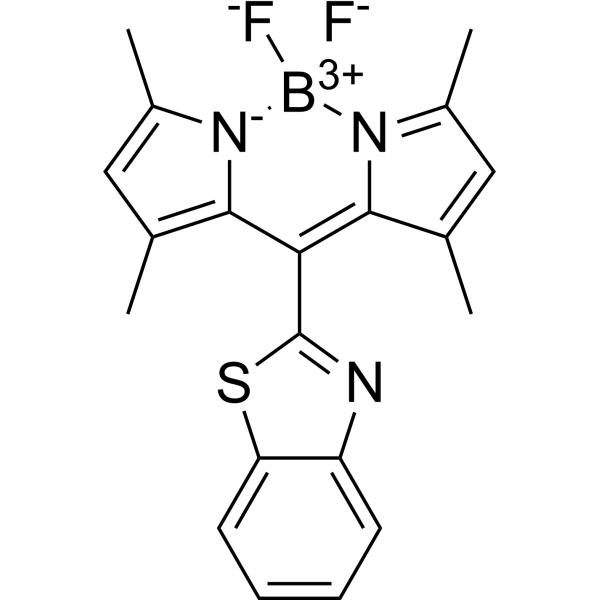 0 ImagesCat. No.: HY-151536CAS No.: 2922973-15-5meso-Benzothiazole-BODIPY 505/515 is a boron dipyrromethenes (BODIPY) -based fluorescent probeautophagy. meso-Benzothiazole-BODIPY 505/515 can be used for the research of Alzheimer’s diseases, lysosomal storage diseases and neural degeneration diseases.
-
FAM labled IONIS-MAPTRx sodium
 0 ImagesCat. No.: HY-132582JFAM labled IONIS-MAPTRx sodiumis a FAM labled IONIS-MAPTRx sodium.
-
Cy3 labled Edutirsen sodium
 0 ImagesCat. No.: HY-177628DCy3 labled Edutirsen sodium is a Cy3 labled Edutirsen sodium.
-
CycLuc1 methyl ester
 0 ImagesCat. No.: HY-D3461CAS No.: 2770784-56-8CycLuc1 methyl ester (Example 1) is a selective CES1 substrate and indirect bioluminescent inducer. CycLuc1 methyl ester undergoes catalytic hydrolysis via CES1-mediated ester bond cleavage to form a carboxyl product. The carboxyl product of CycLuc1 methyl ester undergoes an oxidation reaction with luciferase to generate a detectable bioluminescent signal. CycLuc1 methyl ester enables quantitative detection of CES1 activity.
-
PFB-FDG (solution)
 0 ImagesCat. No.: HY-DY1117CAS No.: 209540-64-7PFB-FDG (solution) is a non-fluorescent galactosidase substrate that can be hydrolyzed into green fluorescent PFB-F (Ex=485 nm, Em=535 nm). PFB-FDG (solution) can be hydrolyzed by β-galactosidases derived from humans, bovine liver, and Aspergillus oryzae, producing a non-leakable green fluorescent product, which enables the detection of enzyme activity in liposomes and via flow cytometry. PFB-FDG (solution) is used for the determination of β-galactosidase activity.
Solvent and concentration: DMSO: 10 mM
-
RT-NH2
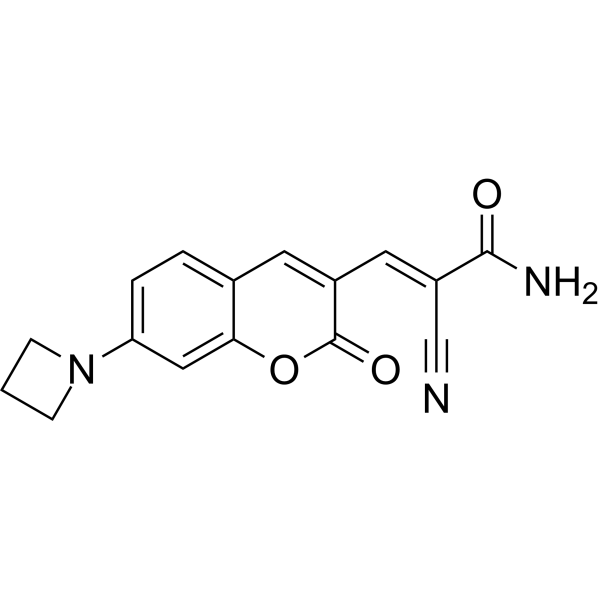 0 ImagesCat. No.: HY-103684CAS No.: 2321343-06-8Synonyms: Real Thiol-NH2RT-NH2 is a RealThiol prototype without the carboxylic acid groups. RT-NH2 is fairly hydrophobic and cannot distribute in the nucleus, which is a hallmark of protein binding for fluorescent probe.
-
DXB-NIR
 0 ImagesCat. No.: HY-D3073CAS No.: 2477607-64-8DXB-NIR is a push-pull dioxaboron fluorescent probe with solvatochromic properties, featuring high fluorescence brightness, photostability, and a large two-photon absorption cross-section. DXB-NIR exhibits Ex/Em of 550/620–780 nm (with two-photon excitation at 930 nm). DXB-NIR quantifies local polarity via the intensity ratio I (>640)/I (<640) between the far-red channel (<640 nm) and the near-infrared channel (>640 nm), and it can simultaneously label the plasma membrane, endoplasmic reticulum, and lipid droplets in live cells. DXB-NIR monitors the increase in local polarity of various cell compartments under conditions of cholesterol depletion, starvation, and oxidative stress. DXB-NIR can be used for polarity imaging of biological membranes and lipid droplets, as well as studies related to cellular stress.
-
RB-PEG3400-COOH
 0 ImagesCat. No.: HY-D2881DSynonyms: Rhodamine B-PEG3400-COOHRB-PEG3400-COOH (Rhodamine B-PEG3400-COOH) is a fluorescent dye composed of Rhodamine B (HY-Y0016), PEG and a COOH. RRB-PEG3400-COOH can be used for fluorescent labeling and imaging (Ex/Em=546/610 nm).
-
SNAP-505
 0 ImagesCat. No.: HY-D2933SNAP-505 is a cell-permeable green fluorescent dye (Ex/Em ≈504/532 nm). It binds specifically and covalently to SNAP-tag fusion proteins, and is used for pulse-chase labeling and localization tracking of proteins in living cells. SNAP-505 can be applied to studies related to insulin granule formation, ER-Golgi protein trafficking, and other relevant processes.




