



Fluorescent Dye
Fluorescence is a phenomenon of photoluminescence in luminescence. When an atom is irradiated by light, some electrons around the nucleus jump from their original orbitals to higher energy orbitals under the influence of light energy, i.e., from the ground state to the first or second excited single-line state, etc. Due to the instability of the first or second excited singlet state, the electron returns from the excited singlet state to the ground state accompanied by released energy, resulting in fluorescence.
Fluorescent dyes can be covalently bound or physically adsorbed in the structure of the substance. The fluorescence properties allow for the characterization, localization and quantitative analysis of the labeled object. Fluorescent dyes have shown great potential for the detection of proteins, nucleic acids, cells, and immunoassays, attributed to the advantages in non-radioactive contamination, simple experimental operation and easy observation.
Fluorescent dyes have penetrated many fields such as pharmacology, physiology, environmental science, and information science, as well as functional studies of proteins and drug screening.
All Product Categories
-
Fluorescent Dye Related Products (4894)
Related Products (4894)

-
Antibodies (4)
-
Methyl Orange (Standard)
 0 ImagesMethyl Orange (Standard) is the analytical standard of Methyl Orange. This product is intended for research and analytical applications. Methyl Orange is a soluble azo dye commonly used as an acid-base indicator and for staining cells and tissue sections, as well as for dyeing textiles. Methyl Orange appears red at a pH of 3.1 and changes to bright yellow as the pH increases to 4.4. Methyl Orange (500 mg/L) exhibits cytotoxicity and can cause DNA damage.
-
Digoxigenin (Standard)
 0 ImagesDigoxigenin (Standard) is the analytical standard of Digoxigenin. This product is intended for research and analytical applications. Digoxigenin (DIG) is a steroid. DIG is used for situ hybridization as a labeling molecule probe due to long shelf life and fast detection and high sensitivity of DIG-labeled riboprobes.
-
Chol-N3
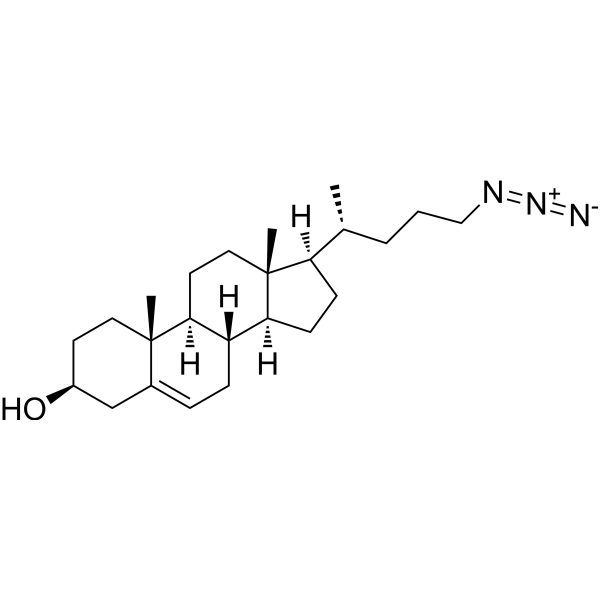 0 ImagesCat. No.: HY-152901CAS No.: 2106868-12-4Chol-N3 is a bioorthogonal-based chol probe. Chol-N3 can combine with super-resolution fluorescence microscopy (SRM), providing direct visualization of nanoscale lipid heterogeneity in the cell surface of resting living cells. Chol-N3 is a click chemistry reagent, it contains an Azide group and can undergo copper-catalyzed azide-alkyne cycloaddition reaction (CuAAc) with molecules containing Alkyne groups. It can also undergo strain-promoted alkyne-azide cycloaddition (SPAAC) reactions with molecules containing DBCO or BCN groups.

-
ALPS
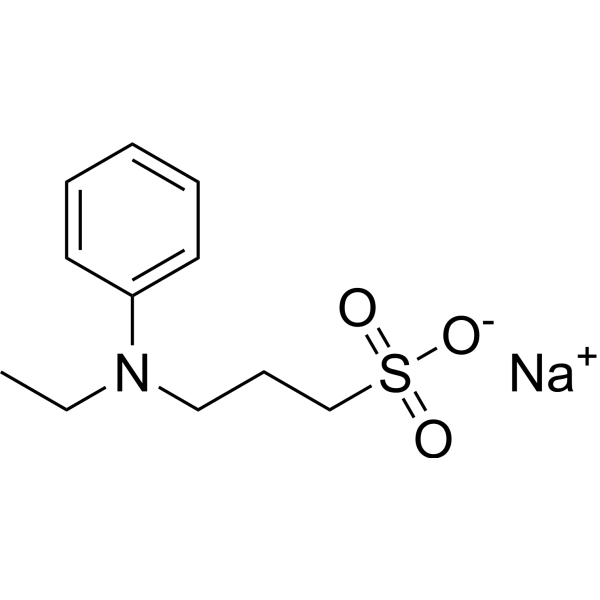 0 ImagesSynonyms: N-Ethyl-N-sulfopropylaniline sodium saltALPS(N-Ethyl-N-sulfopropylaniline sodium salt) is a bio-chemical reagents/chromogenic reagent.
-
QM-FN-SO3
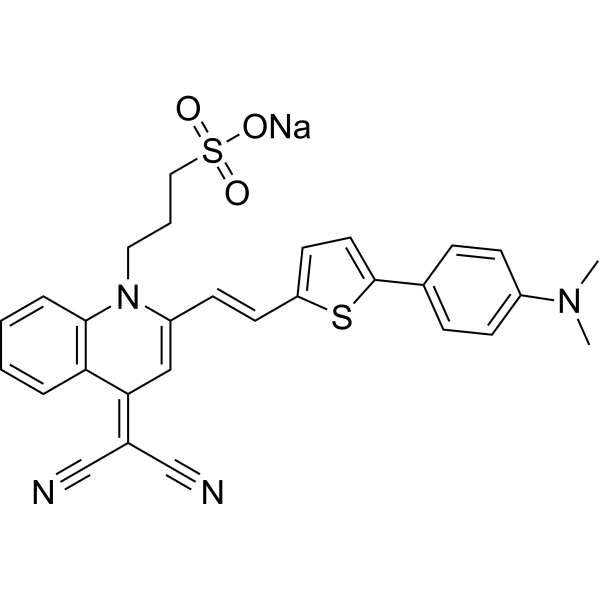 0 ImagesCat. No.: HY-D2268CAS No.: 2316820-94-5QM-FN-SO3 is a BBB-penetrable near-infrared (NIR) aggregation-induced emission (AIE)-active probe for Aβ plaques. QM-FN-SO3 can be used for in vivo detection of Aβ plaques. QM-FN-SO3 has ultra-high S/N ratio, binding affinity, and high-performance NIR emission.
-
N-(p-Tosyl)-GPR-pNA acetate
 0 ImagesSynonyms: Chromozym-THN-(p-Tosyl)-GPR-pNA acetate (Chromozym-TH) is a chromogenic substrate targeting the synthetic peptides Hirunorm IV and Hirunorm V and can be used to detect the dissociation constants (KI) of both peptides. Hirunorm IV and Hirunorm V are reversible inhibitors of amidolytic thrombin activity. By varying the peptide concentration at a fixed concentration of the chromogenic substrate N-(p-Tosyl)-GPR-pNA acetate, the dissociation constants determined were 0.134 nM (Hirunorm IV) and 0.245 nM (Hirunorm V).
-
Allura Red AC (Standard)
 0 ImagesCat. No.: HY-123630RCAS No.: 25956-17-6Synonyms: FD&C RED NO. 40 (Standard); CI 16035 (Standard)Allura Red AC (Standard) is an analytical standard of Allura Red AC. This product is intended for research and analytical applications. Allura Red AC is a food colorant, appearing as a deep red water-soluble powder or granules, used in various applications such as beverages, syrups, candies, and cereals. Allura Red AC can statically quench the intrinsic fluorescence of HSA. Additionally, Allura Red AC is a 5-hydroxytryptamine (5-HT) pathway-associated pro-inflammatory agent, capable of exacerbating experimental colitis. Allura Red AC holds potential for research in inflammatory bowel disease (IBD), intestinal barrier function, and food additive safety.
-
C.I. Acid yellow 3
 0 ImagesSynonyms: Quinoline yellowC.I. Acid yellow 3 is an anionic quinolinone dye that is commonly used as a food additive, but also in the cosmetic and pharmaceutical industries.
-
HOE-S 785026
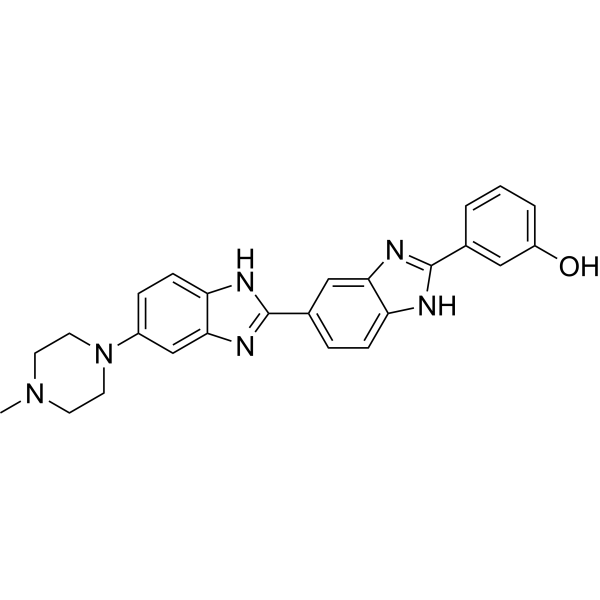 0 ImagesSynonyms: meta-HoechstHOE-S 785026 is a marker dye in Hoechst series. Hoechst is A live nuclear marker dye. Hoechst binds to the grooves in the DNA double strand, which tends to be A/ T-rich DNA strand. Although it binds to all nucleic acids, the A/ T-rich double strand DNA significantly enhances fluorescence intensity Therefore,Hoechst dye can be used for living cell labeling. The fluorescence intensity of Hoechst dye increases with the increase of pH of solution.
-
Solvent Yellow 98
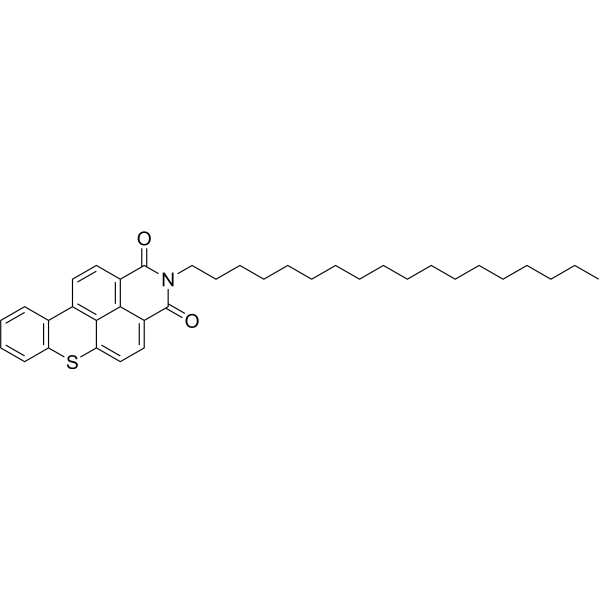 0 ImagesSolvent Yellow 98 is a yellow dye. Its series of products, such as Solvent orange 60 (HY-D1177), has been used in dyeing applications of plastic materials.
-
BP Fluor 488 DBCO
 0 ImagesBP Fluor 488 DBCO is a popular labeling dye used in copper-free Click Chemistry reactions. It will react with the azide group in antibody, proteins, peptides, amino-modified oligos, and other target molecules. The dye has an excitation peak at 499 nm and an emission peak at 520 nm. The conjugates are widely used in microscopy, flow cytometry, and other applications. BP Fluor 488 is a pure 5-sulfonated rhodamine molecule and it eliminates the lot-to-lot variation caused by two isomers ratio differences.
-
QSY-21
 0 ImagesQSY-21 is a fluorescence quencher. QSY-21 possesses broad absorption in far red and NIR range, and can quench fluorescence of dyes that emit in this region. This is a carboxylic acid derivative. QSY-21 has intense absorption maximum at 661 nm, making it useful as an acceptor in fluorescence resonance energy transfer (FRET) applications. It is a common quencher for Cyanine5, Cyanine5.5, AF 647, or other spectrally similar fluorescent dyes.


-
ACE
 0 ImagesCat. No.: HY-D2348CAS No.: 3058751-62-2ACE is a low-background, photostable fluorophore with nanomolar binding affinity for the Okra RNA aptamer. ACE enables clear visualization of mRNA in live bacteria and mammalian cells, including tracking the trafficking of mRNA to stress granules and dual-color super-resolution imaging of RNA in live cells. (Ex=488 nm, Em=555 nm).

-
X-Gluc Dicyclohexylamine
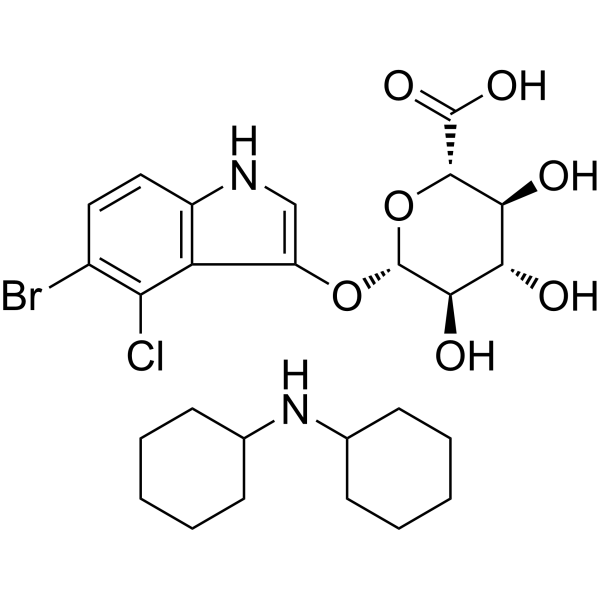 0 ImagesX-Gluc Dicyclohexylamine is a dye reagent for the detection of β-glucuronidase, an enzyme produced by Escherichia coli. X-Gluc sodium can be used to detect E. coli contamination in food, water and the urinary tract. X-Gluc sodium is also widely used in molecular biology experiments to label and detect the expression of target genes (GUS reporter system).
-
Sulfo SMCC R-phycoerythrin
 0 ImagesCat. No.: HY-D2396Synonyms: Sulfo SMCC R-PESulfo SMCC R-phycoerythrin is a conjugate composed of the protein crosslinker SMCC (HY-42360) and R-PE (R-Phycoerythrin) (HY-D0988) that can be used to label proteins to make them carry red fluorescence. Among them, SMCC is able to engage antigen-coupled spleen cells to induce antigen-specific immune responses.




