



AL-438
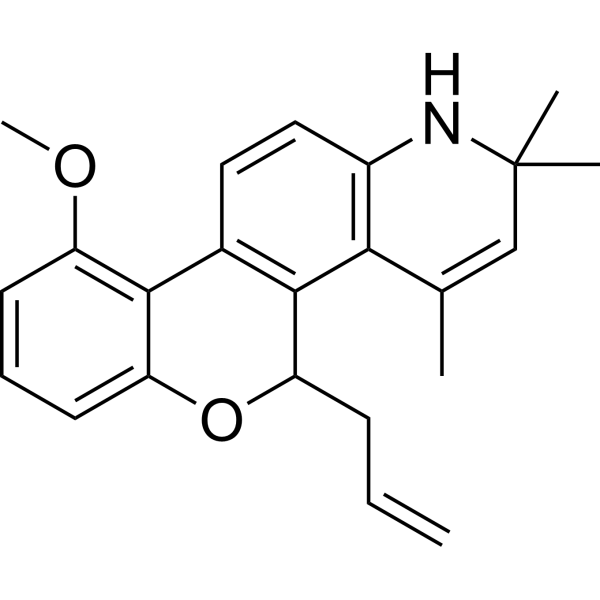
AL-438 is a potent, selective and orally active glucocorticoid receptor modulator with Kis of 2.5, 1786, 53, 1440, >1000 nM for glucocorticoid receptor, progesterone receptor, mineralocorticoid receptor, androgen receptor, estrogen receptor, respectively. AL-438 shows antiinflammatory activity.
For research use only. We do not sell to patients.
- CAS No.: 239066-73-0
- Formula: C23H25NO2
- Molecular Weight:347.45
-
Storage:
Please store the product under the recommended conditions in the Certificate of Analysis.

To place orders, for customer services and technical support, please contact: MedChemExpress USA
Tel: 609-228-6898 E-mail: [email protected] [email protected]


-
 Biological Activity
-
Chemical Information
- Protocols
- Purity & Documentation
- References
-
 Help & FAQs




Biological Activity
Description
IC50 & Target
Ki: 2.5 nM (glucocorticoid receptor)[1]
Cellular Effect
|
Cell Line

|
Type | Value | Description | References |
|---|---|---|---|---|
| CV-1 | EC50 |
33 nM
Compound: 18
|
Transcriptional activation in CV-1 cells expressing human glucocorticoid receptor
Transcriptional activation in CV-1 cells expressing human glucocorticoid receptor
|
[PMID: 12620078] |
| HepG2 | EC50 |
13 nM
Compound: 18
|
Transcriptional repression in HepG2 cells expressing human glucocorticoid receptor
Transcriptional repression in HepG2 cells expressing human glucocorticoid receptor
|
[PMID: 12620078] |
In Vitro
AL-438 (1 µM) decreases the LPS-induced IL-6 production in ATDC5 cells[1].
AL-438 (0-1 µM; 1 h+24 h) inhibits IL-1β (2 ng/ml) induced IL-6 expression in HSKF1501 cells[2].
MedChemExpress (MCE) has not independently confirmed the accuracy of these methods. They are for reference only. Further protocols information, click here.
In Vivo
MedChemExpress (MCE) has not independently confirmed the accuracy of these methods. They are for reference only.
-
Animal Model:Male Sprague Dawley rats (carrageenan paw edema model)[2]
-
Dosage:1, 10, 100 mg/kg
-
Administration:P.o.
-
Result:Showed antiinflammatory activity with ED50 value of 11 mg/kg in acute inflammation assay.


Chemical Information
-
CAS No. 239066-73-0
-
Molecular Weight 347.45
-
Formula C23H25NO2
-
SMILES
C=CCC1OC2=CC=CC(OC)=C2C3=C1C4=C(NC(C)(C)C=C4C)C=C3
-
Shipping
Room temperature in continental US; may vary elsewhere.
-
Storage
Please store the product under the recommended conditions in the Certificate of Analysis.

Protocols
-
Research Protocol for Endocrine Diseases
Endocrine diseases often arise from disrupted hormone production, hormone signaling, or target-tissue responsiveness; for diabetes-focused endocrine disease models, insulin signaling regulates glucose uptake, hepatic glucose output, lipid metabolism, and β-cell compensation. Type 2 diabetes develops through interacting defects in insulin resistance, β-cell dysfunction, adipose inflammation, hepatic glucose overproduction, altered incretin signaling, and ectopic lipid metabolism. A major unresolved question is whether endocrine dysfunction is driven primarily by target-tissue insulin resistance, intrinsic β-cell failure, immune/inflammatory stress, or combined multi-organ failure that differs by disease stage.


Purity & Documentation
References
[1]. Owen HC, et al. The growth plate sparing effects of the selective glucocorticoid receptor modulator, AL-438. Mol Cell Endocrinol. 2007 Jan 29;264(1-2):164-70. [Content Brief]
[2]. Coghlan MJ, et al. A novel antiinflammatory maintains glucocorticoid efficacy with reduced side effects. Mol Endocrinol. 2003 May;17(5):860-9. [Content Brief]

Calculators
Concentration (start) × Volume (start) = Concentration (final) × Volume (final)


AL-438 Related Classifications
HY-114154 Related Classifications
 Powered by Bioz