



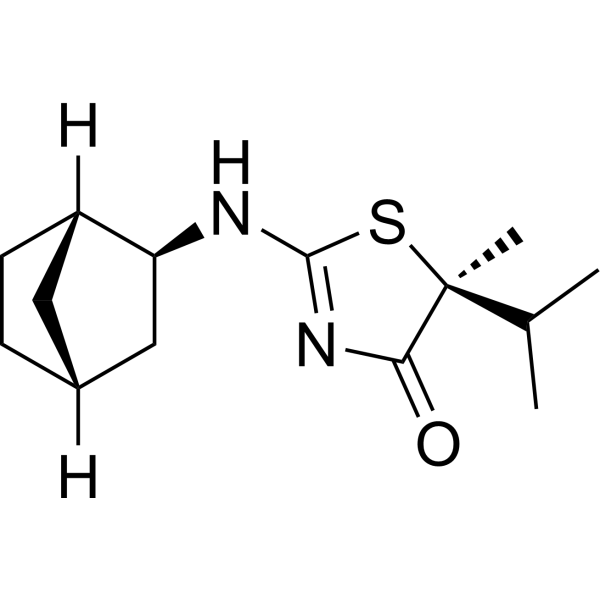
AMG-221
AMG-221 is an inhibitor of 11β-hydroxysteroid dehydrogenase type 1 (11β-HSD1) with a Ki of 12.8 nM in vitro biochemical scintillation proximity assay (SPA) and an IC50 of 10.1 nM in cell-based assays. AMG-221 can be used for the research of type 2 diabetes.
For research use only. We do not sell to patients.
- CAS No.: 1095565-81-3
- Formula: C14H22N2OS
- Molecular Weight:266.40
-
Storage:
Please store the product under the recommended conditions in the Certificate of Analysis.

To place orders, for customer services and technical support, please contact: MedChemExpress USA
Tel: 609-228-6898 E-mail: [email protected] [email protected]


-
 Biological Activity
-
Chemical Information
- Protocols
- Purity & Documentation
- References
-
 Help & FAQs




Biological Activity
Description
Cellular Effect
|
Cell Line

|
Type | Value | Description | References |
|---|---|---|---|---|
| CHO | IC50 |
10.1 nM
Compound: 1, AMG-221
|
Inhibition of human 11beta-HSD1 expressed in CHO cells
Inhibition of human 11beta-HSD1 expressed in CHO cells
|
[PMID: 24900270] |
| HEK293 | IC50 |
10.1 nM
Compound: 8, AMG-221
|
Displacement of [3H]-cortisone human 17beta-HSD1 expressed in HEK293 cells after 30 mins by scintillation proximity assay
Displacement of [3H]-cortisone human 17beta-HSD1 expressed in HEK293 cells after 30 mins by scintillation proximity assay
|
[PMID: 20465278] |
In Vitro
AMG-221 shows selectivity over 11β-HSD2, 17β-HSD1, and glucocorticoid receptor (GR) (IC50 values for all assays are >10 μM)[2].
MedChemExpress (MCE) has not independently confirmed the accuracy of these methods. They are for reference only. Further protocols information, click here.
In Vivo
11β-HSD1 activity is inhibited by 33%, 55%, and 47% in the inguinal fat at 4 h after AMG-221 is orally gavaged at 5, 15, and 50 mg/kg, respectively. At 8 h, the 11β-HSD1 activity in the inguinal fat of the 5 mg/kg group has returned to a level (~10% inhibition) close to that in the control animals treated with vehicle, but there is still significant inhibition in the 15 and 50 mg/kg groups (36% and 39% inhibition, respectively)[2].
AMG-221 has a good bioavailability in mouse, rat, and dog. However, the bioavailability in monkey is low[2].
AMG-221 exhibits moderate oral bioavailability (male CD1 mouse 31%) following oral administration (10 mg/kg)[3].
AMG-221 exhibits terminal elimination half-life (male CD1 mouse 3.32 h) due to high plasma clearance (3.31 L/h/kg) combined with large volumes of distribution (0.9 L/kg) following intravenous administration (2 mg/kg)[3].
MedChemExpress (MCE) has not independently confirmed the accuracy of these methods. They are for reference only.
-
Animal Model:Diet-Induced Obesity (DIO) Mice[2]
-
Dosage:25 or 50 mg/kg (prepare in 0.1% Tween-80 and 0.5% CMC in water)
-
Administration:Orally gavaged; twice a day for 13 or 14 days
-
Result:There were statistically significant decreases in insulin levels in all treated groups when compared with the vehicle control group on day 13.


Chemical Information
-
CAS No. 1095565-81-3
-
Molecular Weight 266.40
-
Formula C14H22N2OS
-
SMILES
O=C1N=C(N[C@@H]2[C@@](C3)([H])CC[C@@]3([H])C2)S[C@@]1(C)C(C)C
-
Shipping
Room temperature in continental US; may vary elsewhere.
-
Storage
Please store the product under the recommended conditions in the Certificate of Analysis.

Protocols
-
Cell Cytotoxicity Assay
Cytotoxicity assays are usually based on the assessment of cell membrane damage, which can also be indirectly detected by measuring cell viability. Detection methods include MTT assay, CKK-8 assay, LDH assay and ATP assay, etc.
-
Research Protocol for Metabolic Diseases
AMP-activated protein kinase, AMPK, is a conserved cellular energy sensor that responds to reduced cellular energy status and coordinates metabolism by increasing ATP-generating catabolic pathways while suppressing ATP-consuming anabolic processes. In metabolic disease research, the AMPK pathway is experimentally relevant because it regulates hepatic lipid synthesis, fatty acid oxidation, glucose production, skeletal-muscle glucose disposal, mTORC1-linked biosynthesis, autophagy, mitochondrial homeostasis, and whole-body energy balance. The central pathway logic is that energy stress, metformin, exercise-like stimulation, or direct AMPK activators increase AMPKα Thr172 phosphorylation and downstream substrate phosphorylation, including ACC and RAPTOR. Phosphorylation of ACC suppresses lipogenesis and supports fatty acid oxidation, whereas phosphorylation of RAPTOR suppresses mTORC1 signaling and links cellular energy status to growth and protein synthesis control. The pathway is linked
-
Directly Induced Neuron Culture
Directly induced neuron culture converts somatic cells, most commonly fibroblasts, into induced neurons without passing through a pluripotent or neural progenitor stage; classic evidence shows that mouse fibroblasts can be converted by Ascl1, Brn2/Pou3f2, and Myt1l, human fibroblasts can be converted by defined neuronal transcription factors, and human fibroblasts can also be converted by miR-9/9-124 with neurogenic or subtype-specifying transcription factors. The readout is acquisition of neuronal identity and function, assessed by neuronal morphology, neuronal markers such as Tuj1/βIII-tubulin, MAP2, synapsin, and subtype markers when relevant, together with functional assays such as action-potential firing, synaptic activity, and electrophysiology.


Purity & Documentation
References
[1]. Seb Caille, et al. Two asymmetric syntheses of AMG 221, an inhibitor of 11beta-hydroxysteroid dehydrogenase type 1.J Org Chem. 2009 May 15;74(10):3833-42. [Content Brief]
[2]. Murielle M Véniant, et al. Discovery of a potent, orally active 11beta-hydroxysteroid dehydrogenase type 1 inhibitor for clinical study: identification of (S)-2-((1S,2S,4R)-bicyclo[2.2.1]heptan-2-ylamino)-5-isopropyl-5-methylthiazol-4(5H)-one (AMG 221). J Med Chem. 2010 Jun 10;53(11):4481-7. [Content Brief]
[3]. Aiwen Li, et al. Synthesis and Evaluation of the Metabolites of AMG 221, a Clinical Candidate for the Treatment of Type 2 Diabetes. ACS Med Chem Lett. 2011 Sep 13;2(11):824-7. [Content Brief]

Calculators
Concentration (start) × Volume (start) = Concentration (final) × Volume (final)


AMG-221 Related Classifications
HY-10555 Related Classifications
 Powered by Bioz