



Antibacterial agent 106
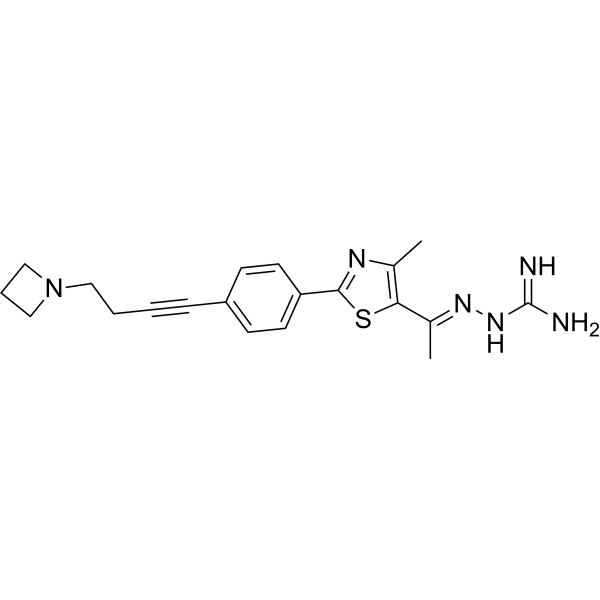
Antibacterial agent 106 (compound 8) is an orally active and potent antibacterial agent with antibiofilm activity. Antibacterial agent 106 shows potent antibacterial effect against multi-agent resistant (MDR)-Gram positive pathogens. Antibacterial agent 106 is highly effective in clearing 99.7% of the intracellular methicillin-resistant S. aureus (MRSA) harbored inside macrophages. Antibacterial agent 106 is a click chemistry reagent, it contains an Alkyne group and can undergo copper-catalyzed azide-alkyne cycloaddition (CuAAc) with molecules containing Azide groups.
For research use only. We do not sell to patients.
- CAS No.: 2459657-11-3
- Formula: C20H24N6S
- Molecular Weight:380.51
-
Storage:
Please store the product under the recommended conditions in the Certificate of Analysis.

To place orders, for customer services and technical support, please contact: MedChemExpress USA
Tel: 609-228-6898 E-mail: [email protected] [email protected]


-
 Biological Activity
-
Chemical Information
- Protocols
- Purity & Documentation
- References
-
 Help & FAQs




Biological Activity
Description
Cellular Effect
|
Cell Line

|
Type | Value | Description | References |
|---|---|---|---|---|
| Caco-2 | CC50 |
>128 μg/mL
Compound: 8
|
Cytotoxicity against human Caco2 cells assessed as reduction in cell viability incubated for 48 hrs by MTS assay
Cytotoxicity against human Caco2 cells assessed as reduction in cell viability incubated for 48 hrs by MTS assay
|
[PMID: 31718945] |
In Vivo
MedChemExpress (MCE) has not independently confirmed the accuracy of these methods. They are for reference only.


Chemical Information
-
CAS No. 2459657-11-3
-
Molecular Weight 380.51
-
Formula C20H24N6S
-
SMILES
CC1=C(SC(C2=CC=C(C=C2)C#CCCN3CCC3)=N1)/C(C)=N/NC(N)=N
-
Shipping
Room temperature in continental US; may vary elsewhere.
-
Storage
Please store the product under the recommended conditions in the Certificate of Analysis.


Purity & Documentation
References

Calculators
Concentration (start) × Volume (start) = Concentration (final) × Volume (final)


Antibacterial agent 106 Related Classifications
HY-147531 Related Classifications
 Powered by Bioz