



Adiponectin Antibody (YA639)
(Synonyms: 30 kDa adipocyte complement related protein; ACDC; ACRP 30; ACRP30; ADIPO_HUMAN; Adipocyte; AdipoQ; Adipose most abundant gene transcript 1; Adipose specific collagen like factor; ADIPQTL1; ADPN; APM 1; apM-1; ApM1; C1q and collagen domain-containing protein; GBP 28; GBP28; Gelatin binding protein; Gelatin binding protein 28; Gelatin-binding protein. )
Based on 1 Customer Validation
Adiponectin Antibody (YA639) is a Rabbit-derived and non-conjugated IgG monoclonal antibody, targeting to Adiponectin.
-
Host:
Rabbit
-
Isotype:
IgG
-
Application:
WB, ICC/IF, IHC-P
-
Reactivity :
Mouse
-
Formulation:
Supplied in 1*TBS (pH7.4), 0.05% BSA and 40% Glycerol. Preservative: 0.05% Sodium Azide.
-
Conjugation:
Non-conjugated


To place orders, for customer services and technical support, please contact: MedChemExpress USA
Tel: 609-228-6898 E-mail: [email protected] [email protected]





Applications
| Application |
WB

WB: Western Blot
|
ICC/IF
ICC/IF: Immunocytochemistry/
Immunofluorescence |
IHC-P
IHC-P: Immunohistochemistry-Paraffin
|
|---|---|---|---|
| Dilution Ratio | 1:500 | 1:50 | 1:400 |


Product Details
Adiponectin Antibody (YA639) is a Rabbit-derived and non-conjugated IgG monoclonal antibody, targeting to Adiponectin.
-
Host Rabbit

-
Clonality Recombinant,Monoclonal

-
Species ReactivityMouse
-
Observed Molecular WeightObserved band size: 30 kDa
Note: Due to possible protein modifications or aggregation, the molecular weight should be confirmed by actual measurement, and the predicted value is for reference only.

-
Calculated Molecular Weight Predicted band size: 27 kDa

Entrez Gene: 22589 Mouse
SwissProt: Q60994 Mouse
Synthetic peptide corresponding to Mouse Adiponectin.AA range:1-247.
Endogenous
Protein A affinity purified.
Non-conjugated
Unmodified
IgG


Product Properties
-
Appearance
Liquid
-
Formulation
Supplied in 1*TBS (pH7.4), 0.05% BSA and 40% Glycerol. Preservative: 0.05% Sodium Azide.
-
Concentration
Batch-dependent, Please check the COA for the concentration of each lot. Check Lot Concentration
-
Storage & Stability
Stored at -20°C for 1 year. Avoid repeated freeze / thaw cycles.
-
Shipping
Shipping with blue ice.


Verification Images
-
 Western blot analysis of extracts from mouse skin (lane 2, 20ug) using Adiponectin Antibody (HY-P80004). Proteins were transferred to a PVDF membrane and blocked with 5% BSA in TBST for 2 hour at room temperature. The primary antibody (1/500) and Loading control antibody (Beta Actin, HY-P80993, 1/10,000) was used in 5% BSA in TBST at 4°C overnight. Goat Anti-Rabbit IgG-HRP Secondary Antibody (HY-P8001,1/10,000) was used for 1 hour at room temperature.
 -
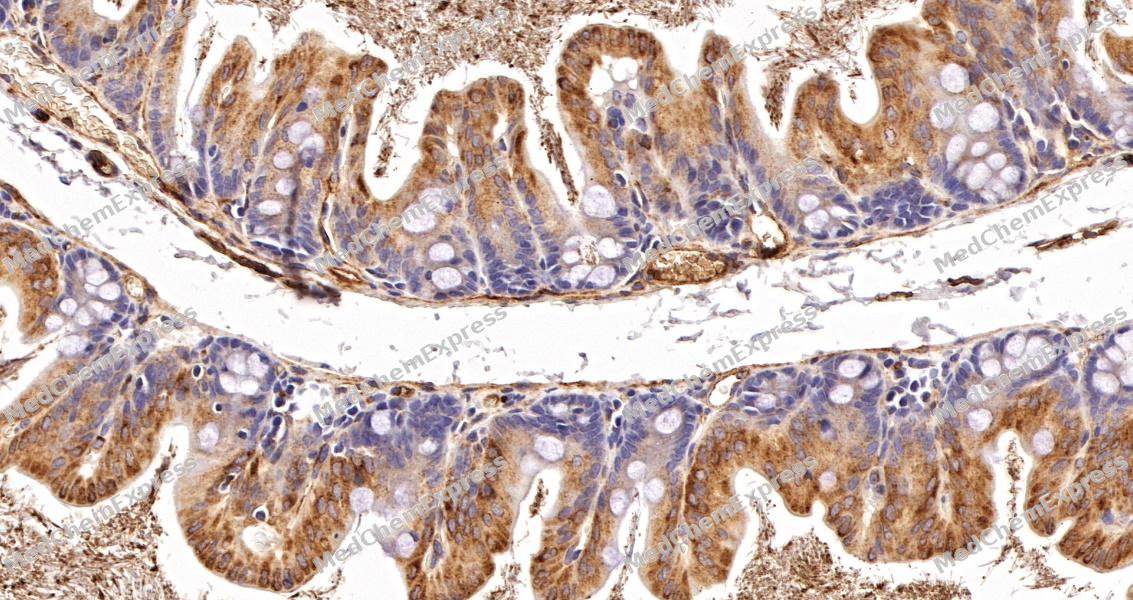 Immunohistochemical analysis of paraffin-embedded mouse colon tissue using Adiponectin Antibody. The section was pre-treated using heat mediated antigen retrieval with sodium citrate buffer (pH 6.0) for 8 minutes. The tissues were blocked in QuickBlock for 20 minutes at room temperature, washed with ddH2O and PBS, and then probed with the primary antibody at 1/100 dilution in 4℃ overnight. The detection was performed using an HRP conjugated compact polymer system. DAB was used as the chromogen. Tissues were counterstained with hematoxylin and mounted with DPX.
 -
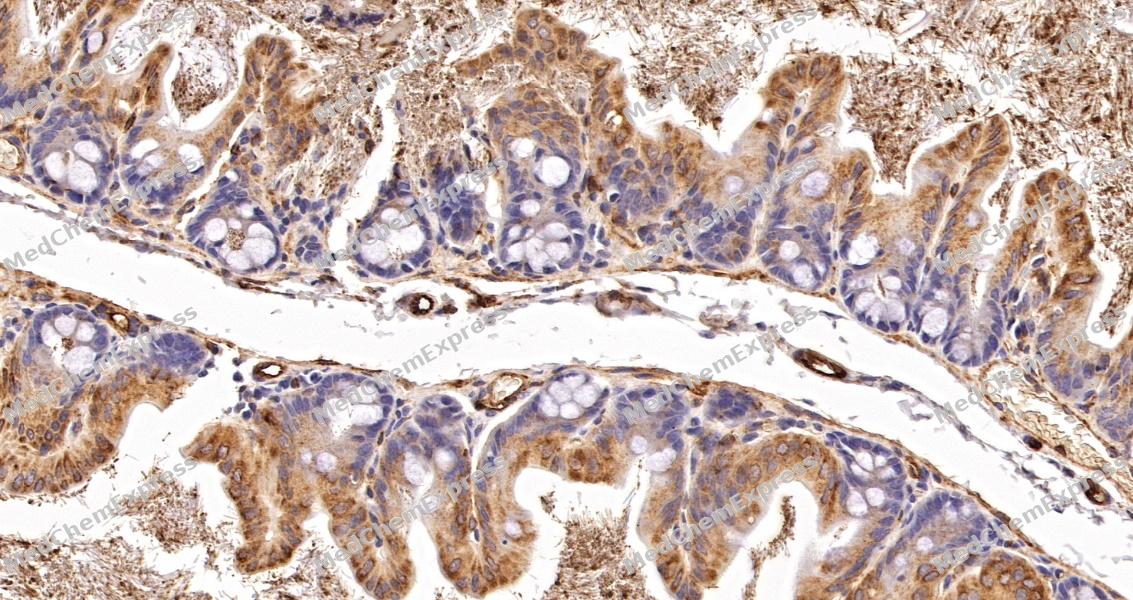 Immunohistochemical analysis of paraffin-embedded mouse colon tissue using Adiponectin Antibody. The section was pre-treated using heat mediated antigen retrieval with sodium citrate buffer (pH 6.0) for 8 minutes. The tissues were blocked in QuickBlock for 20 minutes at room temperature, washed with ddH2O and PBS, and then probed with the primary antibody at 1/100 dilution in 4℃ overnight. The detection was performed using an HRP conjugated compact polymer system. DAB was used as the chromogen. Tissues were counterstained with hematoxylin and mounted with DPX.
 -
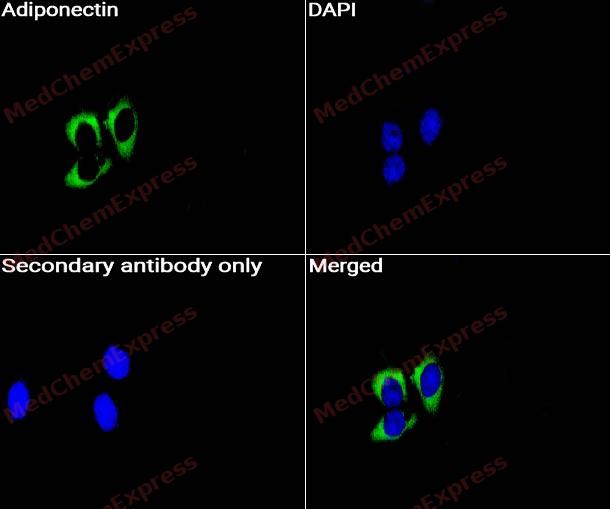 Immunocytochemistry analysis of HepG2 cells labeling Adiponectin with Adiponectin Antibody (HY-P80004) at 1/50 dilution. Cells were fixed in 4% paraformaldehyde for 15 minutes at room temperature, permeabilized with 0.1% Triton X-100 for 10 minutes at room temperature, then blocked with QuickBlock™ Blocking Buffer for Immunol Staining for 10 min at room temperature. Cells were then incubated with Adiponectin Antibody (HY-P80004)at 1/50 dilution in QuickBlock™ Blocking Buffer for Immunol Staining at 4 ℃. Alexa Fluor® 488-conjugated AffiniPure Goat Anti-Rabbit IgG H&L(HY-P8002,Green) was used as the secondary antibody at 1/1,000 dilution. PBS instead of the primary antibody was used as the secondary antibody only control. The Nuclear counterstain was DAPI (Blue).
 -
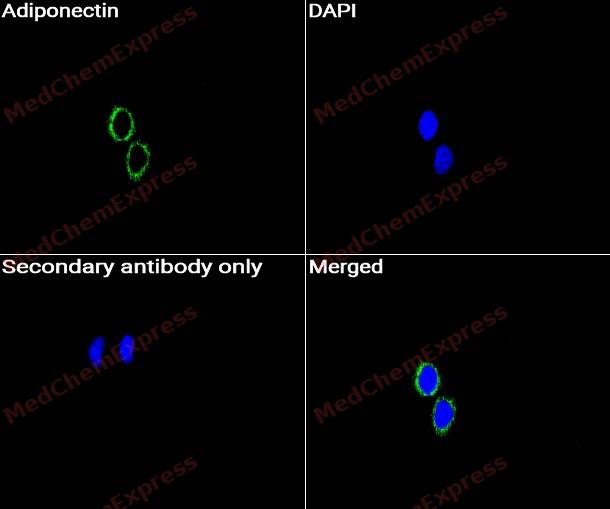 Immunocytochemistry analysis of Hela cells labeling Adiponectin with Adiponectin Antibody (HY-P80004) at 1/50 dilution. Cells were fixed in 4% paraformaldehyde for 15 minutes at room temperature, permeabilized with 0.1% Triton X-100 for 10 minutes at room temperature, then blocked with QuickBlock™ Blocking Buffer for Immunol Staining for 10 min at room temperature. Cells were then incubated with Adiponectin Antibody (HY-P80004) at 1/50 dilution in QuickBlock™ Blocking Buffer for Immunol Staining at 4 ℃. Alexa Fluor® 488-conjugated AffiniPure Goat Anti-Rabbit IgG H&L(HY-P8002, Green) was used as the secondary antibody at 1/1,000 dilution. PBS instead of the primary antibody was used as the secondary antibody only control. The Nuclear counterstain was DAPI (Blue).


Background
-
Function
Adiponectin is important adipokine involved in the control of fat metabolism and insulin sensitivity, with direct anti-diabetic, anti-atherogenic and anti-inflammatory activities. Stimulates AMPK phosphorylation and activation in the liver and the skeletal muscle, enhancing glucose utilization and fatty-acid combustion. Antagonizes TNF-alpha by negatively regulating its expression in various tissues such as liver and macrophages, and also by counteracting its effects. Inhibits endothelial NF-kappa-B signaling through a cAMP-dependent pathway. May play a role in cell growth, angiogenesis and tissue remodeling by binding and sequestering various growth factors with distinct binding affinities, depending on the type of complex, LMW, MMW or HMW
-
Subcellular Localization
Secreted
-
Expression
Tissue_specificity:Synthesized exclusively by adipocytes and secreted into plasma
Induction:During hormone-induced adipose differentiation and activated by insulin -
Subunit
Homomultimer (PubMed:23209641). Forms trimers, hexamers and 12- to 18-mers. The trimers (low molecular weight complexes / LMW) are assembled via non-covalent interactions of the collagen-like domains in a triple helix and hydrophobic interactions within the globular C1q domain.
-
SwissProt ID
-
Synonyms
30 kDa adipocyte complement related protein; ACDC; ACRP 30; ACRP30; ADIPO_HUMAN; Adipocyte; AdipoQ; Adipose most abundant gene transcript 1; Adipose specific collagen like factor; ADIPQTL1; ADPN; APM 1; apM-1; ApM1; C1q and collagen domain-containing protein; GBP 28; GBP28; Gelatin binding protein; Gelatin binding protein 28; Gelatin-binding protein.
-
Research Field
Signal Transduction


Documentation
-
Data Sheet (234 KB)
-
SDS (254 KB)
- English - EN (254 KB)
- Français - FR (254 KB)
- Deutsch - DE (254 KB)
- Norwegian - NO (254 KB)
- Español - ES (254 KB)
- Swedish - SV (254 KB)
- Italian - IT (254 KB)
- Korean - KR (254 KB)
- Portuguese - PT (254 KB)
-
User Guide for Antibodies (1077 KB)

 Powered by Bioz
