



Atg16L1 Antibody (YA2187)
(Synonyms: ATG16L1; APG16L; Autophagy-related protein 16-1; APG16-like 1)
Based on 1 Customer Validation
Atg16L1 Antibody (YA2187) is a Rabbit-derived and non-conjugated IgG monoclonal antibody, targeting to Atg16L1.
-
Host:
Rabbit
-
Isotype:
IgG
-
Application:
WB
-
Reactivity :
Human, Mouse, Rat
-
Formulation:
Supplied in 50mM Tris-Glycine(pH 7.4), 0.15M NaCl, 40% Glycerol, 0.01% Sodium azide and 0.05% BSA
-
Conjugation:
Non-conjugated


To place orders, for customer services and technical support, please contact: MedChemExpress USA
Tel: 609-228-6898 E-mail: [email protected] [email protected]





Applications
| Application |
WB

WB: Western Blot
|
|---|---|
| Dilution Ratio | 1:500-1:1000 |


Product Details
Atg16L1 Antibody (YA2187) is a Rabbit-derived and non-conjugated IgG monoclonal antibody, targeting to Atg16L1.
-
Host Rabbit

-
Clonality Recombinant,Monoclonal

-
Species ReactivityHuman, Mouse, Rat
-
Observed Molecular WeightObserved band size: 68 kDa
Note: Due to possible protein modifications or aggregation, the molecular weight should be confirmed by actual measurement, and the predicted value is for reference only.

-
Calculated Molecular Weight Predicted band size: 68 kDa

Entrez Gene: 55054 Human ; 77040 Mouse ; 363278 Rat
SwissProt: Q676U5 Human ; Q8C0J2 Mouse ;
OMIM: 611081 Human
Recombinant protein of human ATG16L1
Endogenous
Affinity Purified
Non-conjugated
Unmodified
IgG


Product Properties
-
Appearance
Liquid
-
Formulation
Supplied in 50mM Tris-Glycine(pH 7.4), 0.15M NaCl, 40% Glycerol, 0.01% Sodium azide and 0.05% BSA
-
Concentration
Batch-dependent, Please check the COA for the concentration of each lot. Check Lot Concentration
-
Storage & Stability
Stored at -20°C for 1 year. Avoid repeated freeze / thaw cycles.
-
Shipping
Shipping with blue ice.


Verification Images
-
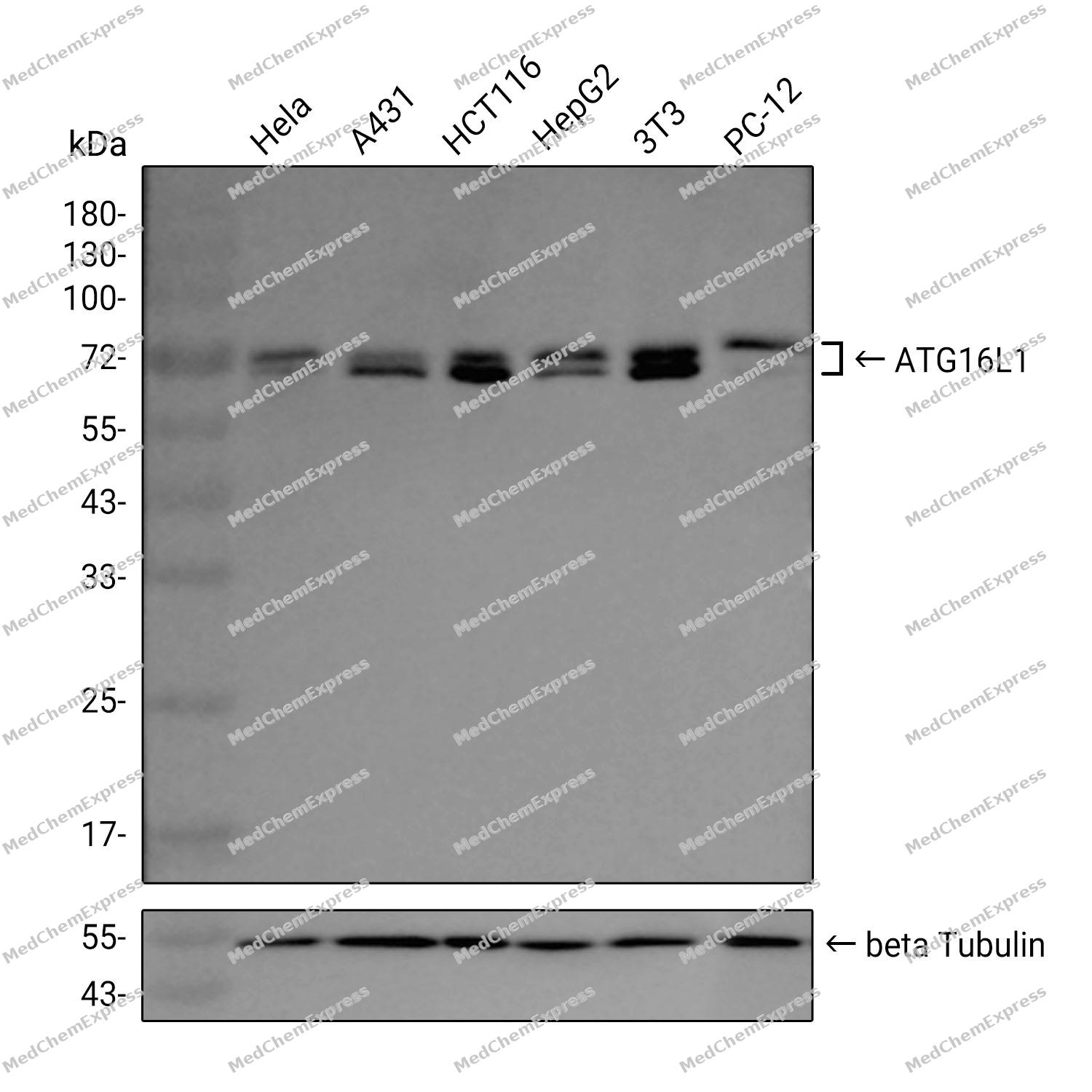 Western blot analysis was performed on extracts from Hela (lane 1, 15 μg), A431 (lane 2, 15 μg), HCT116 (lane 3, 15 μg), HepG2 (lane 4, 15 μg), 3T3 (lane 5, 15 μg), and PC-12 (lane 6, 15 μg) using ATG16L1 Rabbit mAb. Proteins were transferred to a PVDF membrane and blocked with 5% non - fat milk in TBST at 4°C overnight. The primary antibody (1:1000 dilution) and the loading control antibody (beta-Tubulin(HRP), HY-P80955A, 1:5000 dilution) was incubated in 5% non-fat milk in TBST for 1 hour at 37°C. Goat Anti - Rabbit IgG - HRP Secondary Antibody (1:20000 dilution) was then applied for 40 minutes at 37°C.


Background
-
Function
Atg16L1 plays an essential role in both canonical and non-canonical autophagy: interacts with ATG12-ATG5 to mediate the lipidation to ATG8 family proteins (MAP1LC3A, MAP1LC3B, MAP1LC3C, GABARAPL1, GABARAPL2 and GABARAP). Acts as a molecular hub, coordinating autophagy pathways via distinct domains that support either canonical or non-canonical signaling. During canonical autophagy, interacts with ATG12-ATG5 to mediate the conjugation of phosphatidylethanolamine (PE) to ATG8 proteins, to produce a membrane-bound activated form of ATG8. Thereby, controls the elongation of the nascent autophagosomal membrane. As part of the ATG8 conjugation system with ATG5 and ATG12, required for recruitment of LRRK2 to stressed lysosomes and induction of LRRK2 kinase activity in response to lysosomal stress. Also involved in non-canonical autophagy, a parallel pathway involving conjugation of ATG8 proteins to single membranes at endolysosomal compartments, probably by catalyzing conjugation of phosphatidylserine (PS) to ATG8. Non-canonical autophagy plays a key role in epithelial cells to limit lethal infection by influenza A (IAV) virus. Regulates mitochondrial antiviral signaling (MAVS)-dependent type I interferon (IFN-I) production. Negatively regulates NOD1- and NOD2-driven inflammatory cytokine response. Instead, promotes an autophagy-dependent antibacterial pathway together with NOD1 or NOD2. Plays a role in regulating morphology and function of Paneth cell[1][2][3][4][5][6][7][8][9][10][11][12][13].
-
Subcellular Localization
Cytoplasm; Preautophagosomal structure membrane; Peripheral membrane protein; Endosome membrane; Peripheral membrane protein; Lysosome membrane; Peripheral membrane protein
-
Isoforms & Post-Translational Modification
Q676U5 has 5 isomers: Q676U5-1: 68265 Da (predicted); Q676U5-2: 66296 Da (predicted); Q676U5-3: 53220 Da (predicted); Q676U5-4: 47686 Da (predicted); Q676U5-5: 49486 Da (predicted).
Proteolytic cleavage by activated CASP3 leads to degradation and may regulate autophagy upon cellular stress and apoptotic stimuli;Phosphorylation at Ser-139 promotes association with the ATG12-ATG5 conjugate to form the ATG12-ATG5-ATG16L1 complex -
Subunit
Homodimer (PubMed:25484072). Homooligomer (By similarity). Heterooligomer with ATG16L2 (By similarity). Interacts with WIPI1 (PubMed:28561066). Interacts with WIPI2 (PubMed:24954904, PubMed:28561066). Interacts with RB1CC1; the interaction is required for ULK1 complex-dependent autophagy (PubMed:23262492, PubMed:23392225, PubMed:24954904). Interacts with ATG5 (PubMed:23202584, PubMed:24191030, PubMed:25484072, PubMed:26812546). Part of the minor complex composed of 4 sets of ATG12-ATG5 and ATG16L1 (400 kDa); this complex interacts with ATG3 leading to disruption of ATG7 interaction and promotion of ATG8-like proteins lipidation (PubMed:23202584, PubMed:24191030, PubMed:26083323, PubMed:29317426, PubMed:30778222). Part of the major complex composed of 8 sets of ATG12-ATG5 and ATG16L1 (800 kDa) (PubMed:23202584, PubMed:26083323, PubMed:29317426, PubMed:30778222). Interacts with RAB33B (GTP- and GDP-bound forms); the complex consists of a tetramer where two RAB33B molecules bind independently one molecule of the ATG16L1 homodimer; the interaction promotes ATG12-ATG5-ATG16L1 complex recruitment to phagophores (PubMed:21808068, PubMed:32960676). Interacts (via WD repeats) with TMEM59; the interaction mediates unconventional autophagic activity of TMEM59 (PubMed:23376921, PubMed:27273576). Interacts with TLR2 (PubMed:23376921). Interacts (via WD repeats) with MEFV (PubMed:26347139). Interacts with PPP1CA; the interaction dephosphorylates ATG16L1 causing dissociation of ATG12-ATG5-ATG16L1 complex (PubMed:26083323). Interacts (via N-terminal) with CLTC (PubMed:20639872). Interacts with NOD1 (By similarity). Interacts with NOD2 (PubMed:20637199). Interacts with TUFM (PubMed:22749352). Interacts with TRIM16 (PubMed:30143514). Interacts (via WD repeats) with SPATA33 (PubMed:33087875). Interacts with IRGM (PubMed:25891078)
-
SwissProt ID
-
Synonyms
ATG16L1; APG16L; Autophagy-related protein 16-1; APG16-like 1
-
Research Field
Cell Biology


Documentation
-
Data Sheet (234 KB)
-
SDS (251 KB)
- English - EN (251 KB)
- Français - FR (251 KB)
- Deutsch - DE (251 KB)
- Norwegian - NO (251 KB)
- Español - ES (251 KB)
- Swedish - SV (251 KB)
- Italian - IT (251 KB)
- Korean - KR (251 KB)
- Portuguese - PT (251 KB)
-
User Guide for Antibodies (1077 KB)

 Powered by Bioz
