



Beta Tubulin Antibody (YA839)
(Synonyms: Human,Mouse,Monkey,Goat,Hamster,Rat,ChlamydomonasReinhardtii)Based on 1 Customer Validation
Beta Tubulin Antibody (YA839) is a non-conjugated and Mouse origined IgG1 monoclonal antibody, targeting to Tubulin beta chain (TUBB). It can be used as a loading control antibody.
-
Host:
Mouse
-
Isotype:
IgG
-
Application:
WB, ICC/IF
-
Reactivity :
Human, Mouse, Monkey, Goat, Hamster, Rat, Chlamydomonas Reinhardtii
-
Formulation:
Supplied in PBS containing 50% glycerol, 0.5% BSA and 0.02% sodium azide, pH 7.3.
-
Conjugation:
Non-conjugated


To place orders, for customer services and technical support, please contact: MedChemExpress USA
Tel: 609-228-6898 E-mail: [email protected] [email protected]





Applications
| Application |
WB

WB: Western Blot
|
ICC/IF
ICC/IF: Immunocytochemistry/
Immunofluorescence |
|---|---|---|
| Dilution Ratio | 1:5000-1:10000 | 1:100-1:200 |


Product Details
Beta Tubulin Antibody (YA839) is a non-conjugated and Mouse origined IgG1 monoclonal antibody, targeting to Tubulin beta chain (TUBB). It can be used as a loading control antibody.
-
Host Mouse

-
Clonality Monoclonal

-
Species ReactivityHuman, Mouse, Monkey, Goat, Hamster, Rat, Chlamydomonas Reinhardtii
-
Observed Molecular WeightObserved band size: 55 kDa
Note: Due to possible protein modifications or aggregation, the molecular weight should be confirmed by actual measurement, and the predicted value is for reference only.

-
Calculated Molecular Weight Predicted band size: 50 kDa

Entrez Gene: 203068 Human ; 22154 Mouse ; 29214 Rat
SwissProt: P07437 Human ; P99024 Mouse ; P69897 Rat
OMIM: 615771 Human
Synthetic peptide corresponding to Human Tubulin beta.The exact sequence is proprietary to MCE.
Endogenous
Non-conjugated
Unmodified
IgG


Product Properties
-
Appearance
Solution
-
Formulation
Supplied in PBS containing 50% glycerol, 0.5% BSA and 0.02% sodium azide, pH 7.3.
-
Concentration
Batch-dependent, Please check the COA for the concentration of each lot. Check Lot Concentration
-
Storage & Stability
Stored at -20°C for 1 year. Avoid repeated freeze / thaw cycles.
-
Shipping
Shipping with blue ice.


Verification Images
-
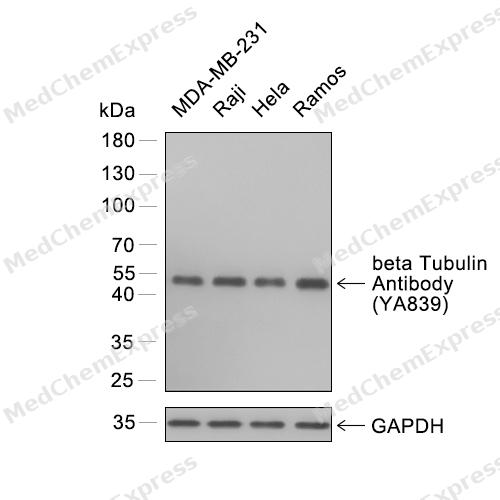 Western blot analysis of extracts from MDA-MB-231 (lane 1) and Raji (lane 2) and Hela (lane 3) and Ramos (lane 4) using beta Tubulin antibody. Proteins were transferred to a PVDF membrane and blocked with 5% nonfat powdered milk in PBST for 2 hour at room temperature. The primary antibody (1/3000) and Loading control antibody (GAPDH, HY-P80954A, 1/3000) was diluted with 5% nonfat powdered milk in PBST at 4°C overnight. Goat Anti-Rabbit IgG-HRP Secondary Antibody (1/8,000) was incubated for 45min at room temperature.
 -
 Immunocytochemistry analysis of Hela cells labeling Beta Tubulin with Beta Tubulin Antibody (HY-P80955) at 1/100 dilution. Cells were fixed in 4% paraformaldehyde for 15 minutes at room temperature, permeabilized with 0.1% Triton X-100 in PBS for 15 minutes at room temperature, then blocked with quick block buffer for 10 minutes at room temperature. Cells were then incubated with Beta Tubulin Antibody (HY-P80955) at 1/100 dilution in quick block buffer overnight at 4 ℃. AF488-conjugated Goat Anti-Mouse IgG H&L(HY-P8005, Green) was used as the secondary antibody at 1/1,000 dilution. PBS instead of the primary antibody was used as the secondary antibody only control. The Nuclear counterstain was DAPI (Blue).
 -
 Immunocytochemistry analysis of Hela cells labeling Beta Tubulin with Beta Tubulin Antibody (HY-P80955) at 1/200 dilution. Cells were fixed in 4% paraformaldehyde for 15 minutes at room temperature, permeabilized with 0.1% Triton X-100 in PBS for 15 minutes at room temperature, then blocked with quick block buffer for 10 minutes at room temperature. Cells were then incubated with Beta Tubulin Antibody (HY-P80955) at 1/200 dilution in quick block buffer overnight at 4 ℃. AF488-conjugated Goat Anti-Mouse IgG H&L(HY-P8005, Green) was used as the secondary antibody at 1/1,000 dilution. PBS instead of the primary antibody was used as the secondary antibody only control. The Nuclear counterstain was DAPI (Blue).


Background
-
Function
Beta Tubulin is a Tubulin is the major constituent of microtubules, a cylinder consisting of laterally associated linear protofilaments composed of alpha- and beta-tubulin heterodimers. Microtubules grow by the addition of GTP-tubulin dimers to the microtubule end, where a stabilizing cap forms. Below the cap, tubulin dimers are in GDP-bound state, owing to GTPase activity of alpha-tubulin
-
Subcellular Localization
Cytoplasm, cytoskeleton
-
Expression
Tissue_specificity:This gene is widely expressed in all tissues of the body, with the highest expression levels in the spleen, thymus, and immature brain tissue.
Induction:Autoregulated by feedback control of mRNA degradation (PubMed:31727855) . In excess of soluble tubulin, nascent beta-tubulin chain binds TTC5/STRAP cofactor through the MREI motif which triggers cotranslation degradation of tubulin mRNA (PubMed:31727855) -
Subunit
Heterodimer of alpha and beta chains (PubMed:26637975). A typical microtubule is a hollow water-filled tube with an outer diameter of 25 nm and an inner diameter of 15 nM. Alpha-beta heterodimers associate head-to-tail to form protofilaments running lengthwise along the microtubule wall with the beta-tubulin subunit facing the microtubule plus end conferring a structural polarity. Microtubules usually have 13 protofilaments but different protofilament numbers can be found in some organisms and specialized cells. Interacts with CIMAP3 (PubMed:20643351). Interacts with DIAPH1 (PubMed:23325789). Interacts with MX1 (By similarity). May interact with RNABP10 (By similarity). Interacts with CFAP157 (By similarity). Nascent tubulin polypeptide interacts (via beta-tubulin MREI motif) with TTC5/STRAP; this interaction results in tubulin mRNA-targeted degradation (PubMed:31727855)
-
SwissProt ID
-
Synonyms
Human,Mouse,Monkey,Goat,Hamster,Rat,ChlamydomonasReinhardtii
-
Research Field
Cell Biology


Documentation
-
Data Sheet (232 KB)
-
SDS (251 KB)
- English - EN (251 KB)
- Français - FR (251 KB)
- Deutsch - DE (251 KB)
- Norwegian - NO (251 KB)
- Español - ES (251 KB)
- Swedish - SV (251 KB)
- Italian - IT (251 KB)
- Korean - KR (251 KB)
- Portuguese - PT (251 KB)
-
User Guide for Antibodies (1077 KB)

 Powered by Bioz
