



CSK Antibody (YA2742)
(Synonyms: CSK; Tyrosine-protein kinase CSK; C-Src kinase; Protein-tyrosine kinase CYL)
Based on 1 Customer Validation
CSK Antibody (YA2742) is a Rabbit-derived and non-conjugated IgG monoclonal antibody, targeting to CSK.
-
Host:
Rabbit
-
Isotype:
IgG
-
Application:
WB, IHC-P
-
Reactivity :
Human, Mouse, Rat
-
Formulation:
Supplied in Rabbit IgG in 10mM phosphate buffered saline , pH 7.4, 150mM sodium chloride, 0.05% BSA, 0.02% sodium azide and 50% glycerol.
-
Conjugation:
Non-conjugated


To place orders, for customer services and technical support, please contact: MedChemExpress USA
Tel: 609-228-6898 E-mail: [email protected] [email protected]





Applications
| Application |
WB

WB: Western Blot
|
IHC-P
IHC-P: Immunohistochemistry-Paraffin
|
|---|---|---|
| Dilution Ratio | 1:500-1:1000 | 1:50-1:100 |


Product Details
CSK Antibody (YA2742) is a Rabbit-derived and non-conjugated IgG monoclonal antibody, targeting to CSK.
-
Host Rabbit

-
Clonality Recombinant,Monoclonal

-
Species ReactivityHuman, Mouse, Rat
-
Observed Molecular WeightObserved band size: 51 kDa
Note: Due to possible protein modifications or aggregation, the molecular weight should be confirmed by actual measurement, and the predicted value is for reference only.

-
Calculated Molecular Weight Predicted band size: 51 kDa

Entrez Gene: 1445 Human ; 12988 Mouse ; 315707 Rat
SwissProt: P41240 Human ; P41241 Mouse ; P32577 Rat
OMIM: 124095 Human
A synthesized peptide derived from human CSK aa50-100/450.
Endogenous
Affinity Purified
Non-conjugated
Unmodified
IgG


Product Properties
-
Appearance
Solution
-
Formulation
Supplied in Rabbit IgG in 10mM phosphate buffered saline , pH 7.4, 150mM sodium chloride, 0.05% BSA, 0.02% sodium azide and 50% glycerol.
-
Concentration
Batch-dependent, Please check the COA for the concentration of each lot. Check Lot Concentration
-
Storage & Stability
Stored at -20°C for 1 year. Avoid repeated freeze / thaw cycles.
-
Shipping
Shipping with blue ice.


Verification Images
-
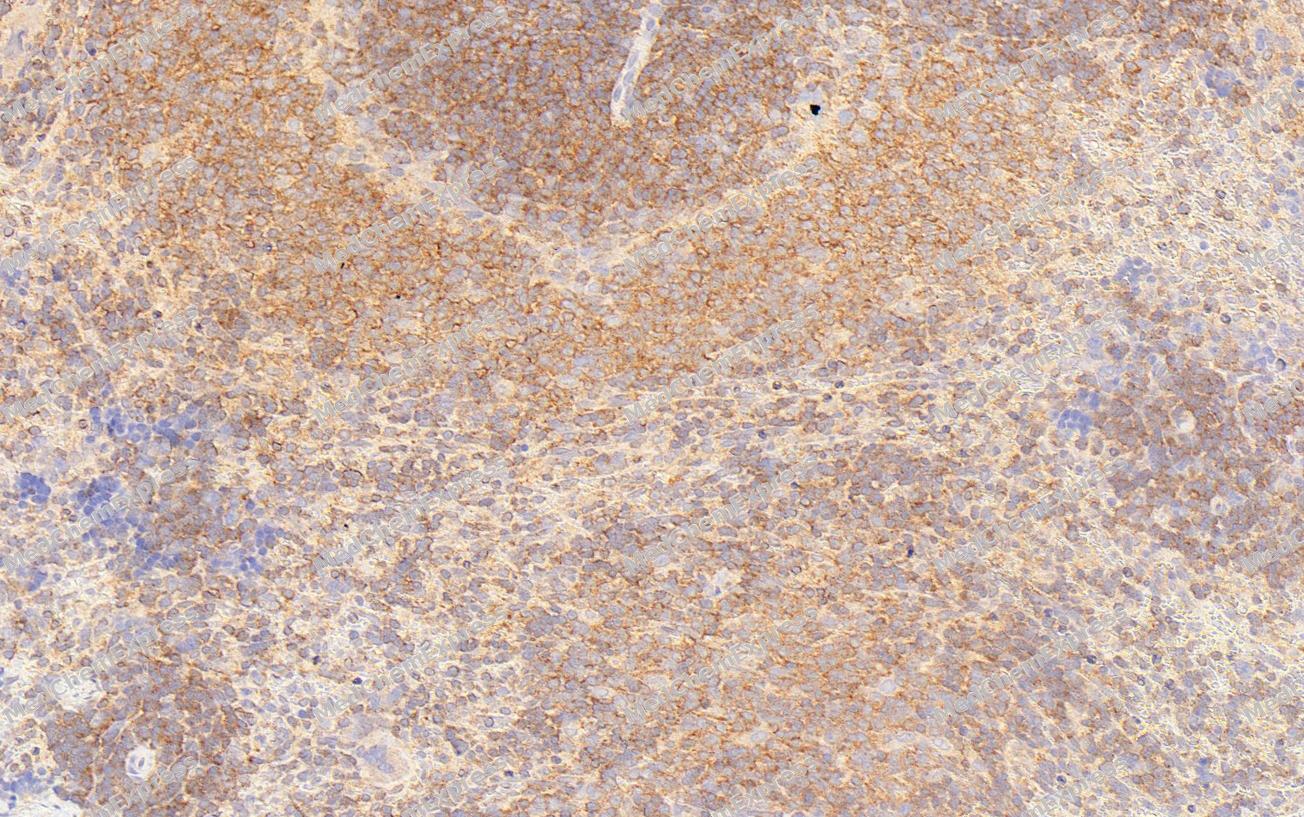 Immunohistochemical analysis of paraffin-embedded Rat spleen tissue using CSK Antibody (YA2742). The section was pre-treated using heat mediated antigen retrieval with Tris-EDTA buffer (pH 9.0) for 8 minutes. The tissues were blocked in QuickBlock for 20 minutes at room temperature, washed with ddH2O and PBS, and then probed with the primary antibody (HY-P82997, 1/100) in 4℃ overnight. The detection was performed using an HRP conjugated compact polymer system. DAB was used as the chromogen. Tissues were counterstained with hematoxylin and mounted with DPX.
 -
Immunohistochemical analysis of paraffin-embedded Rat spleen tissue using CSK Antibody (YA2742). The section was pre-treated using heat mediated antigen retrieval with Tris-EDTA buffer (pH 9.0) for 8 minutes. The tissues were blocked in QuickBlock for 20 minutes at room temperature, washed with ddH2O and PBS, and then probed with the primary antibody (HY-P82997, 1/100) in 4℃ overnight. The detection was performed using an HRP conjugated compact polymer system. DAB was used as the chromogen. Tissues were counterstained with hematoxylin and mounted with DPX.


Background
-
Function
CSK (C-terminal Src kinase) is a non-receptor tyrosine kinase that functions as a central negative regulator of Src family kinases (SFKs) through phosphorylation of their conserved C-terminal inhibitory tyrosine residue, thereby maintaining controlled intracellular tyrosine kinase signaling and suppressing excessive SFK activity[1]. Mechanistically, CSK is recruited to membrane-associated signaling complexes through interactions mediated by its SH2 domain, and this localization enables efficient regulation of SFK-dependent pathways involved in cell proliferation, differentiation, migration, immune signaling, and survival[1][2]. Disruption of the CSK-centered regulatory network, including alterations in scaffold proteins such as Cbp/PAG1 and associated phosphatase systems, can result in sustained SFK activation, a molecular feature frequently observed in cancer and other pathological conditions[1]. Experimental studies further demonstrate that loss of CSK function causes constitutive activation of SFKs in vivo, highlighting its essential role in maintaining signaling homeostasis during development and tissue regulation[1]. Compared with the closely related isoform CHK (CSK-homologous kinase), CSK functions as a highly specific kinase for the inhibitory C-terminal regulatory site of SFKs, whereas CHK exhibits distinct inhibitory properties and mechanistic characteristics despite sharing the common role of SFK suppression[3]. For experimental applications, CSK is widely used as a molecular tool for investigating SFK signaling, kinase regulation, immune receptor pathways, and oncogenic tyrosine kinase networks, while small-molecule CSK inhibitors remain relatively limited compared with the extensive pharmacological targeting of SFKs themselves[2][4].
-
Subcellular Localization
Cytoplasm; Cell membrane
-
Expression
Tissue_specificity:Expressed in lung and macrophage cells -
Subunit
Homodimer (via SH3-domain) (PubMed:19888460). Interacts with PTPN22 (PubMed:15208781). Interacts with phosphorylated SIT1, PAG1, LIME1 and TGFB1I1; these interactions serve to recruit CSK to the membrane where it can phosphorylate and inhibit Src-family kinases (PubMed:10790433, PubMed:10838081, PubMed:11433379, PubMed:14610046). Interacts with SRCIN1 (PubMed:17525734). Interacts with RHOH (PubMed:20851766). Interacts (via SH2 domain) with SCIMP; this interaction is dependent on phosphorylation of SCIMP 'Tyr-107' (PubMed:21930792). Interacts (via SH2 domain) with PRAG1 (when phosphorylated at 'Tyr-391'); this interaction prevents translocation of CSK from the cytoplasm to the membrane leading to increased activity of CSK (By similarity). Interacts with LRRK1 (PubMed:23526378)
-
SwissProt ID
-
Synonyms
CSK; Tyrosine-protein kinase CSK; C-Src kinase; Protein-tyrosine kinase CYL
-
Research Field
Signal Transduction


Documentation
-
Data Sheet (261 KB)
-
SDS (251 KB)
- English - EN (251 KB)
- Français - FR (251 KB)
- Deutsch - DE (251 KB)
- Norwegian - NO (251 KB)
- Español - ES (251 KB)
- Swedish - SV (251 KB)
- Italian - IT (251 KB)
- Korean - KR (251 KB)
- Portuguese - PT (251 KB)
-
User Guide for Antibodies (1077 KB)
References
[1]. Okada M. Regulation of the SRC family kinases by Csk. Int J Biol Sci. 2012;8(10):1385-97. doi: 10.7150/ijbs.5141. Epub 2012 Nov 1. PMID: 23139636; PMCID: PMC3492796. et al. Regulation of the SRC family kinases by Csk. Int J Biol Sci. 2012;8(10):1385-97. [Content Brief]
[2]. Zhu S, et al. Regulation, targets and functions of CSK. Front Cell Dev Biol. 2023 Jun 16;11:1206539. [Content Brief]
[3]. Advani G, et al. Csk-homologous kinase (Chk) is an efficient inhibitor of Src-family kinases but a poor catalyst of phosphorylation of their C-terminal regulatory tyrosine. Cell Commun Signal. 2017 Aug 7;15(1):29. [Content Brief]

 Powered by Bioz
