



Cyclin D2/CCND2 Antibody (YA789)
(Synonyms: KIAK0002.)
Based on 1 Customer Validation
Cyclin D2/CCND2 Antibody (YA789) is a Mouse-derived and non-conjugated IgG2b monoclonal antibody, targeting to Cyclin D2/CCND2.
-
Host:
Mouse
-
Isotype:
IgG
-
Application:
WB
-
Reactivity :
Human
-
Formulation:
Supplied in 1*PBS (pH 7.3), 50% glycerol and 0.5% BSA. Preservative: 0.02% sodium azide.
-
Conjugation:
Non-conjugated


To place orders, for customer services and technical support, please contact: MedChemExpress USA
Tel: 609-228-6898 E-mail: [email protected] [email protected]





Applications
| Application |
WB

WB: Western Blot
|
|---|---|
| Dilution Ratio | 1:500-1:1000 |


Product Details
Cyclin D2/CCND2 Antibody (YA789) is a Mouse-derived and non-conjugated IgG2b monoclonal antibody, targeting to Cyclin D2/CCND2.
-
Host Mouse

-
Clonality Monoclonal

-
Species ReactivityHuman
-
Observed Molecular WeightObserved band size: 38 kDa
Note: Due to possible protein modifications or aggregation, the molecular weight should be confirmed by actual measurement, and the predicted value is for reference only.

-
Calculated Molecular Weight Predicted band size: 33 kDa

Synthetic peptide corresponding to Human Cyclin D2.The exact sequence is proprietary to MCE.
Endogenous
affinity purified
Non-conjugated
Unmodified
IgG


Product Properties
-
Appearance
Solution
-
Formulation
Supplied in 1*PBS (pH 7.3), 50% glycerol and 0.5% BSA. Preservative: 0.02% sodium azide.
-
Concentration
Batch-dependent, Please check the COA for the concentration of each lot. Check Lot Concentration
-
Storage & Stability
Stored at -20°C for 1 year. Avoid repeated freeze / thaw cycles.
-
Shipping
Shipping with blue ice.


Verification Images
-
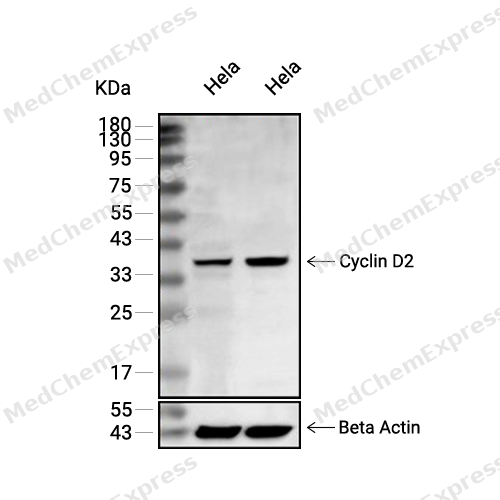 Western blot analysis of extracts from Hela (lane 2(20μg) and Hela (lane 3(40μg) using Cyclin D2 (HY-P80634) Mouse mAb. Proteins were transferred to a PVDF membrane and blocked with 5% non-fat milk in TBST for 2 hour at room temperature. The primary antibody (1/1000) and Loading control antibody (Beta Actin, HY-P80438, 1/10000) was used in 5% non-fat milk in TBST at 4°C overnight. Goat Anti-Mouse IgG-HRP Secondary Antibody (1/10000) was used for 1 hour at room temperature.


Background
-
Function
Cyclin D2/CCND2 is a Regulatory component of the cyclin D2-CDK4 (DC) complex that phosphorylates and inhibits members of the retinoblastoma (RB) protein family including RB1 and regulates the cell-cycle during G(1)/S transition. Phosphorylation of RB1 allows dissociation of the transcription factor E2F from the RB/E2F complex and the subsequent transcription of E2F target genes which are responsible for the progression through the G(1) phase. Hypophosphorylates RB1 in early G(1) phase. Cyclin D-CDK4 complexes are major integrators of various mitogenenic and antimitogenic signals[1][2].
-
Subcellular Localization
Nucleus; Cytoplasm; Nucleus membrane; Cytoplasm
-
Isoforms & Post-Translational Modification
P30279 has 2 isomers: P30279-1: 33067 Da (predicted); P30279-2: 24461 Da (predicted).
Phosphorylation at Thr-280 by MAP kinases is required for ubiquitination and degradation by the DCX(AMBRA1) complex;Ubiquitinated by the DCX(AMBRA1) complex during the transition from G1 to S cell phase, leading to its degradation: ubiquitination is dependent on Thr-280 phosphorylation (PubMed:33854235, PubMed:33854239). The DCX(AMBRA1) complex represents the major regulator of CCND2 stability during the G1/S transition (PubMed:33854235, PubMed:33854239). Polyubiquitinated by the SCF(FBXL2) complex, leading to proteasomal degradation (PubMed:22323446) -
Subunit
Interacts with either CDK4 or CDK6 protein kinase to form a serine/threonine kinase holoenzyme complex (PubMed:18827403, PubMed:8114739). The cyclin subunit imparts substrate specificity to the complex (PubMed:18827403, PubMed:8114739)
-
SwissProt ID
-
Synonyms
KIAK0002.
-
Research Field
Cell Biology


Documentation
-
Data Sheet (261 KB)
-
SDS (251 KB)
- English - EN (251 KB)
- Français - FR (251 KB)
- Deutsch - DE (251 KB)
- Norwegian - NO (251 KB)
- Español - ES (251 KB)
- Swedish - SV (251 KB)
- Italian - IT (251 KB)
- Korean - KR (251 KB)
- Portuguese - PT (251 KB)
-
User Guide for Antibodies (1077 KB)
References
[1]. Wang Z, et al. Migratory localization of cyclin D2-Cdk4 complex suggests a spatial regulation of the G1-S transition. Cell Struct Funct. 2008;33(2):171-83. [Content Brief]
[2]. Meyerson M, et al. Identification of G1 kinase activity for cdk6, a novel cyclin D partner. Mol Cell Biol. 1994 Mar;14(3):2077-86. [Content Brief]

 Powered by Bioz
