



E7 Antibody (YA4820)
Based on 1 publication(s) in Google Scholar
E7 Antibody (YA4820) is a Mouse-derived and non-conjugated monoclonal antibody, targeting to E7.
-
Host:
Mouse
-
Application:
WB, IHC-P, ICC/IF, ELISA
-
Reactivity :
Human
-
Formulation:
Supplied in PBS containing 50% glycerol, 0.5% BSA and 0.02% sodium azide.
-
Conjugation:
Non-conjugated


To place orders, for customer services and technical support, please contact: MedChemExpress USA
Tel: 609-228-6898 E-mail: [email protected] [email protected]



Publications Citing Use of MedChemExpress (MCE) E7 Antibody (YA4820)
More

Applications
| Application |
WB

WB: Western Blot
|
IHC-P
IHC-P: Immunohistochemistry-Paraffin
|
ELISA
ELISA: Enzyme Linked Immunosorbent Assay
|
ICC/IF
ICC/IF: Immunocytochemistry/
Immunofluorescence |
|---|---|---|---|---|
| Dilution Ratio | 1:500-1:2000 | 1:200-1:1000 | 1:10000 | 1:50-200 |


Product Details
E7 Antibody (YA4820) is a Mouse-derived and non-conjugated monoclonal antibody, targeting to E7.
-
Host Mouse

-
Clonality Monoclonal

-
Species ReactivityHuman
Purified recombinant fragment of E7 expressed in E. Coli.
affinity purified.
Non-conjugated
Unmodified


Product Properties
-
Appearance
Liquid
-
Formulation
Supplied in PBS containing 50% glycerol, 0.5% BSA and 0.02% sodium azide.
-
Concentration
Batch-dependent, Please check the COA for the concentration of each lot. Check Lot Concentration
-
Storage & Stability
Stored at -20°C for 1 year. Avoid repeated freeze / thaw cycles.
-
Shipping
Shipping with blue ice.


Publications (1)
-
Journal Impact Factor
-
Most Recent


Verification Images
-
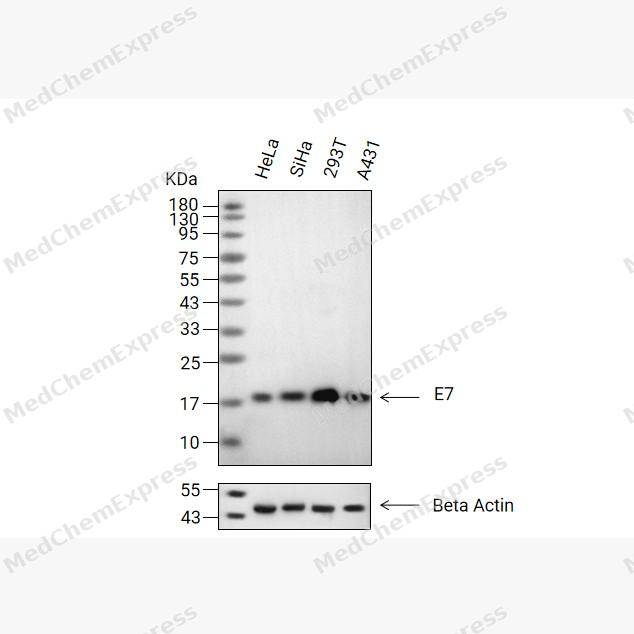 Western blot analysis of extracts from HeLa(lane 2(20μg)), SiHa(lane 3(20μg)), 293T(lane 4(20μg)) and A431(lane 5(20μg)) using E7 Antibody(HY-P85128). Proteins were transferred to a PVDF membrane and blocked with 5% non-fat milk in TBST for 2 hour at room temperature. The primary antibody ( 1/1000) and Loading control antibody (Beta Actin, HY-P80993,1/10000) was used in 5% non-fat milk in TBST at 4°C overnight. Goat Anti-Mouse IgG-HRP Secondary Antibody (HY-P8004,1/10,000) was used for 1 hour at room temperature.


Background
-
Function
E7 plays a role in viral genome replication by driving entry of quiescent cells into the cell cycle. Stimulation of progression from G1 to S phase allows the virus to efficiently use the cellular DNA replicating machinery to achieve viral genome replication. E7 protein has both transforming and trans-activating activities. Induces the disassembly of the E2F1 transcription factor from RB1, with subsequent transcriptional activation of E2F1-regulated S-phase genes. Interferes with host histone deacetylation mediated by HDAC1 and HDAC2, leading to transcription activation. Also plays a role in the inhibition of both antiviral and antiproliferative functions of host interferon alpha. Interaction with host TMEM173/STING impairs the ability of TMEM173/STING to sense cytosolic DNA and promote the production of type I interferon (IFN-alpha and IFN-beta)
-
Subcellular Localization
Host cytoplasm; Host nucleus
-
Subunit
Homodimer (PubMed:11123931). Homooligomer (PubMed:15035602). Interacts with host RB1; this interaction induces dissociation of RB1-E2F1 complex thereby disrupting RB1 activity (PubMed:1316611). Interacts with host EP300; this interaction represses EP300 transcriptional activity (PubMed:12970734). Forms a complex with CHD4 and HDAC1, thereby altering the action of host histone deacetylation. A similar complex involving E7, CHD4 and HDAC2 may also form (PubMed:10228159). Interacts with protein E2; this interaction inhibits E7 oncogenic activity (PubMed:16439535)
-
SwissProt ID
Documentation
-
Data Sheet (234 KB)
-
SDS (251 KB)
- English - EN (251 KB)
- Français - FR (251 KB)
- Deutsch - DE (251 KB)
- Norwegian - NO (251 KB)
- Español - ES (251 KB)
- Swedish - SV (251 KB)
- Italian - IT (251 KB)
- Korean - KR (251 KB)
- Portuguese - PT (251 KB)
-
User Guide for Antibodies (1077 KB)

 Powered by Bioz
