



Histone H3 Antibody (YA368)
Based on 4 publication(s) in Google Scholar
Histone H3 Antibody is a non-conjugated and Rabbit origined IgG monoclonal antibody, targeting to Histone H3. It can be used as a loading control antibody.
-
Host:
Rabbit
-
Isotype:
IgG
-
Application:
WB, ICC/IF, IHC-P, IP, ChIP
-
Reactivity :
Human, Mouse, Rat
-
Formulation:
Supplied in 1*TBS (pH7.4), 0.05% BSA and 40% Glycerol. Preservative: 0.05% Sodium Azide.
-
Conjugation:
Non-conjugated


To place orders, for customer services and technical support, please contact: MedChemExpress USA
Tel: 609-228-6898 E-mail: [email protected] [email protected]




Publications Citing Use of MedChemExpress (MCE) Histone H3 Antibody (YA368)
More
 4 Publications Citing Use of MCE Histone H3 Antibody (YA368) (5)
-
Histological Imaging/Staining

-
WB

-
WB

-
WB

-
WB


Applications
| Application |
WB

WB: Western Blot
|
ICC/IF
ICC/IF: Immunocytochemistry/
Immunofluorescence |
IHC-P
IHC-P: Immunohistochemistry-Paraffin
|
IP
IP: Immunoprecipitation
|
ChIP
ChIP: Chromatin Immunoprecipitation
|
|---|---|---|---|---|---|
| Dilution Ratio | 1:20000 | 1:100 | 1:5000-1:10000 | 1-2μg/sample | Use 0.5~2 μg for 25 μg of chromatin. |


Product Details
Histone H3 Antibody is a non-conjugated and Rabbit origined IgG monoclonal antibody, targeting to Histone H3. It can be used as a loading control antibody.
-
Host Rabbit

-
Clonality Recombinant, Monoclonal

-
Species ReactivityHuman, Mouse, Rat
-
Observed Molecular WeightObserved band size: 15 kDa
Note: Due to possible protein modifications or aggregation, the molecular weight should be confirmed by actual measurement, and the predicted value is for reference only.

-
Calculated Molecular Weight Predicted band size: 15 kDa

Entrez Gene: 8290 Human ; 8350 Human ; 8351 Human ; 8352 Human ; 8353 Human ; 8354 Human ; 8355 Human ; 8356 Human ; 8357 Human ; 8358 Human ; 8968 Human ; 319152 Mouse ; 319153 Mouse ; 360198 Mouse ; 97908 Mouse ; 100364501 Rat 100365669
SwissProt: P68431 Human ; P84243 Human ; Q16695 Human ; Q6NXT2 Human ; Q71DI3 Human ; P68433 Mouse ; P84228 Mouse
OMIM: 601128 Human ; 602810 Human ; 602811 Human ; 602812 Human ; 602813 Human ; 602814 Human ; 602815 Human ; 602816 Human ; 602817 Human ; 602818 Human ; 602819 Human
Synthetic peptide corresponding to Human Histone H3.AA range:85-136.
Endogenous
Protein A affinity purified.
Non-conjugated
Unmodified
IgG


Product Properties
-
Appearance
Liquid
-
Formulation
Supplied in 1*TBS (pH7.4), 0.05% BSA and 40% Glycerol. Preservative: 0.05% Sodium Azide.
-
Concentration
Batch-dependent, Please check the COA for the concentration of each lot. Check Lot Concentration
-
Storage & Stability
Stored at -20°C for 1 year. Avoid repeated freeze / thaw cycles.
-
Shipping
Shipping with blue ice.


Publications (4)
-
Journal Impact Factor
-
Most Recent
-
Sci Adv
TPM1 drives cytoskeleton-immunometabolism coupling and LGALS9/CD45-mediated neuroinflammatory propagation in retinitis pigmentosa. [Abstract]2026 May 29;12(22):eaea6467. PMID: 42202020
Histone H3 Antibody (YA368) purchased from MedChemExpress. Usage Cited in: Sci Adv. 2026 May 29;12(22):eaea6467. [Abstract]
Retinal section stained with Filipin (free cholesterol; magenta), Iba-1 (microglia; green), and Histone H3 (nuclei; white) antibodies. Yellow arrowheads indicate Filipin+ microglia. Scale bar, 20 μm. For image acquiring, three views in each retinal section at 100 μm (central), 1 mm (middle), and 1.8 mm (peripheral) from the optic nerve head along the dorsal and ventral directions were captured. Retinal sections were incubated with goat Iba-1 (1:500) and rabbit Histone H3 (Histone H3 Antibody (YA368), 1:100, HY-P80166) in blocking buffer at 4°C overnight, followed by incubation with donkey anti-goat Alexa Fluor 488 (1:500) and donkey anti-rabbit Alexa Fluor 594 (1:500) for 2 hours.
-
Cell Death Dis
A new candidate tumor suppressor tRF-Ser inhibits gastric cancer progression by regulating the CNBP/HSPA8 axis. [Abstract]2026 Mar 25;17(1):379. PMID: 41881984
Histone H3 Antibody (YA368) purchased from MedChemExpress. Usage Cited in: Cell Death Dis. 2026 Mar 25;17(1):379. [Abstract]
WB assays showed tRF-Ser overexpression inhibited CNBP nuclear accumulation in MKN-45 cells. Primary antibodies; anti-Histone-H3 (Histone H3 Antibody (YA368) (HY-P80166)), anti-CNBP, anti-β-actin.
-
Life Sci
KAT2A-mediated H3K79 succinylation promotes ferroptosis in diabetic nephropathy by regulating SAT2. [Abstract]2025 Sep 1:376:123746. PMID: 40409584
Histone H3 Antibody (YA368) purchased from MedChemExpress. Usage Cited in: Life Sci. 2025 Sep 1:376:123746. [Abstract]
WB detection of KAT2A, H3K79succ, and histone acetylation modification protein H3 levels. Primary antibodies: H3 (Histone H3 Antibody (YA368), 1:20000, HY-P80166), H3K79succ, KAT2A(1:500), β-actin(1:1000).
Histone H3 Antibody (YA368) purchased from MedChemExpress. Usage Cited in: Life Sci. 2025 Sep 1:376:123746. [Abstract]
WB detection of KAT2A, H3K79succ, H3, and SAT2 expression in HPo cells with endogenous KAT2A knockout and transfected with recombinant oe-KAT2A WT or oe-KAT2A Y645A mutant. Primary antibodies: KAT2A (1:500), SAT2 (1:1000), H3K79succ, H3 (Histone H3 Antibody (YA368), 1:20000, HY-P80166), β-actin(1:1000).
-
Histone H3 Antibody (YA368) purchased from MedChemExpress. Usage Cited in: J Appl Toxicol. 2026 Jun 28.
Subcellular fractionation followed by WB analysis of nuclear Nrf2 protein levels in rat liver tissues. Primary antibodies: Histone H3 (Histone H3 Antibody (YA368), 1:20000, HY-P80166), Nrf2 (1:1000), GAPDH (1:10000).


Verification Images
-
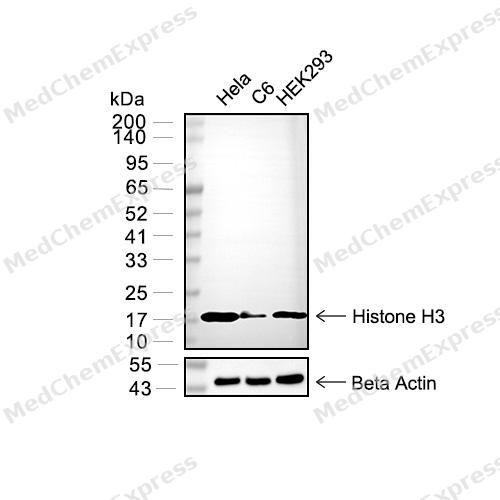 Western blot analysis of extracts from Hela (lane 2(20μg) , C6 (lane 3(20μg) , HEK293 (lane 4(20μg),using Histone H3 Antibody (HY-P80166). Proteins were transferred to a PVDF membrane and blocked with 5% BSA in TBST for 2 hour at room temperature. The primary antibody and Loading control antibody (Beta Actin, HY-P80438, 1/3000) was used in 5% BSA in TBST at 4°C overnight. Goat Anti-Mouse/Rabbit IgG-HRP Secondary Antibody (HY-P8004/HY-P8001, 1/10,000) was used for 1 hour at room temperature.
 -
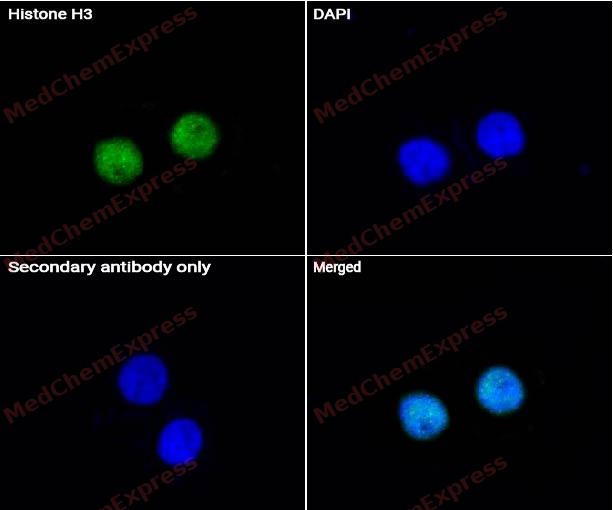 Immunocytochemistry analysis of Hela cells labeling Histone H3 Antibody (HY-P80166) at 1/50 dilution. Cells were fixed in 4% paraformaldehyde for 15 minutes at room temperature, permeabilized with 0.1% Triton X-100 for 10 minutes at room temperature, then blocked with QuickBlock™ Blocking Buffer for Immunol Staining for 10 min at room temperature. Cells were then incubated with Histone H3 Antibody (HY-P80166) at 1/50 dilution in QuickBlock™ Blocking Buffer for Immunol Staining at 4 ℃. Alexa Fluor® 488-conjugated AffiniPure Goat Anti-Rabbit IgG H&L(HY-P8002, Green) was used as the secondary antibody at 1/1,000 dilution. PBS instead of the primary antibody was used as the secondary antibody only control. The Nuclear counterstain was DAPI (Blue).
 -
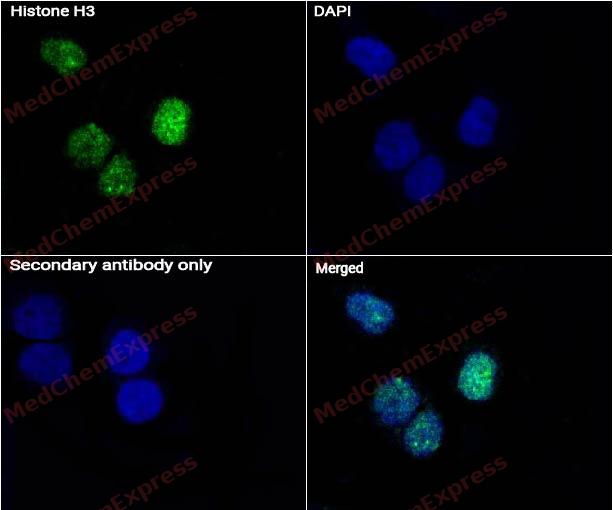 Immunocytochemistry analysis of Hela cells labeling Histone H3 Antibody (HY-P80166) at 1/200 dilution. Cells were fixed in 4% paraformaldehyde for 15 minutes at room temperature, permeabilized with 0.1% Triton X-100 for 10 minutes at room temperature, then blocked with QuickBlock™ Blocking Buffer for Immunol Staining for 10 min at room temperature. Cells were then incubated with Histone H3 Antibody (HY-P80166) at 1/200 dilution in QuickBlock™ Blocking Buffer for Immunol Staining at 4 ℃. Alexa Fluor® 488-conjugated AffiniPure Goat Anti-Rabbit IgG H&L(HY-P8002, Green) was used as the secondary antibody at 1/1,000 dilution. PBS instead of the primary antibody was used as the secondary antibody only control. The Nuclear counterstain was DAPI (Blue).
 -
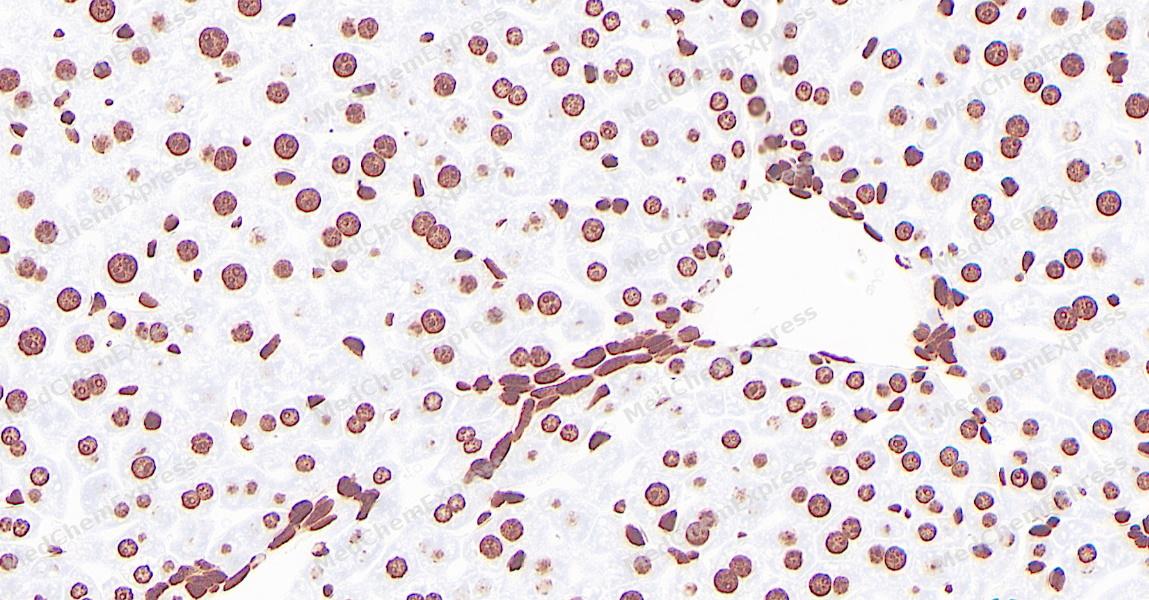 Immunohistochemical analysis of paraffin-embedded mouse liver tissue using Histone H3 Antibody. The section was pre-treated using heat mediated antigen retrieval with sodium citrate buffer (pH 6.0) for 8 minutes. The tissues were blocked in QuickBlock for 20 minutes at room temperature, washed with ddH2O and PBS, and then probed with the primary antibody (HY-P80166, 1:5000) in 4℃ overnight. The detection was performed using an HRP conjugated compact polymer system. DAB was used as the chromogen. Tissues were counterstained with hematoxylin and mounted with DPX.
 -
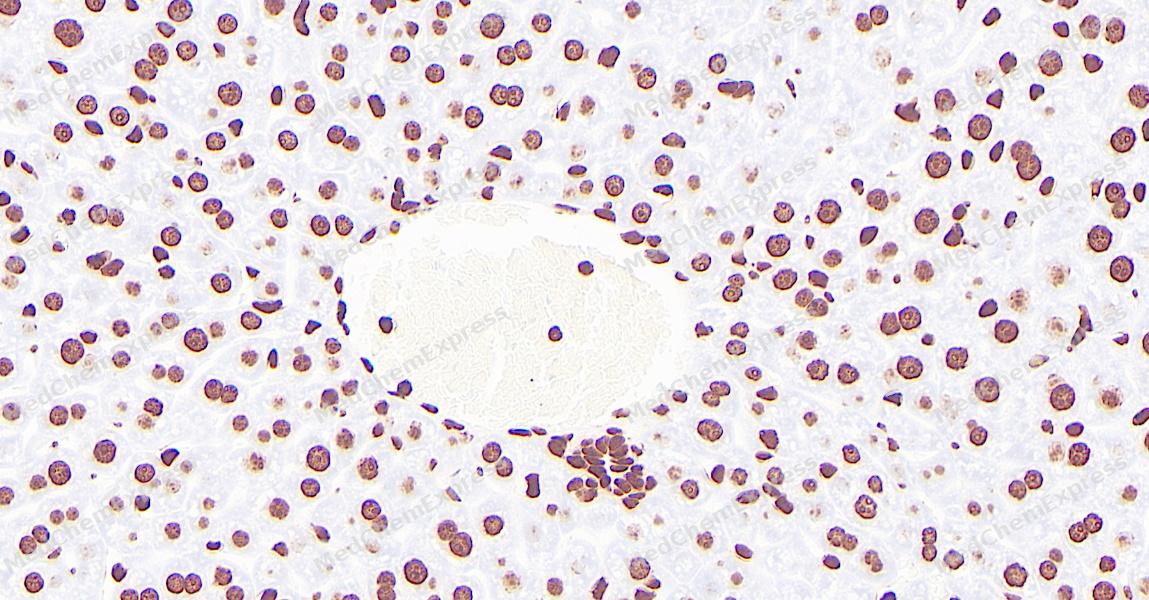 Immunohistochemical analysis of paraffin-embedded mouse liver tissue using Histone H3 Antibody. The section was pre-treated using heat mediated antigen retrieval with sodium citrate buffer (pH 6.0) for 8 minutes. The tissues were blocked in QuickBlock for 20 minutes at room temperature, washed with ddH2O and PBS, and then probed with the primary antibody (HY-P80166, 1:5000) in 4℃ overnight. The detection was performed using an HRP conjugated compact polymer system. DAB was used as the chromogen. Tissues were counterstained with hematoxylin and mounted with DPX.


Background
-
Function
Histone H3 is a P68431: Core component of nucleosome. Nucleosomes wrap and compact DNA into chromatin, limiting DNA accessibility to the cellular machineries which require DNA as a template. Histones thereby play a central role in transcription regulation, DNA repair, DNA replication and chromosomal stability. DNA accessibility is regulated via a complex set of post-translational modifications of histones, also called histone code, and nucleosome remodeling
P84243: Variant histone H3 which replaces conventional H3 in a wide range of nucleosomes in active genes. Constitutes the predominant form of histone H3 in non-dividing cells and is incorporated into chromatin independently of DNA synthesis. Deposited at sites of nucleosomal displacement throughout transcribed genes, suggesting that it represents an epigenetic imprint of transcriptionally active chromatin. Nucleosomes wrap and compact DNA into chromatin, limiting DNA accessibility to the cellular machineries which require DNA as a template. Histones thereby play a central role in transcription regulation, DNA repair, DNA replication and chromosomal stability. DNA accessibility is regulated via a complex set of post-translational modifications of histones, also called histone code, and nucleosome remodeling
Q16695: Core component of nucleosome. Nucleosomes wrap and compact DNA into chromatin, limiting DNA accessibility to the cellular machineries which require DNA as a template. Histones thereby play a central role in transcripQ6NXT2: Core component of nucleosome. Nucleosomes wrap and compact DNA into chromatin, limiting DNA accessibility to the cellular machineries which require DNA as a template. Histones thereby play a central role in transcription regulation, DNA repair, DNA replication and chromosomal stability. DNA accessibility is regulated via a complex set of post-translational modifications of histones, also called histone code, and nucleosome remodeling. Hominid-specific H3.5/H3F3C preferentially colocalizes with euchromatin, and it is associated with actively transcribed genes
tion regulation, DNA repair, DNA replication and chromosomal stability. DNA accessibility is regulated via a complex set of post-translational modifications of histones, also called histone code, and nucleosome remodeling
Q71DI3: Core component of nucleosome. Nucleosomes wrap and compact DNA into chromatin, limiting DNA accessibility to the cellular machineries which require DNA as a template. Histones thereby play a central role in transcription regulation, DNA repair, DNA replication and chromosomal stability. DNA accessibility is regulated via a complex set of post-translational modifications of histones, also called histone code, and nucleosome remodeling -
Subcellular Localization
P68431: Nucleus; Chromosome
P84243: Nucleus; Chromosome
Q16695: Nucleus; Chromosome
Q6NXT2: Nucleus; Chromosome
Q71DI3: Nucleus; Chromosome -
Expression
Tissue_specificity: Q16695: Expressed in testicular cells
Q6NXT2: Specifically expressed in the seminiferous tubules of testis -
Subunit
P68431: The nucleosome is a histone octamer containing two molecules each of H2A, H2B, H3 and H4 assembled in one H3-H4 heterotetramer and two H2A-H2B heterodimers. The octamer wraps approximately 147 bp of DNA.
P84243: The nucleosome is a histone octamer containing two molecules each of H2A, H2B, H3 and H4 assembled in one H3-H4 heterotetramer and two H2A-H2B heterodimers.
Q16695: The nucleosome is a histone octamer containing two molecules each of H2A, H2B, H3 and H4 assembled in one H3-H4 heterotetramer and two H2A-H2B heterodimers. The octamer wraps approximately 147 bp of DNA. Interacts with TONSL; CHAF1A and CHAF1B (PubMed:33857403)
Q6NXT2: The nucleosome is a histone octamer containing two molecules each of H2A, H2B, H3 and H4 assembled in one H3-H4 heterotetramer and two H2A-H2B heterodimers. The octamer wraps approximately 147 bp of DNA
Q71DI3: The nucleosome is a histone octamer containing two molecules each of H2A, H2B, H3 and H4 assembled in one H3-H4 heterotetramer and two H2A-H2B heterodimers. The octamer wraps approximately 147 bp of DNA. -
Research Field
Isotype/Loading Controls
Documentation
-
Data Sheet (236 KB)
-
SDS (254 KB)
- English - EN (254 KB)
- Français - FR (254 KB)
- Deutsch - DE (254 KB)
- Norwegian - NO (254 KB)
- Español - ES (254 KB)
- Swedish - SV (254 KB)
- Italian - IT (254 KB)
- Korean - KR (254 KB)
- Portuguese - PT (254 KB)
-
User Guide for Antibodies (1077 KB)

 Powered by Bioz
