



Integrin beta 1 Antibody (YA337)

Based on 1 Customer Validation
Integrin beta 1 Antibody (YA337) is a Rabbit-derived and non-conjugated IgG monoclonal antibody, targeting to Integrin beta 1.
-
Host:
Rabbit
-
Isotype:
IgG
-
Application:
WB, IHC-P
-
Reactivity :
Human, Mouse
-
Formulation:
Supplied in 1*TBS (pH7.4), 0.05% BSA and 40% Glycerol. Preservative: 0.05% Sodium Azide.
-
Conjugation:
Non-conjugated


To place orders, for customer services and technical support, please contact: MedChemExpress USA
Tel: 609-228-6898 E-mail: [email protected] [email protected]





Applications
| Application |
WB

WB: Western Blot
|
IHC-P
IHC-P: Immunohistochemistry-Paraffin
|
|---|---|---|
| Dilution Ratio | 1:1000 | 1:50 |


Product Details
Integrin beta 1 Antibody (YA337) is a Rabbit-derived and non-conjugated IgG monoclonal antibody, targeting to Integrin beta 1.
-
Host Rabbit

-
Clonality Recombinant,Monoclonal

-
Species ReactivityHuman, Mouse
-
Observed Molecular WeightObserved band size: 120-140 kDa
Note: Due to possible protein modifications or aggregation, the molecular weight should be confirmed by actual measurement, and the predicted value is for reference only.

-
Calculated Molecular Weight Predicted band size: 88 kDa;

Synthetic peptide corresponding to Human Integrin beta-1.AA range:652-701.
Endogenous
Protein A affinity purified.
Non-conjugated
Unmodified
IgG


Product Properties
-
Appearance
Liquid
-
Formulation
Supplied in 1*TBS (pH7.4), 0.05% BSA and 40% Glycerol. Preservative: 0.05% Sodium Azide.
-
Concentration
Batch-dependent, Please check the COA for the concentration of each lot. Check Lot Concentration
-
Storage & Stability
Stored at -20°C for 1 year. Avoid repeated freeze / thaw cycles.
-
Shipping
Shipping with blue ice.


Verification Images
-
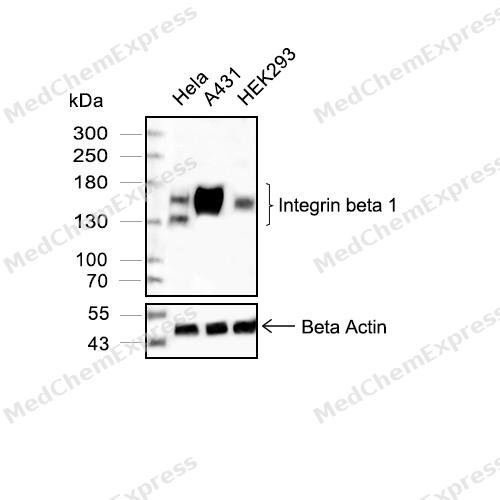 Western blot analysis of extracts from Hela(lane 2(20μg) , A431(lane 3(20μg) and HEK293(lane 4(20ug)using Integrin beta 1 (HY-P80418 Rabbit mAb. Proteins were transferred to a PVDF membrane and blocked with 5% non-fat milk in TBST for 2 hour at room temperature. The primary antibody (1/1000) and Loading control antibody (Beta Actin, HY-P80438, 1/10000) was used in 5% non-fat milk in TBST at 4°C overnight. Goat Anti-Mouse/Rabbit IgG-HRP Secondary Antibody (1/10000) was used for 1 hour at room temperature.


Background
-
Function
Integrin beta 1 is an Integrins alpha-1/beta-1, alpha-2/beta-1, alpha-10/beta-1 and alpha-11/beta-1 are receptors for collagen. Integrins alpha-1/beta-1 and alpha-2/beta-2 recognize the proline-hydroxylated sequence G-F-P-G-E-R in collagen. Integrins alpha-2/beta-1, alpha-3/beta-1, alpha-4/beta-1, alpha-5/beta-1, alpha-8/beta-1, alpha-10/beta-1, alpha-11/beta-1 and alpha-V/beta-1 are receptors for fibronectin. Alpha-4/beta-1 recognizes one or more domains within the alternatively spliced CS-1 and CS-5 regions of fibronectin. Integrin alpha-5/beta-1 is a receptor for fibrinogen. Integrin alpha-1/beta-1, alpha-2/beta-1, alpha-6/beta-1 and alpha-7/beta-1 are receptors for lamimin. Integrin alpha-6/beta-1 (ITGA6:ITGB1) is present in oocytes and is involved in sperm-egg fusion. Integrin alpha-4/beta-1 is a receptor for VCAM1. It recognizes the sequence Q-I-D-S in VCAM1. Integrin alpha-9/beta-1 is a receptor for VCAM1, cytotactin and osteopontin. It recognizes the sequence A-E-I-D-G-I-E-L in cytotactin. Integrin alpha-3/beta-1 is a receptor for epiligrin, thrombospondin and CSPG4. Alpha-3/beta-1 may mediate with LGALS3 the stimulation by CSPG4 of endothelial cells migration. Integrin alpha-V/beta-1 is a receptor for vitronectin. Beta-1 integrins recognize the sequence R-G-D in a wide array of ligands. When associated with alpha-7 integrin, regulates cell adhesion and laminin matrix deposition. Involved in promoting endothelial cell motility and angiogenesis. Involved in osteoblast compaction through the fibronectin fibrillogenesis cell-mediated matrix assembly process and the formation of mineralized bone nodules. May be involved in up-regulation of the activity of kinases such as PKC via binding to KRT1. Together with KRT1 and RACK1, serves as a platform for SRC activation or inactivation. Plays a mechanistic adhesive role during telophase, required for the successful completion of cytokinesis. Integrin alpha-3/beta-1 provides a docking site for FAP (seprase) at invadopodia plasma membranes in a collagen-dependent manner and hence may participate in the adhesion, formation of invadopodia and matrix degradation processes, promoting cell invasion. ITGA4:ITGB1 binds to fractalkine (CX3CL1) and may act as its coreceptor in CX3CR1-dependent fractalkine signaling. ITGA4:ITGB1 and ITGA5:ITGB1 bind to PLA2G2A via a site (site 2) which is distinct from the classical ligand-binding site (site 1) and this induces integrin conformational changes and enhanced ligand binding to site 1. ITGA5:ITGB1 acts as a receptor for fibrillin-1 (FBN1) and mediates R-G-D-dependent cell adhesion to FBN1. ITGA5:ITGB1 acts as a receptor for fibronectin FN1 and mediates R-G-D-dependent cell adhesion to FN1. ITGA5:ITGB1 is a receptor for IL1B and binding is essential for IL1B signaling. ITGA5:ITGB3 is a receptor for soluble CD40LG and is required for CD40/CD40LG signaling. Plays an important role in myoblast differentiation and fusion during skeletal myogenesis. ITGA9:ITGB1 may play a crucial role in SVEP1/polydom-mediated myoblast cell adhesion. Integrins ITGA9:ITGB1 and ITGA4:ITGB1 repress PRKCA-mediated L-type voltage-gated channel Ca(2+) influx and ROCK-mediated calcium sensitivity in vascular smooth muscle cells via their interaction with SVEP1, thereby inhibit vasocontraction; Interferes with isoform 1 resulting in a dominant negative effect on cell adhesion and migration (in vitro); Isoform 5 displaces isoform 1 in striated muscles; (Microbial infection) Integrin ITGA2:ITGB1 acts as a receptor for Human echoviruses 1 and 8; (Microbial infection) Acts as a receptor for Cytomegalovirus/HHV-5; (Microbial infection) Acts as a receptor for Epstein-Barr virus/HHV-4; (Microbial infection) Integrin ITGA5:ITGB1 acts as a receptor for Human parvovirus B19; (Microbial infection) Integrin ITGA2:ITGB1 acts as a receptor for Human rotavirus; (Microbial infection) Acts as a receptor for Mammalian reovirus; (Microbial infection) In case of HIV-1 infection, integrin ITGA5:ITGB1 binding to extracellular viral Tat protein seems to enhance angiogenesis in Kaposi's sarcoma lesions; (Microbial infection) Interacts with CotH proteins expressed by fungi of the order mucorales, the causative agent of mucormycosis, which plays an important role in epithelial cell invasion by the fungi. Integrin ITGA3:ITGB1 may act as a receptor for R.delemar CotH7 in alveolar epithelial cells, which may be an early step in pulmonary mucormycosis disease progression; (Microbial infection) May serve as a receptor for adhesin A (nadA) of N.meningitidis; (Microbial infection) Facilitates rabies infection in a fibronectin-dependent manner and participates in rabies virus traffic after internalization[1][2][3][4][5][6][7][8][9][10][11].
-
Subcellular Localization
Cell membrane; Single-pass type I membrane protein; Cell projection, invadopodium membrane; Single-pass type I membrane protein; Cell projection, ruffle membrane; Single-pass type I membrane protein; Recycling endosome; Melanosome; Cleavage furrow; Cell projection, lamellipodium; Cell junction, focal adhesion; Cell membrane, sarcolemma; Cell junction
-
Expression
Tissue_specificity:It is expressed in vascular smooth muscle cells (protein level) ; expressed in the placenta (protein level) (PubMed:33962943) . It is widely expressed, and other subtypes are often co-expressed, but with a narrower distribution (PubMed:1551917, PubMed:7545396, PubMed:7681433) ; expressed in skin, liver, skeletal muscle, myocardium, placenta, umbilical vein endothelial cells, neuroblastoma cells, lymphoma cells, hepatocellular carcinoma cells, and astrocytoma cells; co-expressed with subtype 4 in muscle, kidney, liver, placenta, cervical epithelium, umbilical vein endothelial cells, fibroblasts, embryonic kidney cells, platelets, and various blood cell lines. It is expressed on the surface of non-proliferative and differentiated prostate epithelial cells, platelets, erythroleukemia cells, and various hematopoietic cell lines; it is co-expressed with isoform 3 in muscle, kidney, liver, placenta, cervical epithelium, umbilical vein endothelial cells, fibroblasts, embryonic kidney cells, platelets, and various blood cell lines. Unlike isoform 3, it is selectively expressed on peripheral T cells; it is specifically expressed on striated muscle (skeletal muscle and cardiac muscle) .
Induction:Induced in alveolar epithelial cells during exposure to the fungus R.delemar, a causative agent of mucormycosis -
Subunit
Heterodimer of an alpha and a beta subunit (PubMed:33962943). Beta-1 associates with either alpha-1, alpha-2, alpha-3, alpha-4, alpha-5, alpha-6, alpha-7, alpha-8, alpha-9, alpha-10, alpha-11 or alpha-V. ITGA6:ITGB1 is found in a complex with CD9; interaction takes place in oocytes and is involved in sperm-egg fusion (By similarity). Interacts with seprase FAP (seprase); the interaction occurs at the cell surface of invadopodia membrane in a collagen-dependent manner. Binds LGALS3BP and NMRK2, when associated with alpha-7, but not with alpha-5. Interacts with FGR and HCK. Interacts (via the cytoplasmic region) with RAB25 (via the hypervariable C-terminal region). Interacts with RAB21. Interacts with KRT1 in the presence of RACK1 and SRC. Interacts with JAML; integrin alpha-4/beta-1 may regulate leukocyte to endothelial cells adhesion by controlling JAML homodimerization. Interacts with FLNB and RANBP9. Interacts with MYO10. Interacts with DAB2. Interacts with FERMT2; the interaction is inhibited in presence of ITGB1BP1. Interacts with ITGB1BP1 (via C-terminal region); the interaction is a prerequisite for focal adhesion disassembly. Interacts with TLN1; the interaction is prevented by competitive binding of ITGB1BP1. Interacts with ACAP1; required for ITGB1 recycling. Interacts with ASAP3. Interacts with EMP2; the interaction may be direct or indirect and ITGB1 has a heterodimer form (By similarity). ITGA5:ITGB1 interacts with CCN3. ITGA4:ITGB1 is found in a ternary complex with CX3CR1 and CX3CL1 (PubMed:23125415). ITGA5:ITGB1 interacts with FBN1 (PubMed:12807887, PubMed:17158881). ITGA5:ITGB1 interacts with IL1B (PubMed:29030430). ITGA4:ITGB1 interacts with MDK; this interaction mediates MDK-induced osteoblast cells migration through PXN phosphorylation (PubMed:15466886). ITGA6:ITGB1 interacts with MDK; this interaction mediates MDK-induced neurite-outgrowth (PubMed:15466886). ITGA5:ITGB1 interacts with ACE2 (PubMed:33102950). Interacts with TMEM182 and LAMB1 (By similarity). Interacts with tensin TNS3; TNS3 also interacts with PEAK1, thus acting as an adapter molecule to bridge the association of PEAK1 with ITGB1 (PubMed:35687021). Interacts with tensin TNS4; the interaction displaces tensin TNS3 from the ITGB1 cytoplasmic tail and promotes ITGB1 stability (PubMed:17643115, PubMed:24814316). Integrin ITGA9:ITGB1 interacts with SPP1/OPN (via N-terminus) (By similarity). Integrin ITGA9:ITGB1 interacts with TNC/TNFN3 (via the 3rd Fibronectin type-III domain) (PubMed:22654117). Integrins ITGA4:ITGB1 and ITGA9:ITGB1 interact with SVEP1 (via Sushi domain 21); thereby inhibit Ca(2+) intracellular signaling and as a result repress vasocontraction (PubMed:35802072). ITGA4:ITGB1 and ITGA5:ITGB1 interacts with SELP (PubMed:37184585). Interacts with CD248 (By similarity). ITGA5:ITGB1 interacts with IGFBP1 (PubMed:7504269). ITGA4:ITGB1 interacts with BCAM (PubMed:17158232). Interacts with ADGRG6 (By similarity)
-
SwissProt ID
-
Research Field
Neuroscience


Documentation
-
Data Sheet (235 KB)
-
SDS (313 KB)
- English - EN (313 KB)
- Français - FR (313 KB)
- Deutsch - DE (313 KB)
- Norwegian - NO (313 KB)
- Español - ES (313 KB)
- Swedish - SV (313 KB)
- Italian - IT (313 KB)
- Korean - KR (313 KB)
- Portuguese - PT (313 KB)
-
User Guide for Antibodies (1077 KB)

 Powered by Bioz
