



JAK2 Antibody (YA330)
(Synonyms: JAK2; Tyrosine-protein kinase JAK2; Janus kinase 2; JAK-2)Based on 4 publication(s) in Google Scholar
JAK2 Antibody (YA330) is a Rabbit-derived and non-conjugated IgG monoclonal antibody, targeting to JAK2.
-
Host:
Rabbit
-
Isotype:
IgG
-
Application:
WB
-
Reactivity :
Human, Mouse
-
Formulation:
Supplied in 50 mM Tris-Glycine (pH 7.4), 0.15 M NaCl, 40% Glycerol and 0.05% BSA. Preservative: 0.01% Sodium azide
-
Conjugation:
Non-conjugated


To place orders, for customer services and technical support, please contact: MedChemExpress USA
Tel: 609-228-6898 E-mail: [email protected] [email protected]



-

HY-P80344
STAT3 Antibody (YA056) -
HY-P80467
Phospho-JAK2 (Tyr1007+Tyr1008) Antibody (YA181) -
HY-P80281
Phospho-STAT3 (Ser727) Antibody (YA147) -
HY-13818
StatticSTAT3 Inhibitor -
HY-P80857
Phospho-STAT3 (Tyr705) Antibody -
HY-P8001
HRP-conjugated Goat Anti-Rabbit IgG H&L -
HY-P80137
GAPDH Antibody (YA418) -
HY-P80765
NF-KB p65 Antibody (YA268) -
HY-P80829A
Phospho-JAK2 (Tyr1007/1008) Antibody (YA6449) -
HY-P80839
Phospho-NF-KB p65 (Ser536) Antibody -
HY-P80282
Phospho-STAT3 (Tyr705) Antibody (YA146)
Publications Citing Use of MedChemExpress (MCE) JAK2 Antibody (YA330)
More

Applications
| Application |
WB

WB: Western Blot
|
|---|---|
| Dilution Ratio | 1:500-1:1000 |


Product Details
JAK2 Antibody (YA330) is a Rabbit-derived and non-conjugated IgG monoclonal antibody, targeting to JAK2.
-
Host Rabbit

-
Clonality Recombinant,Monoclonal

-
Species ReactivityHuman, Mouse
-
Observed Molecular WeightObserved band size: 131 kDa
Note: Due to possible protein modifications or aggregation, the molecular weight should be confirmed by actual measurement, and the predicted value is for reference only.

-
Calculated Molecular Weight Predicted band size: 131 kDa

Entrez Gene: 3717 Human ; 16452 Mouse ; 24514 Rat
SwissProt: O60674 Human ; Q62120 Mouse ; Q62689 Rat
OMIM: 600880 Human
Synthetic peptide corresponding to Human JAK2.The exact sequence is proprietary to MCE.
Endogenous
affinity purified
Non-conjugated
Unmodified
IgG


Product Properties
-
Appearance
Solution
-
Formulation
Supplied in 50 mM Tris-Glycine (pH 7.4), 0.15 M NaCl, 40% Glycerol and 0.05% BSA. Preservative: 0.01% Sodium azide
-
Concentration
Batch-dependent, Please check the COA for the concentration of each lot. Check Lot Concentration
-
Storage & Stability
Stored at -20°C for 1 year. Avoid repeated freeze / thaw cycles.
-
Shipping
Shipping with blue ice.


Publications (4)
-
Journal Impact Factor
-
Most Recent
-
Phytother Res
Resveratrol Alleviates Inflammation in Polycystic Ovary Syndrome by Inhibiting Absent in Melanoma 2 Expression. [Abstract]2026 May 12. PMID: 42118129 -
Biochem Pharmacol
IFN-γ-induced AIM2-PANoptosis in granulosa cells leads to ovulatory dysfunction in polycystic ovary syndrome. [Abstract]2026 May 12;250(Pt 2):118039. PMID: 42114679 -
Neuroscience
Olfactomedin 1 acts as a tumor suppressor in glioblastoma: integrated analysis and mechanistic prediction. [Abstract]2026 May 14:602:31-45. PMID: 41831591


Verification Images
-
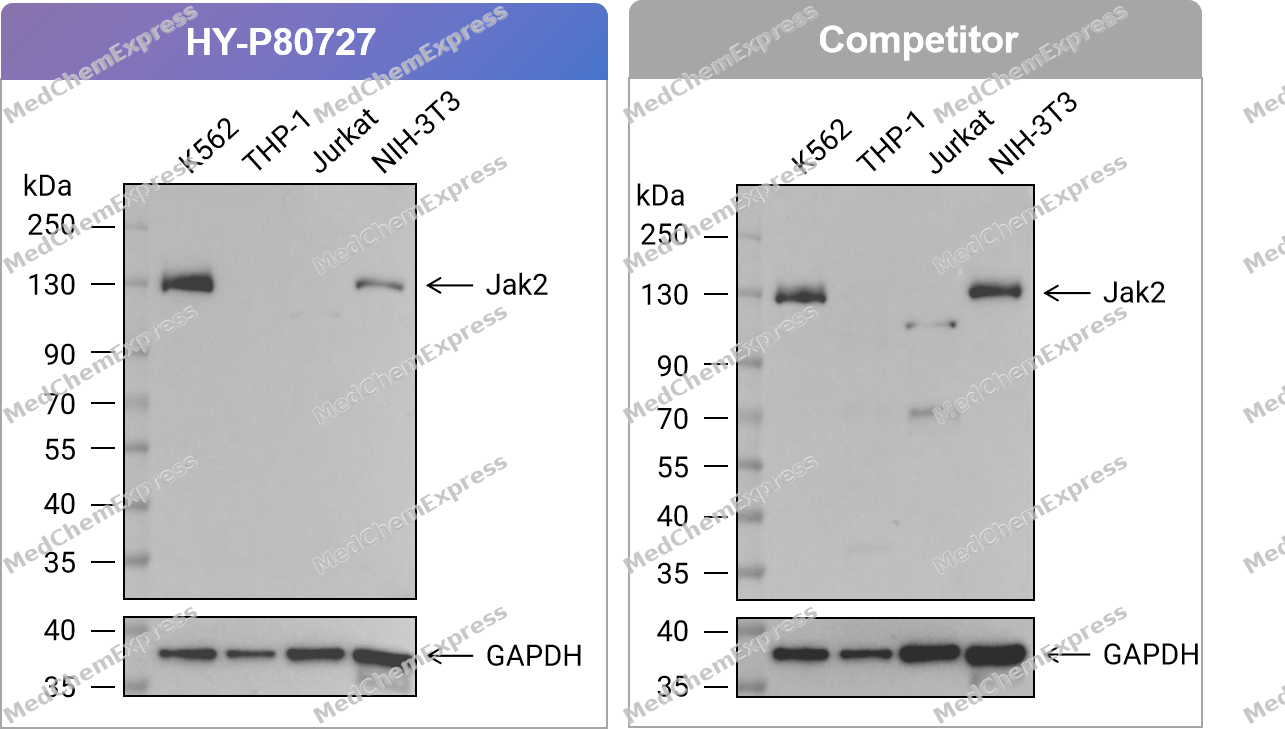 Western blot analysis of extracts from K562 (lane 1(20μg)) 、THP-1 (lane 2(20μg)) 、Jurkat (lane 3(20μg)) and NIH-3T3 (lane 4(20μg)) using Jak2 Antibody . Proteins were transferred to a PVDF membrane and blocked with 5% nonfat dry milk in TBST for 1.5 hour at room temperature. The primary antibody (HY-P80727, 1/1000) , competitor's antibody (1/1000) and Loading control antibody (GAPDH, 1/10000) was used in 5% nonfat dry milk in TBST at 4℃ overnight. Goat Anti-Rabbit IgG-HRP Secondary Antibody (1/10,000) was used for 1 hour at room temperature.
 -
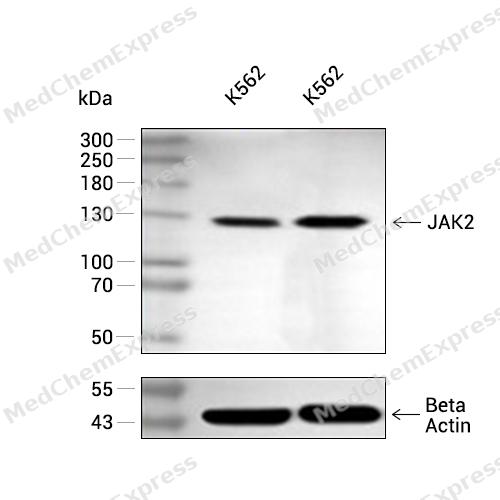 Western blot analysis of extracts from K562 (lane 2(20μg) and K562(lane 3(40μg) using JAK2 (HY-P80727) Rabbit mAb. Proteins were transferred to a PVDF membrane and blocked with 5% non-fat milk in TBST for 2 hour at room temperature. The primary antibody (1/1000) and Loading control antibody (Beta Actin, HY-P80438, 1/10000) was used in 5% non-fat milk in TBST at 4°C overnight. Goat Anti-Mouse/Rabbit IgG-HRP Secondary Antibody (1/10000) was used for 1 hour at room temperature.
 -
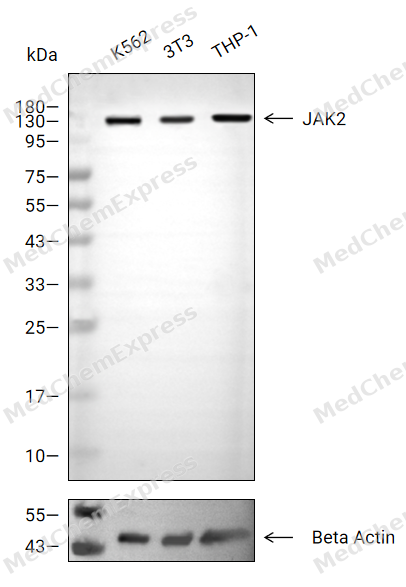 Western blot analysis of extracts from K562 (lane 2(20μg), 3T3 (lane 3(20μg), THP-1 (lane 4(20μg),using JAK2 Antibody. Proteins were transferred to a PVDF membrane and blocked with 5% BSA in TBST for 2 hour at room temperature. The primary antibody and Loading control antibody (Beta Actin, HY-P80438, 1/3000) was used in 5% BSA in TBST at 4°C overnight. Goat Anti-Mouse/Rabbit IgG-HRP Secondary Antibody (HY-P8004/HY-P8001, 1/10,000) was used for 1 hour at room temperature.
 -
 Western blot analysis of extracts from K562 (lane 1(20μg)) 、THP-1 (lane 2(20μg)) 、Jurkat (lane 3(20μg)) and NIH-3T3 (lane 4(20μg)) using Jak2 Antibody (HY-P80727) . Proteins were transferred to a PVDF membrane and blocked with 5% nonfat dry milk in TBST for 1.5 hour at room temperature. The primary antibody (1/1000) and Loading control antibody (GAPDH, 1/10000) was used in 5% nonfat dry milk in TBST at 4℃ overnight. Goat Anti-Rabbit IgG-HRP Secondary Antibody (1/10,000) was used for 1 hour at room temperature.


Background
-
Function
JAK2 is a non-receptor tyrosine kinase in the JAK1-JAK2-JAK3-TYK2 family and acts as a cytoplasmic signaling component of cytokine receptors[1]. Mechanistically, cytokine-mediated activation of JAK2 promotes receptor phosphorylation, recruits STAT proteins, and drives STAT phosphorylation-dependent transcriptional signaling[1][2]. This pathway supports cell growth, survival, development, differentiation, hematopoiesis, immune regulation, and homeostasis[2][3]. In disease models, gain-of-function JAK2 V617F in the pseudokinase domain causes constitutive activity and is strongly linked to myeloproliferative neoplasms and leukemias[1][4]. Compared with related isoforms, JAK3 is essential for common γ-chain cytokine receptor signaling in T- and B-cell development, whereas complete mouse deletion of JAK1 or JAK2 is not compatible with life[5][6]. For experimental applications, ruxolitinib is a selective oral JAK1/JAK2 inhibitor, and JAK2-focused compounds support studies of mutant signaling, cytokine responses, splenomegaly, angiogenesis, and inhibitor resistance[7][8][9].
-
Subcellular Localization
Endomembrane system; Peripheral membrane protein; Cytoplasm; Nucleus
-
Expression
Tissue_specificity:Commonly expressed in most organizations -
Subunit
Interacts with EPOR, LYN, SIRPA, SH2B1 and TEC (By similarity). Interacts with IL23R (PubMed:12023369). Interacts with SKB1 (PubMed:10531356). Interacts with STAM2 (PubMed:10899310). Interacts with IFNGR2 (via intracellular domain) (PubMed:7615558, PubMed:7673114). Interacts with LEPR (Isoform B) (By similarity). Interacts with HSP90AB1; promotes functional activation in a heat shock-dependent manner (PubMed:20353823). Interacts with STRA6 (PubMed:21368206). Interacts with RHEX; this interaction occurs in a erythropoietin (EPO)-dependent manner (PubMed:25092874). Interacts with ASB2; the interaction targets JAK2 for Notch-induced proteasomal degradation (PubMed:21119685). Interacts with MPL/TPOR (PubMed:15899890)
-
SwissProt ID
-
Synonyms
JAK2; Tyrosine-protein kinase JAK2; Janus kinase 2; JAK-2
-
Research Field
Cell Biology
Documentation
-
Data Sheet (263 KB)
-
SDS (251 KB)
- English - EN (251 KB)
- Français - FR (251 KB)
- Deutsch - DE (251 KB)
- Norwegian - NO (251 KB)
- Español - ES (251 KB)
- Swedish - SV (251 KB)
- Italian - IT (251 KB)
- Korean - KR (251 KB)
- Portuguese - PT (251 KB)
-
User Guide for Antibodies (1077 KB)
References
[1]. Hubbard SR. Mechanistic Insights into Regulation of JAK2 Tyrosine Kinase. Front Endocrinol (Lausanne). 2018 Jan 5;8:361. doi: 10.3389/fendo.2017.00361. PMID: 29379470; PMCID: PMC5770812. et al. Mechanistic Insights into Regulation of JAK2 Tyrosine Kinase. Front Endocrinol (Lausanne). 2018 Jan 5;8:361. [Content Brief]
[2]. Ihle JN, et al. Jaks and Stats in signaling by the cytokine receptor superfamily. Trends Genet. 1995 Feb;11(2):69-74. [Content Brief]
[3]. Rawlings JS, et al. The JAK/STAT signaling pathway. J Cell Sci. 2004 Mar 15;117(Pt 8):1281-3. [Content Brief]
[4]. Gäbler K, et al. JAK2 mutants (e.g., JAK2V617F) and their importance as drug targets in myeloproliferative neoplasms. JAKSTAT. 2013 Jul 1;2(3):e25025. [Content Brief]
[5]. Suzuki K, et al. Janus kinase 3 (Jak3) is essential for common cytokine receptor gamma chain (gamma(c))-dependent signaling: comparative analysis of gamma(c), Jak3, and gamma(c) and Jak3 double-deficient mice. Int Immunol. 2000 Feb;12(2):123-32. [Content Brief]
[6]. Ghoreschi K, et al. Janus kinases in immune cell signaling. Immunol Rev. 2009 Mar;228(1):273-87. [Content Brief]
[7]. Naqvi K, et al. A potential role of ruxolitinib in leukemia. Expert Opin Investig Drugs. 2011 Aug;20(8):1159-66. [Content Brief]
[8]. Hart S, et al. SB1518, a novel macrocyclic pyrimidine-based JAK2 inhibitor for the treatment of myeloid and lymphoid malignancies. Leukemia. 2011 Nov;25(11):1751-9. [Content Brief]
[9]. Cheng Z, et al. Angiogenesis in JAK2 V617F positive myeloproliferative neoplasms and ruxolitinib decrease VEGF, HIF-1 enesis in JAK2 V617F positive cells. Leuk Lymphoma. 2018 Jan;59(1):196-203. [Content Brief]

 Powered by Bioz
