



Keap1 Antibody (YA324)
(Synonyms: INrf2; KLHL19)Based on 4 publication(s) in Google Scholar
Keap1 Antibody (YA324) is a Rabbit-derived and non-conjugated IgG monoclonal antibody, targeting to Keap1.
-
Host:
Rabbit
-
Isotype:
IgG
-
Application:
WB, IHC-P
-
Reactivity :
Human, Mouse
-
Formulation:
Supplied in 50 mM Tris-Glycine (pH 7.4), 0.15 M NaCl, 40% Glycerol and 0.05% BSA. Preservative: 0.01% Sodium azide
-
Conjugation:
Non-conjugated


To place orders, for customer services and technical support, please contact: MedChemExpress USA
Tel: 609-228-6898 E-mail: [email protected] [email protected]



Publications Citing Use of MedChemExpress (MCE) Keap1 Antibody (YA324)
More

Applications
| Application |
WB

WB: Western Blot
|
IHC-P
IHC-P: Immunohistochemistry-Paraffin
|
|---|---|---|
| Dilution Ratio | 1:500-1:1000 | 1:50-1:100 |


Product Details
Keap1 Antibody (YA324) is a Rabbit-derived and non-conjugated IgG monoclonal antibody, targeting to Keap1.
-
Host Rabbit

-
Clonality Recombinant,Monoclonal

-
Species ReactivityHuman, Mouse
-
Observed Molecular WeightObserved band size: 60-64 kDa
Note: Due to possible protein modifications or aggregation, the molecular weight should be confirmed by actual measurement, and the predicted value is for reference only.

-
Calculated Molecular Weight Predicted band size: 70 kDa

Synthetic peptide corresponding to Human Keap1 aa321-609.
Endogenous
affinity purified
Non-conjugated
Unmodified
IgG


Product Properties
-
Appearance
Solution
-
Formulation
Supplied in 50 mM Tris-Glycine (pH 7.4), 0.15 M NaCl, 40% Glycerol and 0.05% BSA. Preservative: 0.01% Sodium azide
-
Concentration
Batch-dependent, Please check the COA for the concentration of each lot. Check Lot Concentration
-
Storage & Stability
Stored at -20°C for 1 year. Avoid repeated freeze / thaw cycles.
-
Shipping
Shipping with blue ice.


Publications (4)
-
Journal Impact Factor
-
Most Recent
-
Mol Med
Lycorine ameliorates liver steatosis, oxidative stress, ferroptosis and intestinal homeostasis imbalance in MASLD mice. [Abstract]2024 Nov 27;30(1):235. PMID: 39604837 -
Cytotechnology
Dietary Zinc activates the Nrf2 signaling pathway to inhibit pyroptosis and attenuate the lung inflammatory response in COPD. [Abstract]2025 Apr;77(2):62. PMID: 39980839 -
Biomed Pharmacother
Cyanidin-3-glucoside confers neuroprotection in ischemic stroke by targeting NOX4-mediated oxidative stress: A network pharmacology and experimental validation study. [Abstract]2026 Feb:195:119072. PMID: 41616469


Verification Images
-
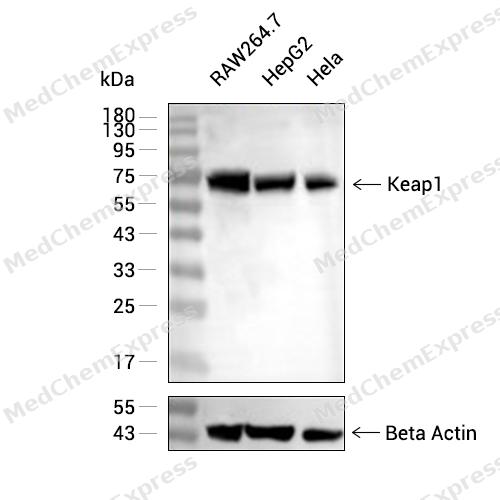 Western blot analysis of extracts from RAW264.7 (lane 2(20μg), HepG2 (lane 3(20μg) and Hela (lane 4(20μg) using Keap1 (HY-P80732) Rabbit mAb. Proteins were transferred to a PVDF membrane and blocked with 5% non-fat milk in TBST for 2 hour at room temperature. The primary antibody (1/1000) and Loading control antibody (Beta Actin, HY-P80438, 1/10000) was used in 5% non-fat milk in TBST at 4°C overnight. Goat Anti-Mouse/Rabbit IgG-HRP Secondary Antibody (1/10000) was used for 1 hour at room temperature.
 -
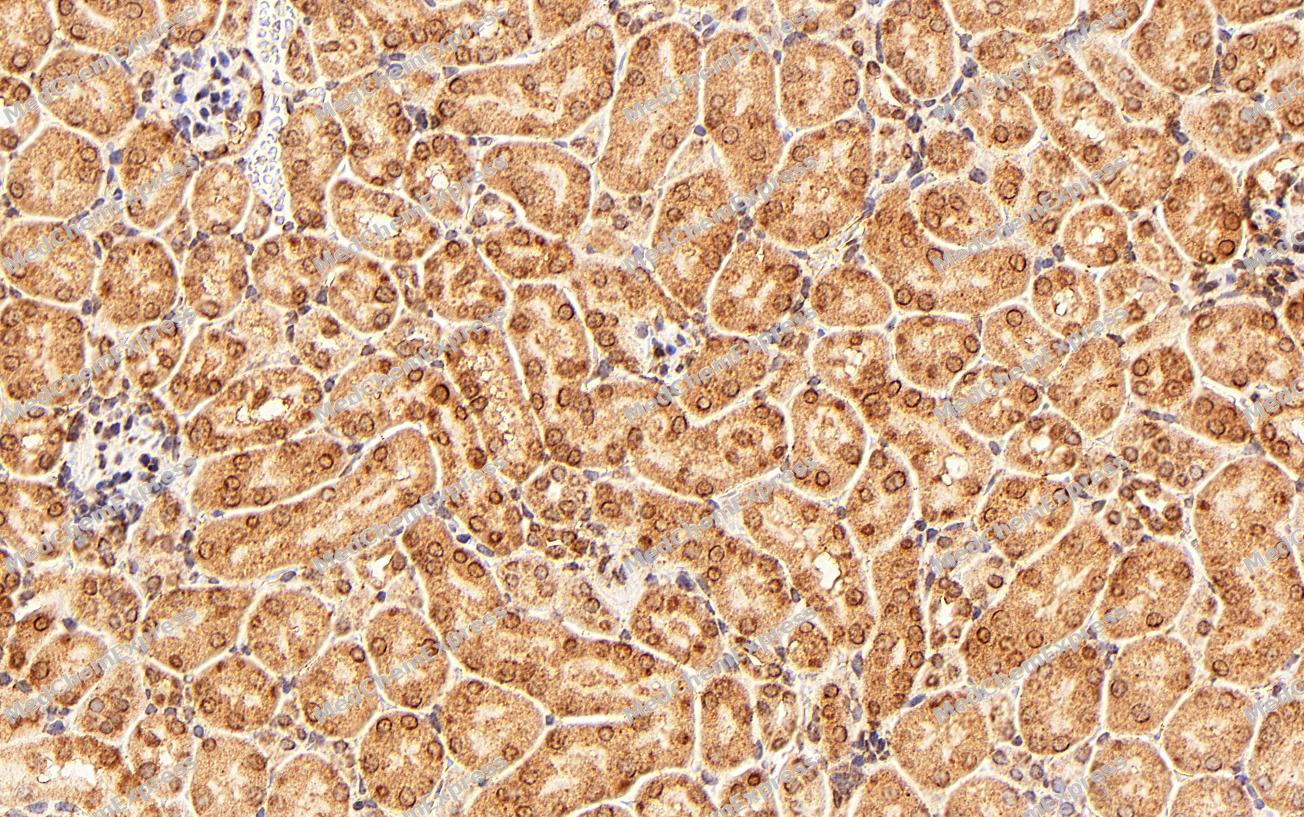 Immunohistochemical analysis of paraffin-embedded Mouse kidney tissue using Keap1 Antibody. The section was pre-treated using heat mediated antigen retrieval with sodium citrate buffer (pH 6.0) for 2 minutes. The tissues were blocked in QuickBlock for 20 minutes at room temperature, washed with ddH2O and PBS, and then probed with the primary antibody (HY-P80732, 1/100) in 4℃ overnight. The detection was performed using an HRP conjugated compact polymer system. DAB was used as the chromogen. Tissues were counterstained with hematoxylin and mounted with DPX.
 -
Immunohistochemical analysis of paraffin-embedded Mouse kidney tissue using Keap1 Antibody. The section was pre-treated using heat mediated antigen retrieval with sodium citrate buffer (pH 6.0) for 2 minutes. The tissues were blocked in QuickBlock for 20 minutes at room temperature, washed with ddH2O and PBS, and then probed with the primary antibody (HY-P80732, 1/100) in 4℃ overnight. The detection was performed using an HRP conjugated compact polymer system. DAB was used as the chromogen. Tissues were counterstained with hematoxylin and mounted with DPX.


Background
-
Function
Keap1 is a Substrate-specific adapter of a BCR (BTB-CUL3-RBX1) E3 ubiquitin ligase complex that regulates the response to oxidative stress by targeting NFE2L2/NRF2 for ubiquitination. KEAP1 acts as a key sensor of oxidative and electrophilic stress: in normal conditions, the BCR(KEAP1) complex mediates ubiquitination and degradation of NFE2L2/NRF2, a transcription factor regulating expression of many cytoprotective genes. In response to oxidative stress, different electrophile metabolites trigger non-enzymatic covalent modifications of highly reactive cysteine residues in KEAP1, leading to inactivate the ubiquitin ligase activity of the BCR(KEAP1) complex, promoting NFE2L2/NRF2 nuclear accumulation and expression of phase II detoxifying enzymes. In response to selective autophagy, KEAP1 is sequestered in inclusion bodies following its interaction with SQSTM1/p62, leading to inactivation of the BCR(KEAP1) complex and activation of NFE2L2/NRF2. The BCR(KEAP1) complex also mediates ubiquitination of SQSTM1/p62, increasing SQSTM1/p62 sequestering activity and degradation. The BCR(KEAP1) complex also targets BPTF and PGAM5 for ubiquitination and degradation by the proteasome[1][2][3][4][5][6][7][8][9][10][11][12][13][14].
-
Subcellular Localization
Cytoplasm; Nucleus
-
Expression
Tissue_specificity:It is widely expressed, with the highest concentration in skeletal muscle. -
Subunit
Component of the BCR(KEAP1) E3 ubiquitin ligase complex, at least composed of 2 molecules of CUL3, 2 molecules of KEAP1, and RBX1 (PubMed:15572695, PubMed:15601839, PubMed:15983046, PubMed:17127771, PubMed:18251510, PubMed:24896564). Interacts with NFE2L2/NRF2; the interaction is direct (PubMed:15379550, PubMed:15601839, PubMed:16006525, PubMed:16888629, PubMed:18387606). Forms a ternary complex with NFE2L2/NRF2 and PGAM5 (PubMed:17046835). Interacts with (phosphorylated) SQSTM1/p62; the interaction is direct and inactivates the BCR(KEAP1) complex by sequestering it in inclusion bodies, promoting its degradation (PubMed:20452972, PubMed:20495340). Interacts with NFE2L1 (PubMed:16687406). Interacts with BPTF and PTMA (PubMed:15657435). Interacts with MAP1LC3B (PubMed:24089205). Interacts indirectly with ENC1 (PubMed:19424503). Interacts with SESN1 and SESN2 (PubMed:23274085). Interacts with HSP90AA1 and HSP90AB1 (PubMed:26517842). Interacts with PGCKA1; this interaction prevents the ubiquitination of KEAP1 by TRIM25, thus protecting KEAP1 from degradation (PubMed:36882524)
-
SwissProt ID
-
Synonyms
INrf2; KLHL19
-
Research Field
Epigenetics and Nuclear Signaling
Documentation
-
Data Sheet (263 KB)
-
SDS (251 KB)
- English - EN (251 KB)
- Français - FR (251 KB)
- Deutsch - DE (251 KB)
- Norwegian - NO (251 KB)
- Español - ES (251 KB)
- Swedish - SV (251 KB)
- Italian - IT (251 KB)
- Korean - KR (251 KB)
- Portuguese - PT (251 KB)
-
User Guide for Antibodies (1077 KB)
References
[1]. Zhang DD, et al. Distinct cysteine residues in Keap1 are required for Keap1-dependent ubiquitination of Nrf2 and for stabilization of Nrf2 by chemopreventive agents and oxidative stress. Mol Cell Biol. 2003 Nov;23(22):8137-51. [Content Brief]
[2]. Strachan GD, et al. Fetal Alz-50 clone 1 interacts with the human orthologue of the Kelch-like Ech-associated protein. Biochemistry. 2004 Sep 28;43(38):12113-22. [Content Brief]
[3]. Zhang DD, et al. Keap1 is a redox-regulated substrate adaptor protein for a Cul3-dependent ubiquitin ligase complex. Mol Cell Biol. 2004 Dec;24(24):10941-53. [Content Brief]
[4]. Furukawa M, et al. BTB protein Keap1 targets antioxidant transcription factor Nrf2 for ubiquitination by the Cullin 3-Roc1 ligase. Mol Cell Biol. 2005 Jan;25(1):162-71. [Content Brief]
[5]. Zhang DD, et al. Ubiquitination of Keap1, a BTB-Kelch substrate adaptor protein for Cul3, targets Keap1 for degradation by a proteasome-independent pathway. J Biol Chem. 2005 Aug 26;280(34):30091-9. [Content Brief]
[6]. Cai C, et al. USP25 regulates KEAP1-NRF2 anti-oxidation axis and its inactivation protects acetaminophen-induced liver injury in male mice. Nat Commun. 2023 Jun 20;14(1):3648. [Content Brief]
[7]. Eggler AL, et al. Modifying specific cysteines of the electrophile-sensing human Keap1 protein is insufficient to disrupt binding to the Nrf2 domain Neh2. Proc Natl Acad Sci U S A. 2005 Jul 19;102(29):10070-5. [Content Brief]
[8]. Gao L, et al. Novel n-3 fatty acid oxidation products activate Nrf2 by destabilizing the association between Keap1 and Cullin3. J Biol Chem. 2007 Jan 26;282(4):2529-37. [Content Brief]
[9]. Rachakonda G, et al. Covalent modification at Cys151 dissociates the electrophile sensor Keap1 from the ubiquitin ligase CUL3. Chem Res Toxicol. 2008 Mar;21(3):705-10. [Content Brief]
[10]. Eggler AL, et al. Cul3-mediated Nrf2 ubiquitination and antioxidant response element (ARE) activation are dependent on the partial molar volume at position 151 of Keap1. Biochem J. 2009 Jul 29;422(1):171-80. [Content Brief]
[11]. Mills EL, et al. Itaconate is an anti-inflammatory metabolite that activates Nrf2 via alkylation of KEAP1. Nature. 2018 Apr 5;556(7699):113-117. [Content Brief]
[12]. Jain A, et al. p62/SQSTM1 is a target gene for transcription factor NRF2 and creates a positive feedback loop by inducing antioxidant response element-driven gene transcription. J Biol Chem. 2010 Jul 16;285(29):22576-91. [Content Brief]
[13]. Lee Y, et al. Keap1/Cullin3 Modulates p62/SQSTM1 Activity via UBA Domain Ubiquitination. Cell Rep. 2017 Apr 4;19(1):188-202. [Content Brief]
[14]. Lo SC, et al. PGAM5, a Bcl-XL-interacting protein, is a novel substrate for the redox-regulated Keap1-dependent ubiquitin ligase complex. J Biol Chem. 2006 Dec 8;281(49):37893-903. [Content Brief]

 Powered by Bioz
