



LGI1 Antibody (YA2885)
(Synonyms: ADLTE; ADPAEF; ADPEAF; Epitempin 1; EPITEMPIN; EPT; ETL1; LGI1)
Based on 1 Customer Validation
LGI1 Antibody (YA2885) is a Rabbit-derived and non-conjugated IgG monoclonal antibody, targeting to LGI1.
-
Host:
Rabbit
-
Isotype:
IgG
-
Application:
WB, IHC-P, IP
-
Reactivity :
Human, Mouse, Rat
-
Formulation:
Supplied in 50mM Tris-Glycine(pH 7.4), 0.15M NaCl, 40%Glycerol, 0.01% sodium azide and 0.05% BSA.
-
Conjugation:
Non-conjugated


To place orders, for customer services and technical support, please contact: MedChemExpress USA
Tel: 609-228-6898 E-mail: [email protected] [email protected]





Applications
| Application |
WB

WB: Western Blot
|
IHC-P
IHC-P: Immunohistochemistry-Paraffin
|
IP
IP: Immunoprecipitation
|
|---|---|---|---|
| Dilution Ratio | 1:500-1:1000 | 1:50-1:100 | 1:50 |


Product Details
LGI1 Antibody (YA2885) is a Rabbit-derived and non-conjugated IgG monoclonal antibody, targeting to LGI1.
-
Host Rabbit

-
Clonality Recombinant, Monoclonal

-
Species ReactivityHuman, Mouse, Rat
-
Observed Molecular WeightObserved band size: 64 kDa
Note: Due to possible protein modifications or aggregation, the molecular weight should be confirmed by actual measurement, and the predicted value is for reference only.

-
Calculated Molecular Weight Predicted band size: 64 kDa

Entrez Gene: 9211 Human ; 56839 Mouse ; 252892 Rat
SwissProt: O95970 Human ; Q9JIA1 Mouse ; Q8K4Y5 Rat
OMIM: 600512 Human
A synthesized peptide derived from human Lgi1 aa150-250.
Endogenous
Affinity Purified
Non-conjugated
Unmodified
IgG


Product Properties
-
Appearance
Liquid
-
Formulation
Supplied in 50mM Tris-Glycine(pH 7.4), 0.15M NaCl, 40%Glycerol, 0.01% sodium azide and 0.05% BSA.
-
Concentration
Batch-dependent, Please check the COA for the concentration of each lot. Check Lot Concentration
-
Storage & Stability
Stored at -20°C for 1 year. Avoid repeated freeze / thaw cycles.
-
Shipping
Shipping with blue ice.


Verification Images
-
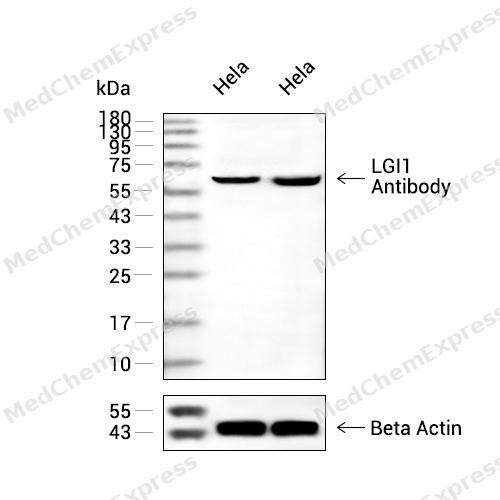 Western blot analysis of extracts from Hela(lane 2(20ug) and Hela(lane 3(40ug) using LGI1 Antibody (HY-P83140) Rabbit mAb. Proteins were transferred to a PVDF membrane and blocked with 5% non-fat milk in TBST for 2 hour at room temperature. The primary antibody (1/1000) and Loading control antibody (Beta Actin, HY-P80438, 1/10000) was used in 5% non-fat milk in TBST at 4°C overnight. Goat Anti-Mouse/Rabbit IgG-HRP Secondary Antibody (1/10000) was used for 1 hour at room temperature.
 -
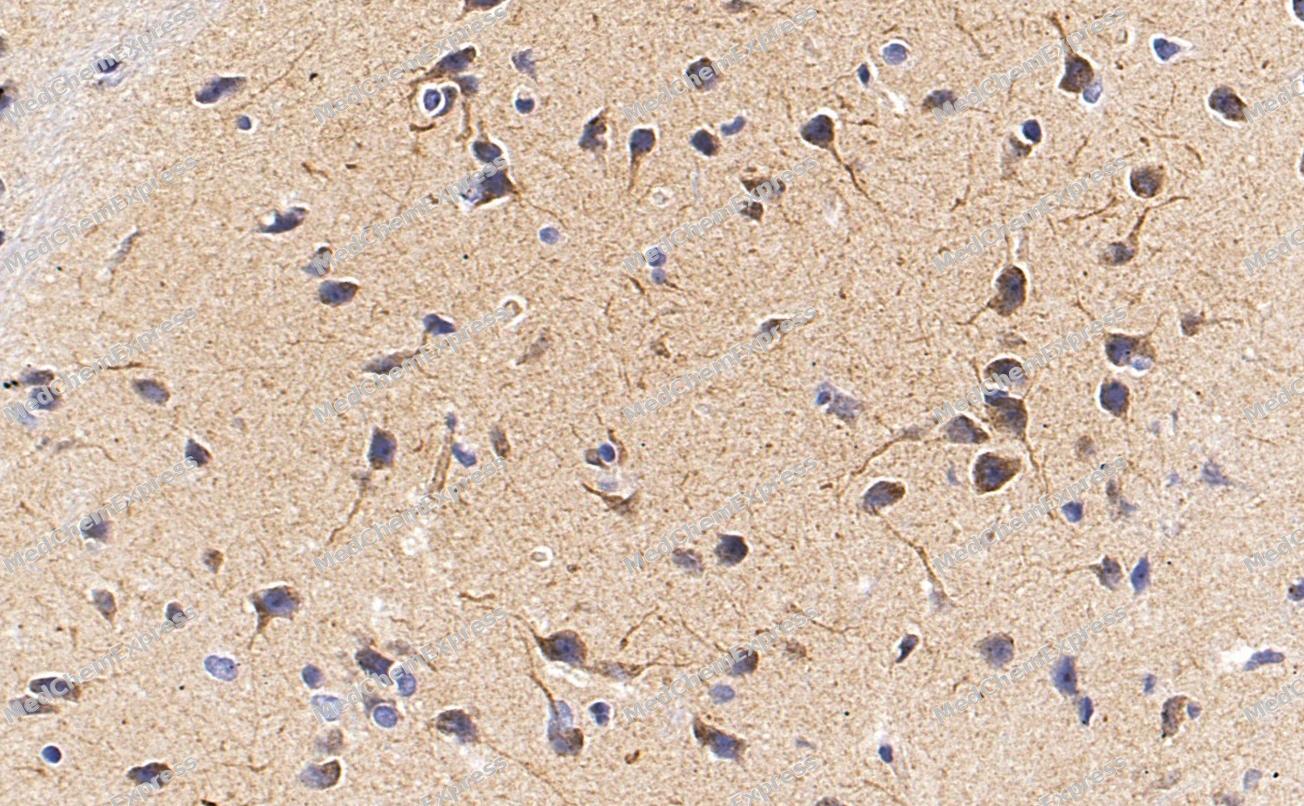 Immunohistochemical analysis of paraffin-embedded Rat brain tissue using LGI1 Antibody (YA2885). The section was pre-treated using heat mediated antigen retrieval with Tris-EDTA buffer (pH 9.0) for 8 minutes. The tissues were blocked in QuickBlock for 20 minutes at room temperature, washed with ddH2O and PBS, and then probed with the primary antibody (HY-P83140, 1/100) in 4℃ overnight. The detection was performed using an HRP conjugated compact polymer system. DAB was used as the chromogen. Tissues were counterstained with hematoxylin and mounted with DPX.
 -
Immunohistochemical analysis of paraffin-embedded Rat brain tissue using LGI1 Antibody (YA2885). The section was pre-treated using heat mediated antigen retrieval with Tris-EDTA buffer (pH 9.0) for 8 minutes. The tissues were blocked in QuickBlock for 20 minutes at room temperature, washed with ddH2O and PBS, and then probed with the primary antibody (HY-P83140, 1/100) in 4℃ overnight. The detection was performed using an HRP conjugated compact polymer system. DAB was used as the chromogen. Tissues were counterstained with hematoxylin and mounted with DPX.


Background
-
Function
LGI1 regulates voltage-gated potassium channels assembled from KCNA1, KCNA4 and KCNAB1. It slows down channel inactivation by precluding channel closure mediated by the KCNAB1 subunit. Ligand for ADAM22 that positively regulates synaptic transmission mediated by AMPA-type glutamate receptors. Plays a role in suppressing the production of MMP1/3 through the phosphatidylinositol 3-kinase/ERK pathway. May play a role in the control of neuroblastoma cell survival
-
Subcellular Localization
Secreted; Synapse; Cytoplasm; Golgi apparatus; Secreted; Cytoplasm; Endoplasmic reticulum; Cytoplasm
-
Expression
Tissue_specificity:Predominantly expressed in neural tissues, especially in brain. Expression is reduced in low-grade brain tumors and significantly reduced or absent in malignant gliomas; Expressed in the occipital cortex and hippocampus; higher amounts are observed in the parietal and frontal cortices, putamen, and, particularly, in the temporal neocortex, where it is between 3 and 5 times more abundant than in the hippocampus (at protein level) (PubMed:16787412) . Expression is absent in the cerebellum (PubMed:16787412) ; Abundantly expressed in the occipital cortex and weakly expressed in the hippocampus (at protein level)
Induction:Down-regulated in neuroblastoma cells -
Isoforms & Post-Translational Modification
O95970 has 3 isomers: O95970-1: 63818 Da (predicted); O95970-2: 33121 Da (predicted); O95970-3: 58302 Da (predicted).
Glycosylated -
Subunit
Oligomer. Interacts with KCNA1 within a complex containing KCNA1, KCNA4 and KCNAB1. Part of a complex containing ADAM22, DLG4/PSD95 and CACNG2/Stargazin (PubMed:27066583). Can bind to ADAM11 and ADAM23
-
SwissProt ID
-
Synonyms
ADLTE; ADPAEF; ADPEAF; Epitempin 1; EPITEMPIN; EPT; ETL1; LGI1
-
Research Field
Neuroscience


Documentation
-
Data Sheet (234 KB)
-
SDS (251 KB)
- English - EN (251 KB)
- Français - FR (251 KB)
- Deutsch - DE (251 KB)
- Norwegian - NO (251 KB)
- Español - ES (251 KB)
- Swedish - SV (251 KB)
- Italian - IT (251 KB)
- Korean - KR (251 KB)
- Portuguese - PT (251 KB)
-
User Guide for Antibodies (1077 KB)

 Powered by Bioz
