



NGB Antibody (YA4512)

Based on 1 Customer Validation
NGB Antibody (YA4512) is a Mouse-derived and non-conjugated IgG1 monoclonal antibody, targeting to NGB.
-
Host:
Mouse
-
Isotype:
IgG1
-
Application:
WB, FC, ELISA
-
Reactivity :
Human, Mouse, Rat
-
Formulation:
Supplied in PBS with 0.05% sodium azide
-
Conjugation:
Non-conjugated


To place orders, for customer services and technical support, please contact: MedChemExpress USA
Tel: 609-228-6898 E-mail: [email protected] [email protected]





Applications
| Application |
WB

WB: Western Blot
|
FC
FC: Flow Cytometry
|
ELISA
ELISA: Enzyme Linked Immunosorbent Assay
|
|---|---|---|---|
| Dilution Ratio | 1:500-1:2000 | 1:200-1:400 | 1:10000 |


Product Details
NGB Antibody (YA4512) is a Mouse-derived and non-conjugated IgG1 monoclonal antibody, targeting to NGB.
-
Host Mouse

-
Clonality Monoclonal

-
Species ReactivityHuman, Mouse, Rat
-
Observed Molecular WeightObserved band size: 43 kDa
Note: Due to possible protein modifications or aggregation, the molecular weight should be confirmed by actual measurement, and the predicted value is for reference only.

-
Calculated Molecular Weight Predicted band size: 17 kDa

Purified recombinant fragment of human NGB(AA: full 1-151) expressed in E. Coli.
affinity purified.
Non-conjugated
Unmodified
IgG1


Product Properties
-
Appearance
Liquid
-
Formulation
Supplied in PBS with 0.05% sodium azide
-
Concentration
Batch-dependent, Please check the COA for the concentration of each lot. Check Lot Concentration
-
Storage & Stability
Stored at -20°C for 1 year. Avoid repeated freeze / thaw cycles.
-
Shipping
Shipping with blue ice.


Verification Images
-
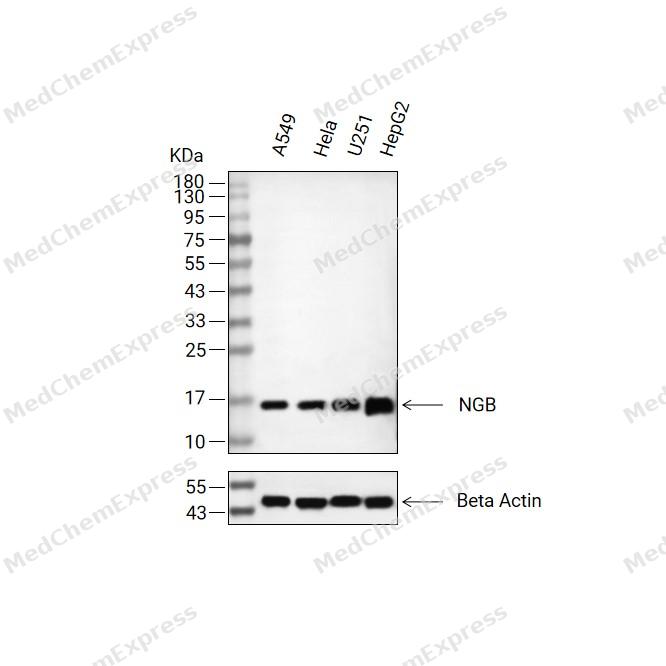 Western blot analysis of extracts from A549(lane 2(20μg) , Hela(lane 3(20μg) ,U251(lane 4(20μg)and HepG2( lane 5(20μg) using NGB Antibody (HY-P84815). Proteins were transferred to a PVDF membrane and blocked with 5% non-fat milk in TBST for 2 hour at room temperature. The primary antibody ( 1/1000) and Loading control antibody (Beta Actin, HY-P80993,1/10000) was used in 5% non-fat milk in TBST at 4°C overnight. Goat Anti-Mouse IgG-HRP Secondary Antibody (HY-P8004,1/10,000) was used for 1 hour at room temperature.


Background
-
Function
NGB is a Monomeric globin with a bis-histidyl six-coordinate heme-iron atom through which it can bind dioxygen, carbon monoxide and nitric oxide. Could help transport oxygen and increase its availability to the metabolically active neuronal tissues, though its low quantity in tissues as well as its high affinity for dioxygen, which may limit its oxygen-releasing ability, argue against it. The ferrous/deoxygenated form exhibits a nitrite reductase activity and it could produce nitric oxide which in turn inhibits cellular respiration in response to hypoxia. In its ferrous/deoxygenated state, it may also exhibit GDI (Guanine nucleotide Dissociation Inhibitor) activity toward heterotrimeric G-alpha proteins, thereby regulating signal transduction to facilitate neuroprotective responses in the wake of hypoxia and associated oxidative stress[1][2][3][4][5][6].
-
Subcellular Localization
Cytoplasm, cytosol; Mitochondrion matrix
-
Expression
Tissue_specificity:Predominantly expressed in brain, the strongest expression is seen in the frontal lobe, the subthalamic nucleus and the thalamus -
Subunit
Monomer (PubMed:11029004). Homodimer and homotetramer; disulfide-linked.
-
SwissProt ID


Documentation
-
Data Sheet (234 KB)
-
SDS (251 KB)
- English - EN (251 KB)
- Français - FR (251 KB)
- Deutsch - DE (251 KB)
- Norwegian - NO (251 KB)
- Español - ES (251 KB)
- Swedish - SV (251 KB)
- Italian - IT (251 KB)
- Korean - KR (251 KB)
- Portuguese - PT (251 KB)
-
User Guide for Antibodies (1077 KB)

 Powered by Bioz
