



PD-L1 Antibody (YA6699)
(Synonyms: B7 H antibody; B7 H1 antibody; B7 homolog 1 antibody; B7-H1 antibody; B7H antibody; B7H1 antibody; CD 274 antibody; CD-274 antibody; CD274 antibody; CD274 antigen antibody; B7 H antibody; B7 H1 antibody; B7 homolog 1 antibody; B7-H1 antibody; B7H antibody; B7H1 antibody; CD 274 antibody; CD-274 antibody; CD274 antibody; CD274 antigen antibody; CD274 molecule antibody; MGC142294 antibody; MGC142296 antibody; OTTHUMP00000021029 antibody; PD L1 antibody; PD-L1 antibody; PD1L1_HUMAN antibody; PDCD1 ligand 1 antibody; PDCD1L1 antibody; PDCD1LG1 antibody; PDL 1 antibody; PDL1 antibody; Programmed cell death 1 ligand 1 antibody; Programmed death ligand 1 antibody; RGD1566211 antibody; )
Based on 1 Customer Validation
PD-L1 Antibody (YA6699) is a Rabbit-derived and non-conjugated IgG monoclonal antibody, targeting to PD-L1.
-
Host:
Rabbit
-
Isotype:
IgG
-
Application:
WB, IHC-P, mIHC
-
Reactivity :
Mouse
-
Formulation:
Supplied in PBS (pH7.4), 0.1% BSA, 40% Glycerol. Preservative: 0.05% Sodium Azide.
-
Conjugation:
Non-conjugated


To place orders, for customer services and technical support, please contact: MedChemExpress USA
Tel: 609-228-6898 E-mail: [email protected] [email protected]





Applications
| Application |
WB

WB: Western Blot
|
IHC-P
IHC-P: Immunohistochemistry-Paraffin
|
mIHC
mIHC: Multiplex Immunohistochemical
|
|---|---|---|---|
| Dilution Ratio | 1:2000 | 1:200 | 1:500 |


Product Details
PD-L1 Antibody (YA6699) is a Rabbit-derived and non-conjugated IgG monoclonal antibody, targeting to PD-L1.
-
Host Rabbit

-
Clonality Recombinant,Monoclonal

-
Species ReactivityMouse
-
Observed Molecular WeightObserved band size: 45-60 kDa
Note: Due to possible protein modifications or aggregation, the molecular weight should be confirmed by actual measurement, and the predicted value is for reference only.

-
Calculated Molecular Weight Predicted band size: 33 kDa

Recombinant protein within mouse PD-L1 aa 1-250 / 290.
affinity purified.
Non-conjugated
Unmodified
IgG


Product Properties
-
Appearance
Solution
-
Formulation
Supplied in PBS (pH7.4), 0.1% BSA, 40% Glycerol. Preservative: 0.05% Sodium Azide.
-
Concentration
Batch-dependent, Please check the COA for the concentration of each lot. Check Lot Concentration
-
Storage & Stability
Stored at -20°C for 1 year. Avoid repeated freeze / thaw cycles.
-
Shipping
Shipping with blue ice.


Verification Images
-
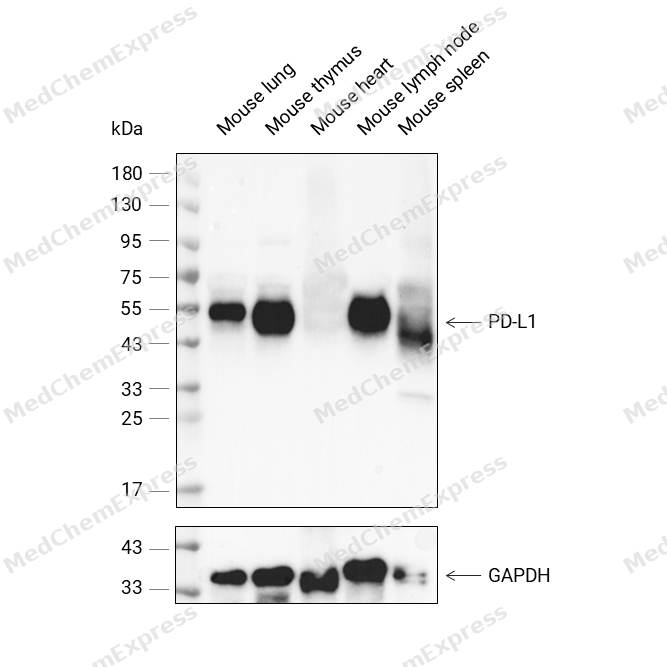 Western blot analysis was performed on protein extracts (30 μg) from Mouse lung (lane 2), Mouse thymus (lane 3), Mouse heart (lane 4,Negative), Mouse lymph node (lane 5), and Mouse spleen (lane 6) using PD-L1 antibody. Proteins were transferred onto a 0.45 μm PVDF membrane using the Trans-Blot® Turbo™ system for 13 min. The membrane was then blocked with 5% nonfat milk in TBST (HY-K1025) for 1 h at room temperature. Thhe primary antibody (1:2000) and loading control antibody GAPDH Antibody (HRP) (HY-P80954A) (1:5000) were diluted in 5% nonfat milk in TBST and incubated with the membrane overnight at 4°C. After washing, the membrane of primary antibody was incubated with HRP-conjugated goat anti-rabbit/mouse IgG secondary antibody (HY-P8001/HY-P8004) (1:5000) diluted in 5% nonfat milk in TBST for 1 h at room temperature. Protein bands were visualized using an Ultra High Sensitivity ECL detection kit (HY-K1005).
 -
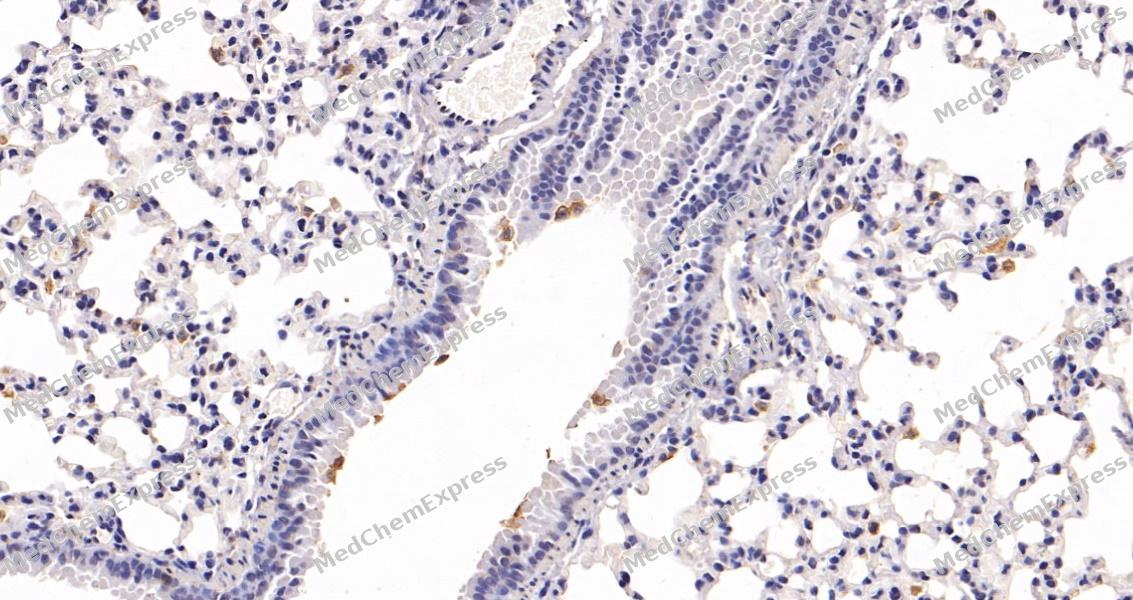 Immunohistochemical analysis of paraffin-embedded mouse lung tissue using PD-L1 Antibody. The section was pre-treated using heat mediated antigen retrieval with sodium citrate buffer (pH 6.0) for 8 minutes. The tissues were blocked in QuickBlock for 20 minutes at room temperature, washed with ddH2O and PBS, and then probed with the primary antibody at 1/100 dilution in 4℃ overnight. The detection was performed using an HRP conjugated compact polymer system. DAB was used as the chromogen. Tissues were counterstained with hematoxylin and mounted with DPX.
 -
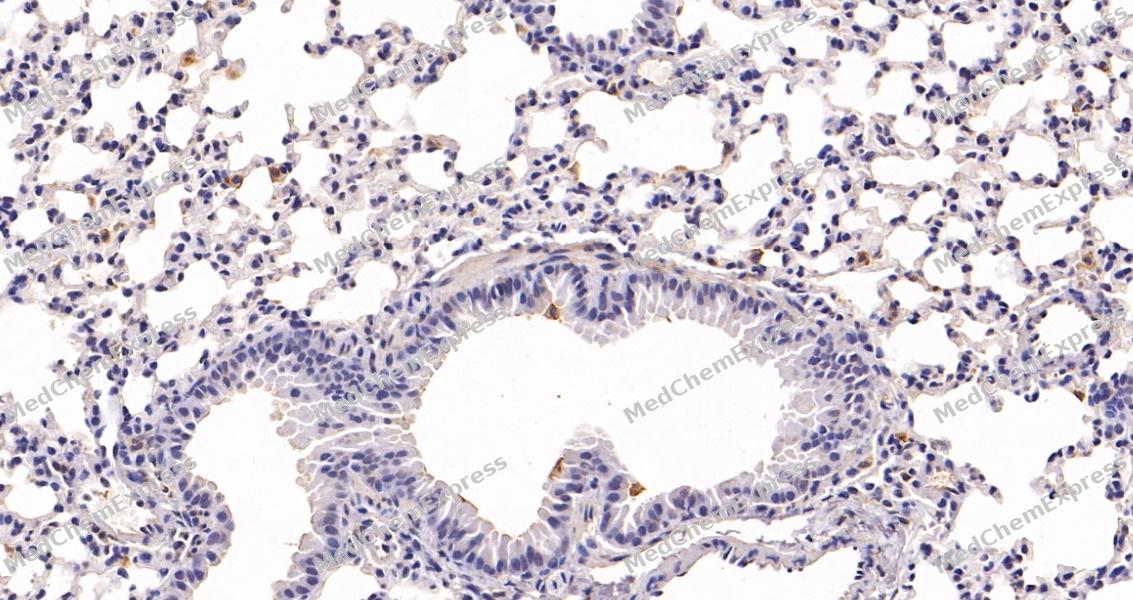 Immunohistochemical analysis of paraffin-embedded mouse lung tissue using PD-L1 Antibody. The section was pre-treated using heat mediated antigen retrieval with sodium citrate buffer (pH 6.0) for 8 minutes. The tissues were blocked in QuickBlock for 20 minutes at room temperature, washed with ddH2O and PBS, and then probed with the primary antibody at 1/100 dilution in 4℃ overnight. The detection was performed using an HRP conjugated compact polymer system. DAB was used as the chromogen. Tissues were counterstained with hematoxylin and mounted with DPX.


Background
-
Function
CD274 (PD-L1) is an important immune checkpoint ligand protein belonging to the B7 family of immunoregulatory molecules. By binding to PD-1 on the surface of T cells, PD-L1 inhibits T-cell activation and immune responses; it is a key mechanism of tumor immune escape and a major target for current immune checkpoint therapies.
-
Subcellular Localization
Cell membrane,Early endosome membrane,Recycling endosome membrane
-
Expression
Tissue_Specificity: Highly expressed in the heart, thymus, skeletal muscle, and lung. Weakly expressed in the kidney, spleen, thyroid, and liver. Expressed on activated dendritic cells, B-cells and macrophages. Expressed in numerous tumor cells lines of lymphoid origin
Induction: Up-regulated by IFNG treatment in monocytes. Up-regulated on dendritic cells, B-cells and macrophages after activation by LPS and IFNG -
Isoforms & Post-Translational Modification
Q9EP73: 290 amino acids, molecular weight 32780 Da.
-
Subunit
Interacts with PDCD1 (PubMed:11015443)
-
SwissProt ID
-
Synonyms
B7 H antibody; B7 H1 antibody; B7 homolog 1 antibody; B7-H1 antibody; B7H antibody; B7H1 antibody; CD 274 antibody; CD-274 antibody; CD274 antibody; CD274 antigen antibody; B7 H antibody; B7 H1 antibody; B7 homolog 1 antibody; B7-H1 antibody; B7H antibody; B7H1 antibody; CD 274 antibody; CD-274 antibody; CD274 antibody; CD274 antigen antibody; CD274 molecule antibody; MGC142294 antibody; MGC142296 antibody; OTTHUMP00000021029 antibody; PD L1 antibody; PD-L1 antibody; PD1L1_HUMAN antibody; PDCD1 ligand 1 antibody; PDCD1L1 antibody; PDCD1LG1 antibody; PDL 1 antibody; PDL1 antibody; Programmed cell death 1 ligand 1 antibody; Programmed death ligand 1 antibody; RGD1566211 antibody;


Documentation
-
Data Sheet (260 KB)
-
SDS (254 KB)
- English - EN (254 KB)
- Français - FR (254 KB)
- Deutsch - DE (254 KB)
- Norwegian - NO (254 KB)
- Español - ES (254 KB)
- Swedish - SV (254 KB)
- Italian - IT (254 KB)
- Korean - KR (254 KB)
- Portuguese - PT (254 KB)
-
User Guide for Antibodies (1077 KB)
References
[1]. Tamura H, et al. B7-H1 costimulation preferentially enhances CD28-independent T-helper cell function. Blood. 2001 Mar 15;97(6):1809-16. [Content Brief]
[2]. Freeman GJ, et al. Engagement of the PD-1 immunoinhibitory receptor by a novel B7 family member leads to negative regulation of lymphocyte activation. J Exp Med. 2000 Oct 2;192(7):1027-34. [Content Brief]
[3]. Wang S, et al. Molecular modeling and functional mapping of B7-H1 and B7-DC uncouple costimulatory function from PD-1 interaction. J Exp Med. 2003 May 5;197(9):1083-91. [Content Brief]
[4]. Iwai Y, et al. Involvement of PD-L1 on tumor cells in the escape from host immune system and tumor immunotherapy by PD-L1 blockade. Proc Natl Acad Sci U S A. 2002 Sep 17;99(19):12293-7. [Content Brief]
[5]. Kataoka K, et al. Aberrant PD-L1 expression through 3'-UTR disruption in multiple cancers. Nature. 2016 Jun 16;534(7607):402-6. [Content Brief]

 Powered by Bioz
