



SC35 Antibody (YA1905)
(Synonyms: Protein PR264; Splicing component; 35 kDa; Splicing factor SC35; SC-35; Splicing factor; arginine/serine-rich 2)
Based on 1 Customer Validation
SC35 Antibody (YA1905) is a Rabbit-derived and non-conjugated IgG monoclonal antibody, targeting to SC35.
-
Host:
Rabbit
-
Isotype:
IgG
-
Application:
WB, IHC-P, IP
-
Reactivity :
Human, Rat
-
Formulation:
Supplied in 50mM Tris-Glycine(pH 7.4), 0.15M NaCl, 40% Glycerol, 0.01% Sodium azide and 0.05% BSA
-
Conjugation:
Non-conjugated


To place orders, for customer services and technical support, please contact: MedChemExpress USA
Tel: 609-228-6898 E-mail: [email protected] [email protected]





Applications
| Application |
WB

WB: Western Blot
|
IHC-P
IHC-P: Immunohistochemistry-Paraffin
|
IP
IP: Immunoprecipitation
|
|---|---|---|---|
| Dilution Ratio | 1:500-1:1000 | 1:50-1:100 | 1:20 |


Product Details
SC35 Antibody (YA1905) is a Rabbit-derived and non-conjugated IgG monoclonal antibody, targeting to SC35.
-
Host Rabbit

-
Clonality Recombinant,Monoclonal

-
Species ReactivityHuman, Rat
-
Observed Molecular WeightObserved band size: 35 kDa
Note: Due to possible protein modifications or aggregation, the molecular weight should be confirmed by actual measurement, and the predicted value is for reference only.

-
Calculated Molecular Weight Predicted band size: 25 kDa

Entrez Gene: 6427 Human ; 20382 Mouse ; 494445 Rat
SwissProt: Q01130 Human ; Q62093 Mouse ; Q6PDU1 Rat
OMIM: 600813 Human
A synthetic peptide of human SC35 aa60-73.
Endogenous
Affinity Purified
Non-conjugated
Unmodified
IgG


Product Properties
-
Appearance
Solution
-
Formulation
Supplied in 50mM Tris-Glycine(pH 7.4), 0.15M NaCl, 40% Glycerol, 0.01% Sodium azide and 0.05% BSA
-
Concentration
Batch-dependent, Please check the COA for the concentration of each lot. Check Lot Concentration
-
Storage & Stability
Stored at -20°C for 1 year. Avoid repeated freeze / thaw cycles.
-
Shipping
Shipping with blue ice.


Verification Images
-
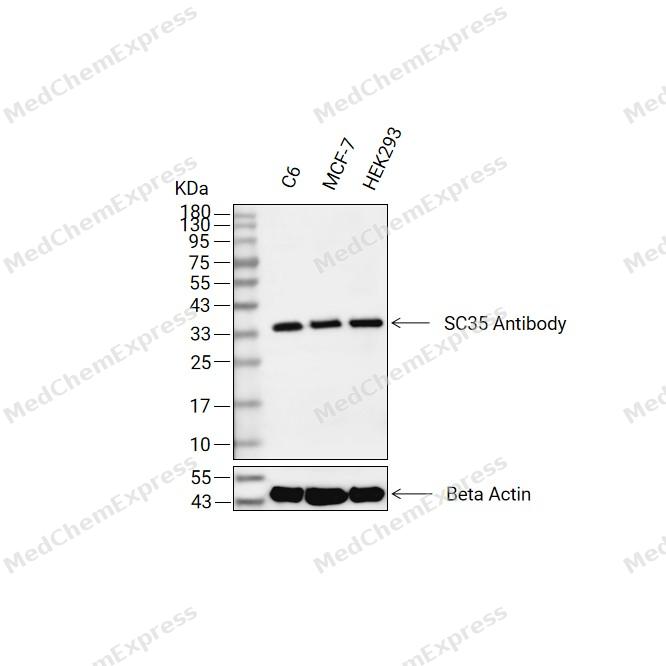 Western blot analysis of extracts from C6(lane 2(20ug),MCF-7(lane 3(20ug) and HEK293(lane 4(20ug) using SC35 Antibody (HY-P82160) Rabbit mAb. Proteins were transferred to a PVDF membrane and blocked with 5% non-fat milk in TBST for 2 hour at room temperature. The primary antibody (1/1000) and Loading control antibody (Beta Actin, HY-P83730, 1/10000) was used in 5% non-fat milk in TBST at 4°C overnight. Goat Anti-Mouse/Rabbit IgG-HRP Secondary Antibody (1/10000) was used for 1 hour at room temperature.
 -
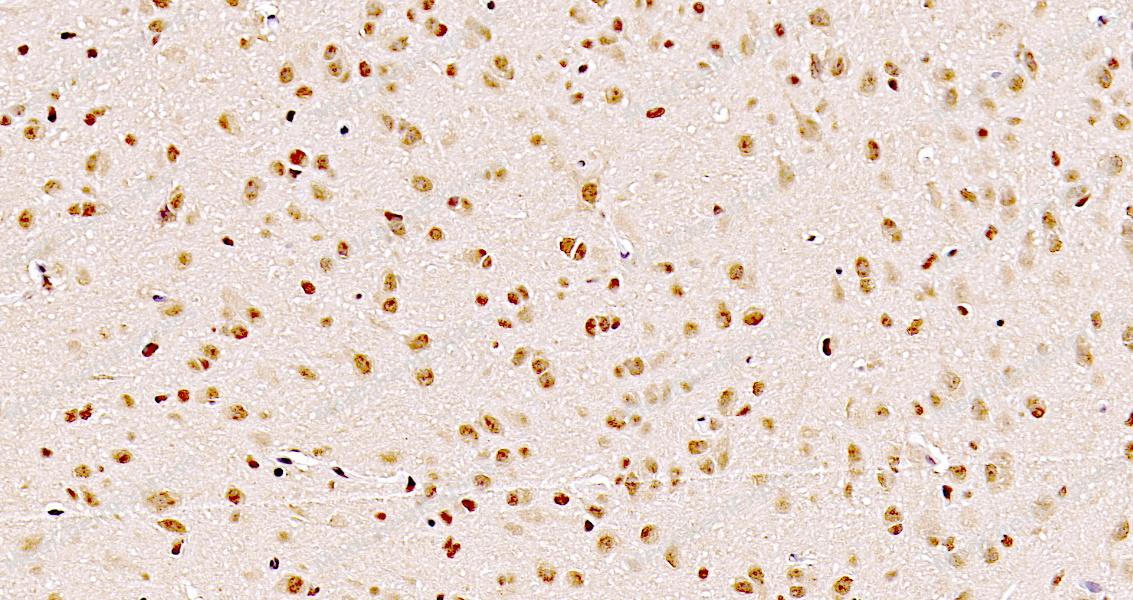 Immunohistochemical analysis of paraffin-embedded mouse brain tissue using SC35 Antibody. The section was pre-treated using heat mediated antigen retrieval with sodium citrate buffer (pH 6.0) for 8 minutes. The tissues were blocked in QuickBlock for 20 minutes at room temperature, washed with ddH2O and PBS, and then probed with the primary antibody at 1/100 dilution in 4℃ overnight. The detection was performed using an HRP conjugated compact polymer system. DAB was used as the chromogen. Tissues were counterstained with hematoxylin and mounted with DPX.
 -
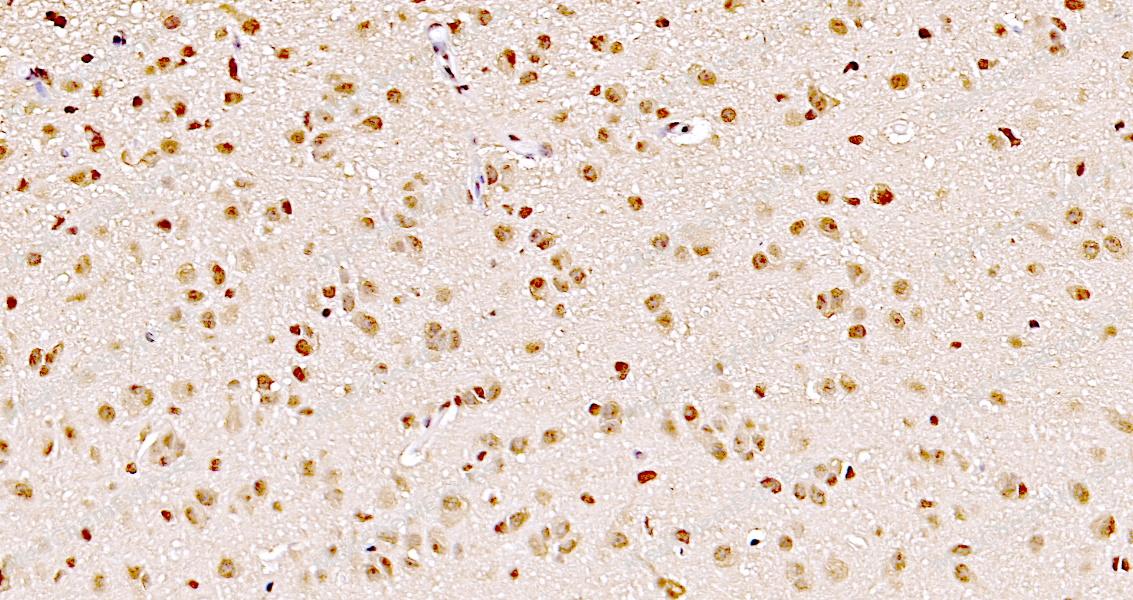 Immunohistochemical analysis of paraffin-embedded mouse brain tissue using SC35 Antibody. The section was pre-treated using heat mediated antigen retrieval with sodium citrate buffer (pH 6.0) for 8 minutes. The tissues were blocked in QuickBlock for 20 minutes at room temperature, washed with ddH2O and PBS, and then probed with the primary antibody at 1/100 dilution in 4℃ overnight. The detection was performed using an HRP conjugated compact polymer system. DAB was used as the chromogen. Tissues were counterstained with hematoxylin and mounted with DPX.


Background
-
Function
SC35 is a Necessary for the splicing of pre-mRNA. It is required for formation of the earliest ATP-dependent splicing complex and interacts with spliceosomal components bound to both the 5'- and 3'-splice sites during spliceosome assembly. It also is required for ATP-dependent interactions of both U1 and U2 snRNPs with pre-mRNA. Interacts with other spliceosomal components, via the RS domains, to form a bridge between the 5'- and 3'-splice site binding components, U1 snRNP and U2AF. Binds to purine-rich RNA sequences, either 5'-AGSAGAGTA-3' (S=C or G) or 5'-GTTCGAGTA-3'. Can bind to beta-globin mRNA and commit it to the splicing pathway. The phosphorylated form (by SRPK2) is required for cellular apoptosis in response to cisplatin treatment
-
Subcellular Localization
Nucleus; Nucleus, nucleoplasm; Nucleus speckle
-
Expression
Induction:Accumulates in a hypoacetylated/phosphorylated form in response to cisplatin treatment -
Isoforms & Post-Translational Modification
Q01130 has 2 isomers: Q01130-1: 25476 Da (predicted); Q01130-2: 24153 Da (predicted).
Extensively phosphorylated on serine residues in the RS domain. Phosphorylated by SRPK2 and this causes its redistribution from the nuclear speckle to nucleoplasm and controls cell fate decision in response to cisplatin treatment. KAT5/TIP60 inhibits its phosphorylation by preventing SRPK2 nuclear translocation;Acetylation on Lys-52 by KAT5/TIP60 promotes its proteasomal degradation. This effect is counterbalanced by HDAC6, which positively controls SRSF2 protein level by deacetylating it and preventing its proteasomal degradation -
Subunit
Interacts with BRDT (By similarity). In vitro, self-associates and binds SRSF1/SFRS1 (ASF/SF2), SNRNP70 and U2AF1 but not U2AF2. Binds SREK1/SFRS12. Interacts with CCNL1 and CCNL2. Interacts with SCAF11. Interacts with ZRSR2/U2AF1-RS2. Interacts with CCDC55 (via C-terminus)
-
SwissProt ID
-
Synonyms
Protein PR264; Splicing component; 35 kDa; Splicing factor SC35; SC-35; Splicing factor; arginine/serine-rich 2
-
Research Field
Epigenetics and Nuclear Signaling


Documentation
-
Data Sheet (234 KB)
-
SDS (251 KB)
- English - EN (251 KB)
- Français - FR (251 KB)
- Deutsch - DE (251 KB)
- Norwegian - NO (251 KB)
- Español - ES (251 KB)
- Swedish - SV (251 KB)
- Italian - IT (251 KB)
- Korean - KR (251 KB)
- Portuguese - PT (251 KB)
-
User Guide for Antibodies (1077 KB)

 Powered by Bioz
