



UCHL3 Antibody (YA2811)
(Synonyms: UCH-L3; Ubiquitin thiolesterase L3; Ubiquitin carboxyl-terminal hydrolase isozyme L3; UCHL3)
Based on 1 Customer Validation
UCHL3 Antibody (YA2811) is a Rabbit-derived and non-conjugated IgG monoclonal antibody, targeting to UCHL3.
-
Host:
Rabbit
-
Isotype:
IgG
-
Application:
WB
-
Reactivity :
Human, Mouse, Rat
-
Formulation:
Supplied in Rabbit IgG in 10mM phosphate buffered saline , pH 7.4, 150mM sodium chloride, 0.05% BSA, 0.02% sodium azide and 50% glycerol.
-
Conjugation:
Non-conjugated


To place orders, for customer services and technical support, please contact: MedChemExpress USA
Tel: 609-228-6898 E-mail: [email protected] [email protected]





Applications
| Application |
WB

WB: Western Blot
|
|---|---|
| Dilution Ratio | 1:500-1:1000 |


Product Details
UCHL3 Antibody (YA2811) is a Rabbit-derived and non-conjugated IgG monoclonal antibody, targeting to UCHL3.
-
Host Rabbit

-
Clonality Recombinant,Monoclonal

-
Species ReactivityHuman, Mouse, Rat
-
Observed Molecular WeightObserved band size: 26 kDa
Note: Due to possible protein modifications or aggregation, the molecular weight should be confirmed by actual measurement, and the predicted value is for reference only.

-
Calculated Molecular Weight Predicted band size: 26 kDa

Entrez Gene: 7347 Human ; 50933 Mouse ; 498560 Rat
SwissProt: P15374 Human ; Q9JKB1 Mouse ; Q91Y78 Rat
OMIM: 603090 Human
A synthesized peptide derived from human UCHL3 aa1-50/230.
Endogenous
Affinity Chromatography
Non-conjugated
Unmodified
IgG


Product Properties
-
Appearance
Solution
-
Formulation
Supplied in Rabbit IgG in 10mM phosphate buffered saline , pH 7.4, 150mM sodium chloride, 0.05% BSA, 0.02% sodium azide and 50% glycerol.
-
Concentration
Batch-dependent, Please check the COA for the concentration of each lot. Check Lot Concentration
-
Storage & Stability
Stored at -20°C for 1 year. Avoid repeated freeze / thaw cycles.
-
Shipping
Shipping with blue ice.


Verification Images
-
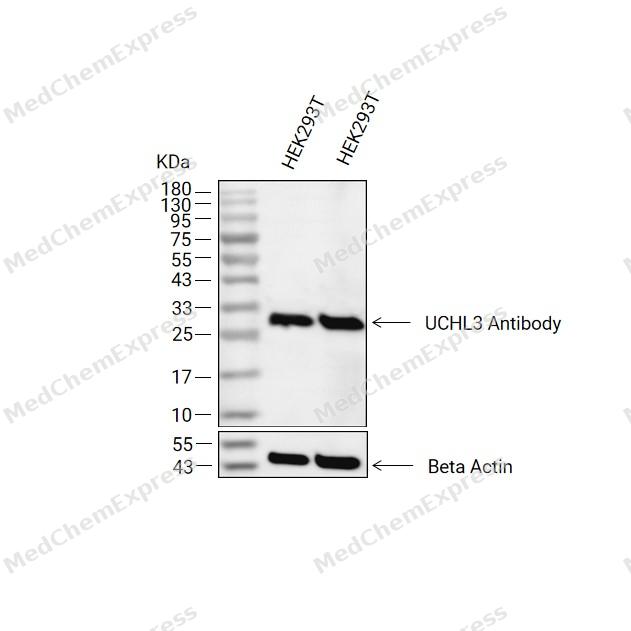 Western blot analysis of extracts from HEK293T(lane 2(20ug) and HEK293T(lane 3(40ug) using UCHL3 Antibody (HY-P83066) Rabbit mAb. Proteins were transferred to a PVDF membrane and blocked with 5% non-fat milk in TBST for 2 hour at room temperature. The primary antibody (1/1000) and Loading control antibody (Beta Actin, HY-P80438, 1/10000) was used in 5% non-fat milk in TBST at 4°C overnight. Goat Anti-Mouse/Rabbit IgG-HRP Secondary Antibody (1/10000) was used for 1 hour at room temperature.


Background
-
Function
UCHL3 (ubiquitin carboxyl-terminal hydrolase L3) is a cysteine protease within the ubiquitin C-terminal hydrolase family that functions as a deubiquitinating enzyme and deNEDDylating enzyme, thereby regulating cellular ubiquitin homeostasis and post-translational protein modification pathways[1][2]. Mechanistically, UCHL3 processes ubiquitin precursors and ubiquitinated substrates and hydrolyzes C-terminal glycine-linked ubiquitin or NEDD8 conjugates, linking its activity to protein turnover, cell cycle regulation, DNA repair, apoptosis, and cellular stress responses[1][2][3]. Through these functions, UCHL3 contributes to genome maintenance and proteostasis, and dysregulation of UCHL3 has been associated with cancer, neurodegenerative disorders, retinal degeneration, and learning deficits in experimental models[1][2]. In disease-related pathways, UCHL3 can stabilize signaling components through deubiquitination and has been implicated in DNA damage repair mechanisms, further supporting its relevance as a therapeutic research target[2][4][5]. Compared with the closely related isoform UCHL1, UCHL3 shares approximately 53% sequence homology but exhibits distinct biochemical characteristics and biological functions, highlighting the importance of isoform-specific investigation in ubiquitin signaling studies[2]. Structural studies further identified a catalytic cysteine protease core and a substrate-selectivity crossover loop that contribute to UCHL3 substrate recognition and enzymatic specificity[5][6]. For experimental applications, increasing interest has focused on the development of UCHL3 inhibitors to interrogate its roles in DNA repair, protein homeostasis, and disease-associated signaling networks[2][4].
-
Subcellular Localization
Cytoplasm
-
Expression
Tissue_specificity:Highly expressed in heart, skeletal muscle, and testis -
Subunit
Preferentially binds diubiquitin; the interaction does not hydrolyze diubiquitin but, in vitro, inhibits the hydrolyzing activity on other substrates
-
SwissProt ID
-
Synonyms
UCH-L3; Ubiquitin thiolesterase L3; Ubiquitin carboxyl-terminal hydrolase isozyme L3; UCHL3
-
Research Field
Cell Biology


Documentation
-
Data Sheet (261 KB)
-
SDS (252 KB)
- English - EN (252 KB)
- Français - FR (252 KB)
- Deutsch - DE (252 KB)
- Norwegian - NO (252 KB)
- Español - ES (252 KB)
- Swedish - SV (252 KB)
- Italian - IT (252 KB)
- Korean - KR (252 KB)
- Portuguese - PT (252 KB)
-
User Guide for Antibodies (1077 KB)
References
[2]. Uniprotkb.
[3]. Johnston SC, et al. Crystal structure of a deubiquitinating enzyme (human UCH-L3) at 1.8 A resolution. EMBO J. 1997 Jul 1;16(13):3787-96. [Content Brief]
[4]. Hewitt CS, et al. Rational Development and Characterization of a Ubiquitin Variant with Selectivity for Ubiquitin C-Terminal Hydrolase L3. Biomolecules. 2022 Jan 1;12(1):62. [Content Brief]
[5]. Liu J, et al. UCHL3: a crucial deubiquitinase in DNA damage repair and tumor progression. Cancer Cell Int. 2025 Jul 21;25(1):276. [Content Brief]
[6]. Rong C, et al. Ubiquitin Carboxyl-Terminal Hydrolases and Human Malignancies: The Novel Prognostic and Therapeutic Implications for Head and Neck Cancer. Front Oncol. 2021 Jan 29;10:592501. [Content Brief]

 Powered by Bioz
