



VGluT1 Antibody (YA012)
(Synonyms: BNPI, VGLUT1, SLC17A7, Vesicular glutamate transporter 1, VGluT1, Brain-specific Na(+)-dependent inorganic phosphate cotransporter, Solute carrier family 17 member 7)
Based on 1 Customer Validation
VGluT1 Antibody (YA012) is a Rabbit-derived and non-conjugated IgG monoclonal antibody, targeting to VGluT1.
-
Host:
Rabbit
-
Isotype:
IgG
-
Application:
WB
-
Reactivity :
Human, Mouse, Rat
-
Formulation:
Supplied in Rabbit IgG in 10mM phosphate buffered saline , pH 7.4, 150mM sodium chloride, 0.05% BSA, 0.02% sodium azide and 50% glycerol.
-
Conjugation:
Non-conjugated


To place orders, for customer services and technical support, please contact: MedChemExpress USA
Tel: 609-228-6898 E-mail: [email protected] [email protected]





Applications
| Application |
WB

WB: Western Blot
|
|---|---|
| Dilution Ratio | 1:500-1:1000 |


Product Details
VGluT1 Antibody (YA012) is a Rabbit-derived and non-conjugated IgG monoclonal antibody, targeting to VGluT1.
-
Host Rabbit

-
Clonality Recombinant,Monoclonal

-
Species ReactivityHuman, Mouse, Rat
-
Observed Molecular WeightObserved band size: 62 kDa
Note: Due to possible protein modifications or aggregation, the molecular weight should be confirmed by actual measurement, and the predicted value is for reference only.

-
Calculated Molecular Weight Predicted band size: 62 kDa

Entrez Gene: 57030 Human ; 72961 Mouse ; 116638 Rat
SwissProt: Q9P2U7 Human ; Q3TXX4 Mouse ; Q62634 Rat
OMIM: 605208 Human
Synthetic peptide corresponding to Human VGluT1 aa500-560.
Endogenous
Non-conjugated
Unmodified
IgG


Product Properties
-
Appearance
Solution
-
Formulation
Supplied in Rabbit IgG in 10mM phosphate buffered saline , pH 7.4, 150mM sodium chloride, 0.05% BSA, 0.02% sodium azide and 50% glycerol.
-
Concentration
Batch-dependent, Please check the COA for the concentration of each lot. Check Lot Concentration
-
Storage & Stability
Stored at -20°C for 1 year. Avoid repeated freeze / thaw cycles.
-
Shipping
Shipping with blue ice.


Verification Images
-
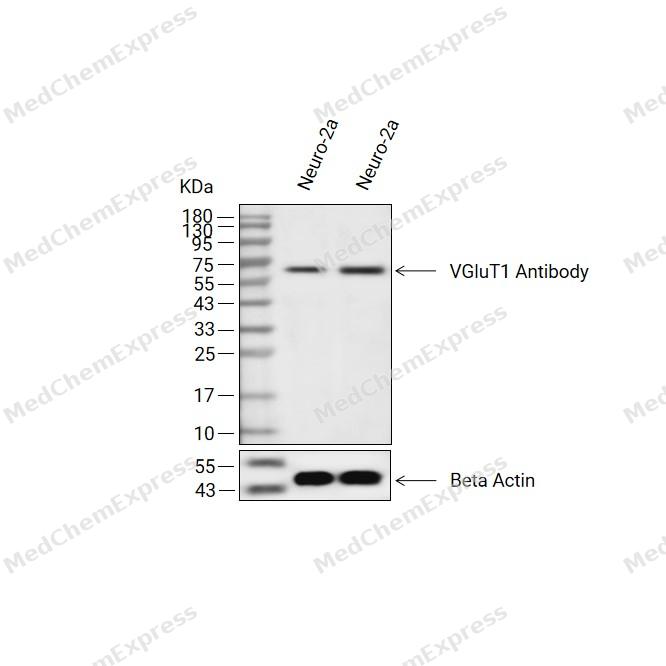 Western blot analysis of extracts from Neuro-2a(lane 2(20ug) and Neuro-2a(lane 3(40ug) using VGluT1 Antibody (HY-P80957) Rabbit mAb. Proteins were transferred to a PVDF membrane and blocked with 5% non-fat milk in TBST for 2 hour at room temperature. The primary antibody (1/1000) and Loading control antibody (Beta Actin, HY-P83730, 1/10000) was used in 5% non-fat milk in TBST at 4°C overnight. Goat Anti-Mouse/Rabbit IgG-HRP Secondary Antibody (1/10000) was used for 1 hour at room temperature.


Background
-
Function
VGluT1 multifunctional transporter that transports L-glutamate as well as multiple ions such as cH2O2ide, proton, potassium, sodium and phosphate. At the synaptic vesicle membrane, mainly functions as an uniporter which transports preferentially L-glutamate but also phosphate from the cytoplasm into synaptic vesicles at presynaptic nerve terminals of excitatory neural cells. The L-glutamate or phosphate uniporter activity is electrogenic and is driven by the proton electrochemical gradient, mainly by the electrical gradient established by the vacuolar H(+)-ATPase across the synaptic vesicle membrane. In addition, functions as a cH2O2ide channel that allows a cH2O2ide permeation tH2O2gh the synaptic vesicle membrane that affects the proton electrochemical gradient and promotes synaptic vesicles acidification. Moreover, may function as a K(+)/H(+) antiport allowing to maintain the electrical gradient and to decrease chemical gradient and therefore sustain vesicular glutamate uptake. The vesicular K(+)/H(+) antiport activity is electroneutral. At the plasma membrane, following exocytosis, functions as a symporter of Na(+) and phosphate from the extracellular space to the cytoplasm allowing synaptic phosphate homeostasis regulation. The symporter activity is driven by an inside negative membrane potential and is electrogenic. Is necessary for synaptic signaling of visual-evoked responses from photoreceptors[1].
-
Subcellular Localization
Cytoplasmic vesicle, secretory vesicle, synaptic vesicle membrane; Cell membrane; Multi-pass membrane protein; Synapse, synaptosome
-
Expression
Tissue_specificity:This gene is expressed in multiple regions of the brain, including the amygdala, cerebellum, cerebral cortex, hippocampus, frontal lobe, medulla oblongata, occipital lobe, putamen, and temporal lobe. -
Subunit
Interacts with SHANK3
-
SwissProt ID
-
Synonyms
BNPI, VGLUT1, SLC17A7, Vesicular glutamate transporter 1, VGluT1, Brain-specific Na(+)-dependent inorganic phosphate cotransporter, Solute carrier family 17 member 7


Documentation
-
Data Sheet (260 KB)
-
SDS (252 KB)
- English - EN (252 KB)
- Français - FR (252 KB)
- Deutsch - DE (252 KB)
- Norwegian - NO (252 KB)
- Español - ES (252 KB)
- Swedish - SV (252 KB)
- Italian - IT (252 KB)
- Korean - KR (252 KB)
- Portuguese - PT (252 KB)
-
User Guide for Antibodies (1077 KB)
References

 Powered by Bioz
