



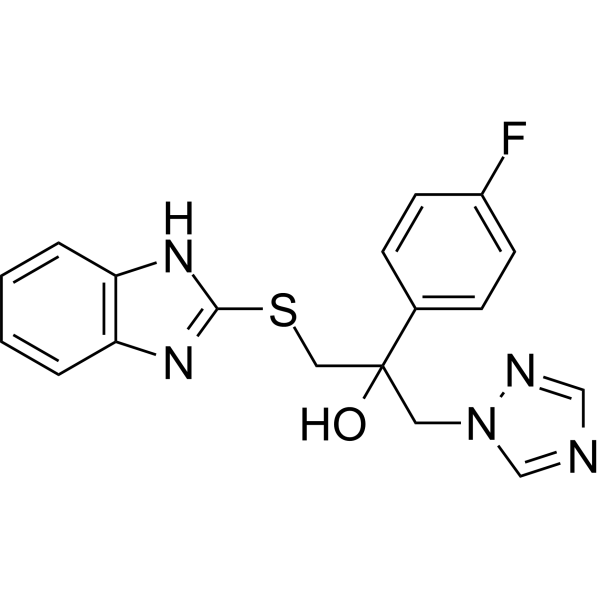
Antifungal agent 51
Antifungal agent 51 (Compound 5c) has potent antifungal activity, especially against Candida albicans FDC 151 , Candida parapsilosis ATCC 22019 and Candida tropicalis FDC 138, with the MIC value is less than 0.063 μg/mL, and it has low toxicity to cells and no carcinogenicity.
For research use only. We do not sell to patients.
- CAS No.: 2896209-47-3
- Formula: C18H16FN5OS
- Molecular Weight:369.42
-
Storage:
Please store the product under the recommended conditions in the Certificate of Analysis.

To place orders, for customer services and technical support, please contact: MedChemExpress USA
Tel: 609-228-6898 E-mail: [email protected] [email protected]


-
 Biological Activity
-
Chemical Information
- Protocols
- Purity & Documentation
- References
-
 Help & FAQs




Biological Activity
Description
In Vitro
Antifungal agent 51 has potent antifungal activity, especially against Candida albicans FDC 151, Candida parapsilosis ATCC 22019 and Candida tropicalis FDC 138, with the MIC value is less than 0.063 μg/mL, and against Candida albicans CMRC 19 and Candida glabrata FDC 192 with MIC value of 0.125 μg/mL, against Candida albicans CMRC 192, with MIC value of 0.25 μg/mL, against Candida glabrata CMRC 89, with MIC value of 1 μg/mL[1].
Antifungal agent 51 (6.25, 12.5, 25 μg/mL; 48 h) partially affects the viability of cell lines even at relatively high concentration of 25 μg/mL in BEAS-2B and HepG2 cells [1].
MedChemExpress (MCE) has not independently confirmed the accuracy of these methods. They are for reference only. Further protocols information, click here.
-
Cell Line:BEAS-2B and HepG2 cells
-
Concentration:6.25, 12.5, and 25 μg/mL
-
Incubation Time:48 h
-
Result:Partially affected the viability of cell lines even at relatively high concentration of 25 μg/mL in BEAS-2B and HepG2 cells


Chemical Information
-
CAS No. 2896209-47-3
-
Molecular Weight 369.42
-
Formula C18H16FN5OS
-
SMILES
FC1=CC=C(C(CSC2=NC3=C(N2)C=CC=C3)(CN4N=CN=C4)O)C=C1
-
Shipping
Room temperature in continental US; may vary elsewhere.
-
Storage
Please store the product under the recommended conditions in the Certificate of Analysis.

Protocols
-
Carcinogenicity Bioassay
A carcinogenicity bioassay detects whether long-term exposure to a test substance increases benign or malignant tumor incidence, changes tumor spectrum, or shortens tumor latency in experimental animals; the classical rodent design exposes rats and/or mice to multiple dose levels for most of their lifespan, followed by complete necropsy and histopathologic diagnosis of neoplastic and non-neoplastic lesions. The readout is tumor incidence by organ, sex, species, dose group, and survival status; interpretation requires concurrent controls, dose-response assessment, survival-adjusted tumor statistics, and pathology review because mortality, spontaneous tumor background, and body-weight effects can influence apparent tumor rates.


Purity & Documentation
References

Calculators
Concentration (start) × Volume (start) = Concentration (final) × Volume (final)


Antifungal agent 51 Related Classifications
HY-149822 Related Classifications
 Powered by Bioz