



APJ receptor agonist 4
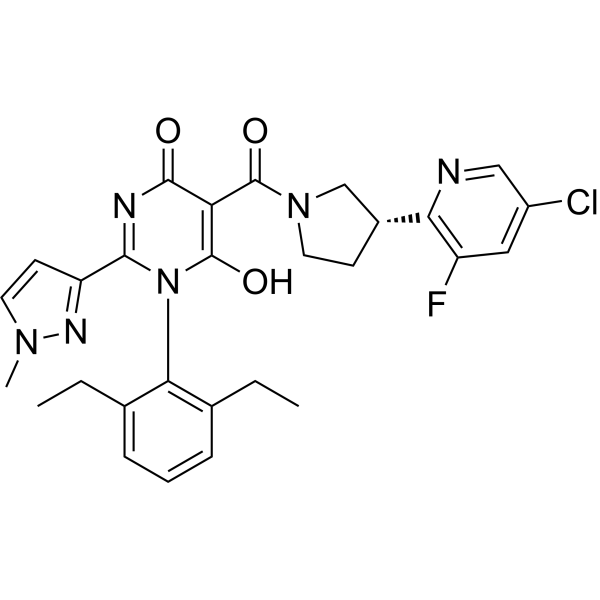
APJ receptor agonist 4 is a potent and orally active agonist of apelin receptor (APJ) with EC50 and Ki of 0.06 nM and 0.07 nM respectively. APJ receptor agonist 4 displays excellent pharmacokinetic profiles in the rodent heart failure (HF) model. APJ receptor agonist 4 also shows an acceptable safety profile in preclinical toxicology studies. APJ receptor agonist 4 leads to improved cardiac function and can be used for researching the HF disease.
For research use only. We do not sell to patients.
- CAS No.: 2762567-70-2
- Formula: C28H28ClFN6O3
- Molecular Weight:551.01
-
Storage:
Please store the product under the recommended conditions in the Certificate of Analysis.

To place orders, for customer services and technical support, please contact: MedChemExpress USA
Tel: 609-228-6898 E-mail: [email protected] [email protected]


-
 Biological Activity
-
Chemical Information
- Protocols
- Purity & Documentation
- References
-
 Help & FAQs




Biological Activity
Description
IC50 & Target
apelin receptor[1]
In Vivo
| species | rat | monkey | dogmax (ng/mL) |
| dose (mg/kg) | 1 (i.v. and p.o.) | 1 (i.v.) and 3 (p.o.) | 1 (i.v. and p.o.) |
| vehiclea | F | G | G |
| CI (mL/min/kg) | 4.6 | 10.6 | 2.4 |
| VSS (L/kg) | 1.6 | 0.2 | 0.2 |
| T1/2 (h) | 4.0 | 1.3 | 2.5 |
| Cmax (μM•h) | 2.2 | 1.4 | 6.5 |
| AUC0-24 (μM•h) | 3.7 | 2.5 | 14.2 |
| F (%) | 54 | 27 | 76 |
a: Vehicle F: 5/5/90 v/v/v DMAC/Cremophor EL/sodium carbonate buffer, pH 9 and vehicle G: 10/40/50 v/v/v ethanol/PEG400/sodium carbonate buffer, pH 9.
MedChemExpress (MCE) has not independently confirmed the accuracy of these methods. They are for reference only.


Chemical Information
-
CAS No. 2762567-70-2
-
Molecular Weight 551.01
-
Formula C28H28ClFN6O3
-
SMILES
O=C1C(C(N2CC[C@@H](C3=C(F)C=C(Cl)C=N3)C2)=O)=C(O)N(C4=C(CC)C=CC=C4CC)C(C5=NN(C)C=C5)=N1
-
Shipping
Room temperature in continental US; may vary elsewhere.
-
Storage
Please store the product under the recommended conditions in the Certificate of Analysis.

Protocols
-
Subchronic/Chronic Toxicity Study
A subchronic/chronic oral toxicity study detects systemic adverse effects caused by repeated administration of a test article, using mortality, clinical signs, body weight, food/water intake, ophthalmology, urinalysis, hematology, serum biochemistry, organ weights, gross necropsy, and histopathology as integrated readouts. The readout reflects dose-related physiological injury, target-organ pathology, reversibility after recovery, and derivation of NOAEL, LOAEL, or related point-of-departure values when the dataset supports them.
-
Research Protocol for Cardiovascular Diseases
Cardiovascular disease can be modeled as maladaptive cardiac remodeling, where ischemic injury or pressure overload activates inflammatory signaling, fibroblast activation, extracellular-matrix deposition, cardiomyocyte hypertrophy, vascular remodeling, and progressive ventricular dysfunction. The TGF-β/SMAD axis is a central profibrotic pathway after myocardial injury and pressure overload, while innate immune and cytokine pathways regulate leukocyte recruitment, scar formation, and adverse remodeling. Key unresolved questions include which inflammatory signals are reparative versus harmful, when fibrosis is protective versus maladaptive, and whether pathway inhibition improves function without weakening necessary infarct healing or compensatory remodeling.
-
Acute Systemic Toxicity Study
Acute systemic toxicity studies evaluate adverse effects occurring after a single exposure, or repeated exposure within a short acute window, and the main in vivo readouts are mortality, moribund condition, clinical signs, body-weight change, and gross pathological findings; acute oral toxicity methods were developed to replace classical LD50 testing with reduced-animal designs such as fixed-dose procedure, acute toxic class method, and up-and-down procedure. The fixed-dose procedure classifies acute toxicity by administering predefined dose levels and observing evident toxicity rather than using death as the primary endpoint, whereas the acute toxic class method uses sequential groups of three animals per step and the up-and-down procedure doses animals sequentially to estimate an LD50 with fewer animals than conventional LD50 testing.


Purity & Documentation
References

Calculators
Concentration (start) × Volume (start) = Concentration (final) × Volume (final)


APJ receptor agonist 4 Related Classifications
HY-145284 Related Classifications
 Powered by Bioz