



AR antagonist 5
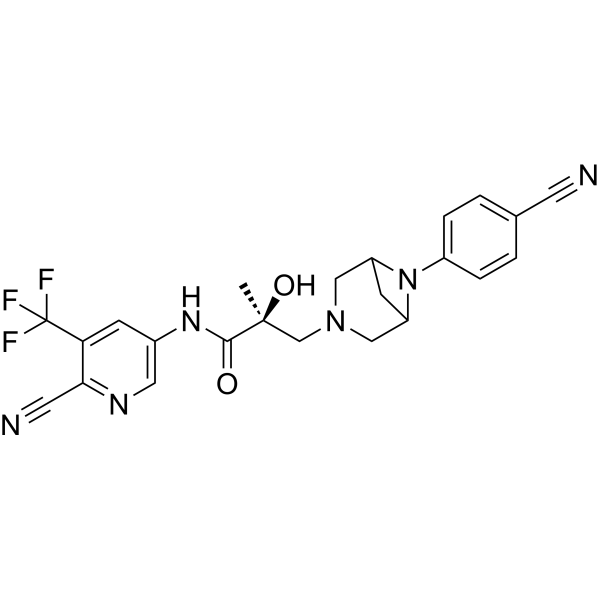
AR antagonist 5 (compound 30a) is a selective androgen receptor (AR) antagonist with an IC50 value of 134.8 nM. AR antagonist 5 has favorable pharmacokinetic properties and shows a high skin exposure and low plasma exposure[1.
Nur für Forschungszwecke. Wir verkaufen nicht an Patienten.
- CAS. Nr.: 2902679-53-0
- Formel: C23H21F3N6O2
- Molecular Weight:470.45
-
Speicherung:
Please store the product under the recommended conditions in the Certificate of Analysis.

To place orders, for customer services and technical support, please contact: MedChemExpress USA
Tel: 609-228-6898 E-mail: [email protected] [email protected]


-
 Biologische Aktivität
-
Chemical Information
- Protokoll
- Reinheit & Dokumentation
- Verweise
-
 Help & FAQs




Biologische Aktivität
Beschreibung
Cellular Effect
|
Cell Line

|
Type | Value | Description | References |
|---|---|---|---|---|
| NIH3T3 | IC50 |
>25 μg/mL
Compound: 30a
|
Dark toxicity against BALB/c mouse 3T3 cells assessed as reduction in cell viability incubated for 1 hr by neutral red dye based assay
Dark toxicity against BALB/c mouse 3T3 cells assessed as reduction in cell viability incubated for 1 hr by neutral red dye based assay
|
[PMID: 38128906] |
| NIH3T3 | IC50 |
>25 μg/mL
Compound: 30a
|
Phototoxicity against BALB/c mouse 3T3 cells assessed as reduction in cell viability preincubated for 1 hr followed by 5 J/cm2 irradiation and subsequent replacement of medium without compound and measured after 24 hrs by neutral red dye based assay
Phototoxicity against BALB/c mouse 3T3 cells assessed as reduction in cell viability preincubated for 1 hr followed by 5 J/cm2 irradiation and subsequent replacement of medium without compound and measured after 24 hrs by neutral red dye based assay
|
[PMID: 38128906] |


Chemical Information
-
CAS. Nr. 2902679-53-0
-
Molecular Weight 470.45
-
Formel C23H21F3N6O2
-
SMILES
C[C@](CN1CC2CC(N2C3=CC=C(C=C3)C#N)C1)(C(NC4=CN=C(C(C(F)(F)F)=C4)C#N)=O)O
-
Versand
Room temperature in continental US; may vary elsewhere.
-
Speicherung
Please store the product under the recommended conditions in the Certificate of Analysis.

Protokoll
-
Research Protocol for Endocrine Diseases
Endocrine diseases often arise from disrupted hormone production, hormone signaling, or target-tissue responsiveness; for diabetes-focused endocrine disease models, insulin signaling regulates glucose uptake, hepatic glucose output, lipid metabolism, and β-cell compensation. Type 2 diabetes develops through interacting defects in insulin resistance, β-cell dysfunction, adipose inflammation, hepatic glucose overproduction, altered incretin signaling, and ectopic lipid metabolism. A major unresolved question is whether endocrine dysfunction is driven primarily by target-tissue insulin resistance, intrinsic β-cell failure, immune/inflammatory stress, or combined multi-organ failure that differs by disease stage.


Reinheit & Dokumentation
Verweise
[1]. Wenqiang Zhang, et al. Discovery of (2 S)- N-(6-Cyano-5-(trifluoromethyl)pyridin-3-yl)-3-(6-(4-cyanophenyl)-3,6-diazabicyclo[3.1.1]heptan-3-yl)-2-hydroxy-2-methylpropanamide as a Highly Potent and Selective Topical Androgen Receptor Antagonist for Androgenetic Alopecia Treatment. J Med Chem. 2024, 67,1. [Content Brief]

Calculators
Konzentration (Stammlösung) × Volumen (Stammlösung) = Konzentration (Ziellösung) × Volumen (Ziellösung)


AR antagonist 5 Related Classifications
HY-157455 Related Classifications
 Powered by Bioz