
AR524
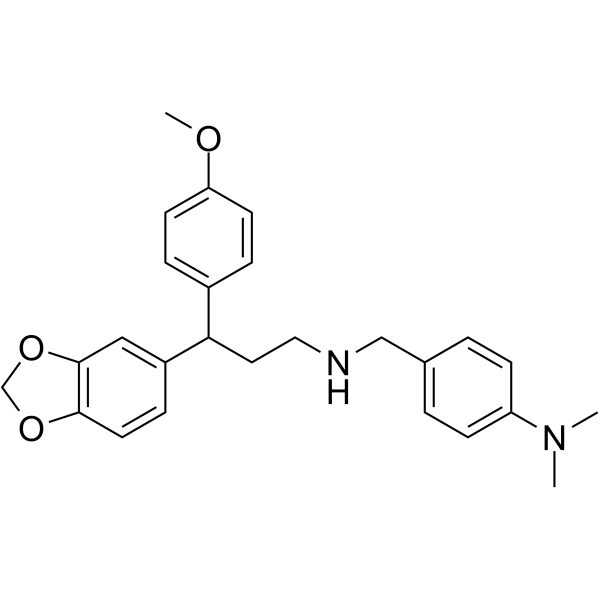
Ar524 has higher inhibitory activity than the known transgenic inhibitor kifunensine. At the same time, ar524 inhibited low concentration (10 μ M) Spheroid formation of human malignant cells.
For research use only. We do not sell to patients.
- CAS No.: 2568148-31-0
- Formula: C26H30N2O3
- Molecular Weight:418.53
-
Storage:
Please store the product under the recommended conditions in the Certificate of Analysis.
Biological Activity
Description
Chemical Information
-
CAS No. 2568148-31-0
-
Molecular Weight 418.53
-
Formula C26H30N2O3
-
SMILES
COC1=CC=C(C=C1)C(C2=CC3=C(OCO3)C=C2)CCNCC4=CC=C(C=C4)N(C)C
-
Shipping
Room temperature in continental US; may vary elsewhere.
-
Storage
Please store the product under the recommended conditions in the Certificate of Analysis.
Protocols
-
Suspension Spheroid Formation (Low-Adhesion/Forced Aggregation)
Suspension spheroid formation by low-adhesion or forced aggregation is a scaffold-free 3D culture method in which cells are prevented from attaching to plastic and are guided to interact with each other, forming compact multicellular aggregates through cell-cell adhesion, gravity-driven settling, microwell confinement, or centrifugation-assisted aggregation. The method detects the capacity of a cell population to self-assemble into spheroids, and the main readouts are spheroid formation efficiency, morphology, compactness, projected area or diameter, circularity, viability, proliferation, and experimental responses such as drug sensitivity. Classic implementations include hanging drops, agarose or hydrogel microwells, ultra-low-attachment round-bottom wells, and centrifugation-assisted aggregation in non-adherent wells. Low-adhesion culture shifts the system away from cell-substrate adhesion and toward cell-cell adhesion, while round-bottom or microwell geometry concentrates cells into
-
Hanging Drop Spheroid Culture
Hanging drop spheroid culture is a scaffold-free 3D culture method in which a small droplet of cell suspension is inverted so that suspended cells sediment by gravity toward the lowest point of the drop, aggregate, and form a multicellular spheroid with direct cell-cell contact. Spheroids generated by this method are used to study 3D cell cohesion, cell-ECM interactions, drug response, co-culture organization, and tumor-like microenvironmental behavior. The primary readouts are spheroid formation efficiency, spheroid size, circularity or compactness, viability, and treatment response; these can be measured by bright-field microscopy, fluorescence viability staining, ATP-, fluorescence-, or colorimetric-based assays, and image-based diameter or volume calculations.
Purity & Documentation
References
Calculators
Concentration (start) × Volume (start) = Concentration (final) × Volume (final)

