



Diuron
Based on 3 publication(s) in Google Scholar
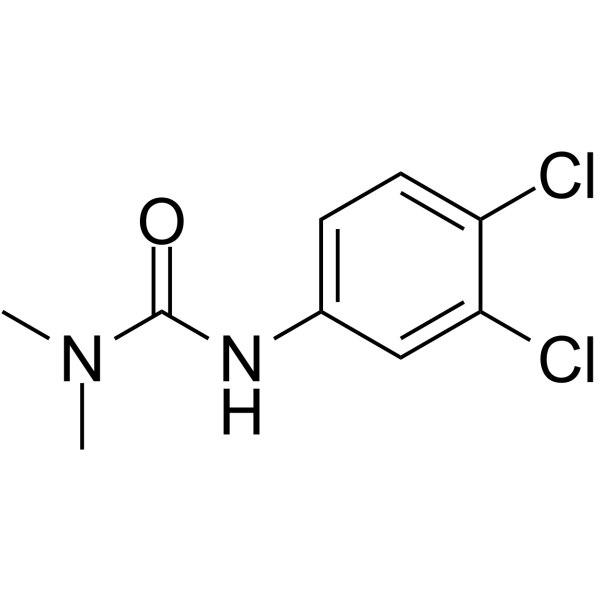
Diuron is an orally active phenylurea herbicide. Diuron inhibits photosynthesis in plants by blocking the formation of ATP and NADH. Diuron increases the production of ROS. Diuron increases expression of p53 in certain cell lines. Diuron has herbicidal activity against annual and perennial broadleaf weeds and grass weeds. Diuron promotes DMBA/BBN-induced bladder cancer. Diuron can be used in breast cancer research.
Nur für Forschungszwecke. Wir verkaufen nicht an Patienten.
- Reinheit : 99.38%
- CAS. Nr.: 330-54-1
- Formel: C9H10Cl2N2O
- Molecular Weight:233.10
-
Speicherung:Powder -20°C, 3 years , 4°C, 2 years ; In solvent -80°C, 2 years , -20°C, 1 year

To place orders, for customer services and technical support, please contact: MedChemExpress USA
Tel: 609-228-6898 E-mail: [email protected] [email protected]


-
 Biologische Aktivität
-
Chemical Information
-
Lösungsmittel & Löslichkeit
- Protokoll
- Reinheit & Dokumentation
- Verweise
-
 Help & FAQs


-

HY-B0860R
Diuron (Standard)Standard of Diuron -
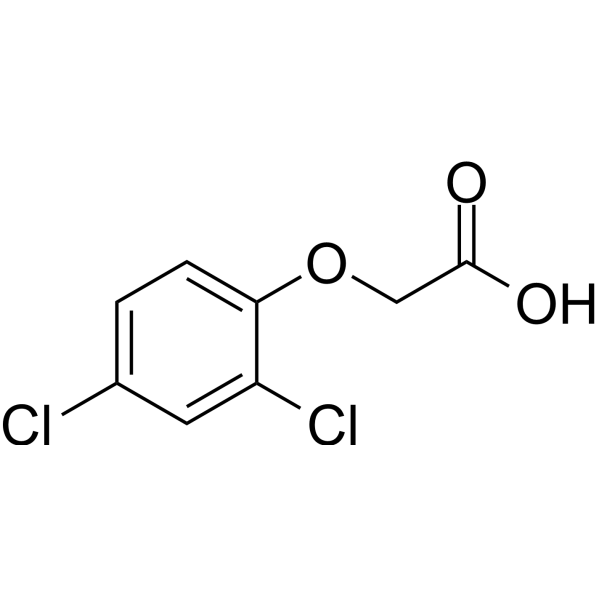
HY-18572
2,4-DHerbicide -
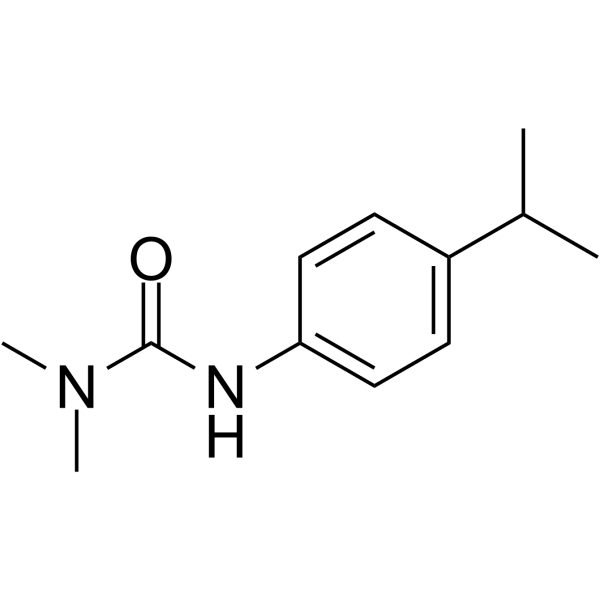
HY-B1859
IsoproturonPhenylurea Herbicide -
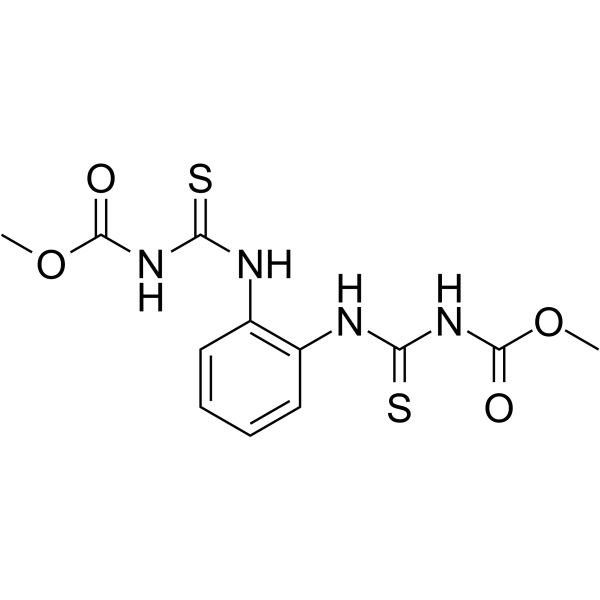
HY-B0842
Thiophanate-Methylpesticide residue/fungicide -
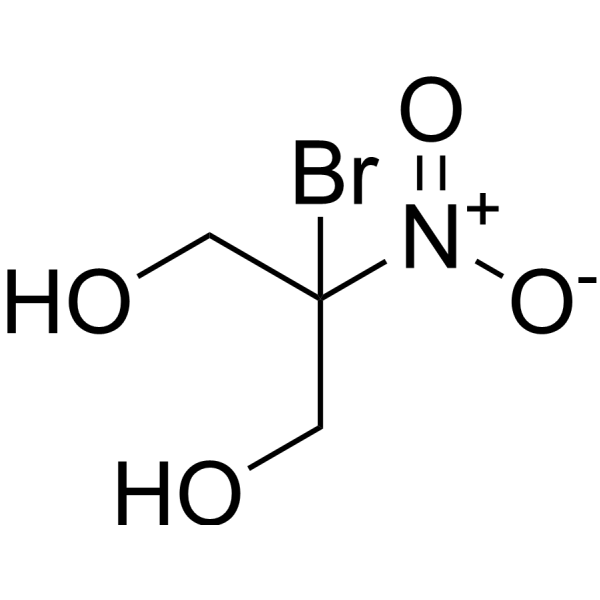
HY-B1217
BronopolBacterial Inhibitor -

HY-18572R
2,4-D (Standard)Herbicide -

HY-B1859R
Isoproturon (Standard)Phenylurea Herbicide -

HY-B0842R
Thiophanate-Methyl (Standard)Fungal Inhibitor -

HY-B1217R
Bronopol (Standard)Bacterial Inhibitor
Publications Citing Use of MedChemExpress (MCE) Diuron
More

Biologische Aktivität
Beschreibung
In Vitro
Diuron (100 nM-200 μM; 24-72 h) significantly increases ROS production in BeWo cells and reduces their cell viability[1].
Diuron (100 nM-200 μM; 24-72 h) significantly increases ROS production in MCF-7 cells and induces DNA damage[1].
Diuron (40-160 ppm; 6-96 h) inhibits Allium cepa root tip cell division, induces various mitotic abnormalities, and causes morphological changes[4].
MedChemExpress (MCE) has not independently confirmed the accuracy of these methods. They are for reference only.
-
Cell Line:MCF-7, BeWo
-
Concentration:100 nM, 10 μM, 50 μM, 100 μM, 150 μM, 200 μM
-
Incubation Time:24, 48, 72 h
-
Result:Increased the expressions of p53 and p21 proteins (MCF-7).
Showed no increase in the expression of p53 and p21 proteins (BeWo).
In Vivo
Diuron (1250-2500 ppm; mixed in diet; p.o.; 13 weeks) promotes the occurrence of bladder cancer induced by DMBA/BBN, increases urothelial cell proliferation and the incidence of simple/nodular hyperplasia in female Swiss mice[6].
MedChemExpress (MCE) has not independently confirmed the accuracy of these methods. They are for reference only.


Chemical Information
-
CAS. Nr. 330-54-1
-
Appearance Solid
-
Molecular Weight 233.10
-
Formel C9H10Cl2N2O
-
Color White to off-white
-
SMILES
O=C(NC1=CC=C(Cl)C(Cl)=C1)N(C)C
-
Versand
Room temperature in continental US; may vary elsewhere.
-
Speicherung
Powder -20°C 3 years 4°C 2 years In solvent -80°C 2 years -20°C 1 year


Publications (3)
-
Journal Impact Factor
-
Most Recent
-
Sci Adv
Mitochondrial ROS trigger interorganellular signaling and prime ER processes to establish enhanced plant immunity. [Abstract]2025 Oct 3;11(40):eady9234. PMID: 41032619 -
Anal Chem
Exposome-Scale Investigation of Cl-/Br-Containing Chemicals Using High-Resolution Mass Spectrometry, Multistage Machine Learning, and Cloud Computing. [Abstract]2025 Jun 3;97(21):11099-11109. PMID: 40401576 -
Toxicol Appl Pharmacol
2026 Jun 26:514:117928. PMID: 42361913


Lösungsmittel & Löslichkeit
In Vitro:
DMSO : 100 mg/mL (429.00 mM; Need ultrasonic; Hygroscopic DMSO has a significant impact on the solubility of product, please use newly opened DMSO)
Please refer to the solubility information to select the appropriate solvent. Once prepared, please aliquot and store the solution to prevent product inactivation from repeated freeze-thaw cycles.
Storage method and period of stock solution: -80°C, 2 years; -20°C, 1 year. When stored at -80°C, please use it within 2 years. When stored at -20°C, please use it within 1 year.
Please refer to the solubility information to select the appropriate solvent. Once prepared, please aliquot and store the solution to prevent product inactivation from repeated freeze-thaw cycles.
Storage method and period of stock solution: -80°C, 2 years; -20°C, 1 year. When stored at -80°C, please use it within 2 years. When stored at -20°C, please use it within 1 year.
Konzentration (Stammlösung) × Volumen (Stammlösung) = Konzentration (Ziellösung) × Volumen (Ziellösung)
In Vivo:
Select the appropriate dissolution method based on your experimental animal and administration route.
- For the following dissolution methods, please ensure to first prepare a clear stock solution using an In Vitro approach and then sequentially add co-solvents:
- To ensure reliable experimental results, the clarified stock solution can be appropriately stored based on storage conditions. As for the working solution for In Vivo experiments, it is recommended to prepare freshly and use it on the same day.
- The percentages shown for the solvents indicate their volumetric ratio in the final prepared solution. If precipitation or phase separation occurs during preparation, heat and/or sonication can be used to aid dissolution.
Add each solvent one by one: 10% DMSO 40% PEG300 5% Tween-80 45% Saline
Solubility: ≥ 6.25 mg/mL (26.81 mM); Clear solution
This protocol yields a clear solution of ≥ 6.25 mg/mL (saturation unknown).
Taking 1 mL working solution as an example, add 100 μL DMSO stock solution (62.5 mg/mL) to 400 μL PEG300, and mix evenly; then add 50 μL Tween-80 and mix evenly; then add 450 μL Saline to adjust the volume to 1 mL.
Preparation of Saline: Dissolve 0.9 g sodium chloride in ddH₂O and dilute to 100 mL to obtain a clear Saline solution.
Add each solvent one by one: 10% DMSO 90% (20% SBE-β-CD in Saline)
Solubility: ≥ 6.25 mg/mL (26.81 mM); Clear solution
This protocol yields a clear solution of ≥ 6.25 mg/mL (saturation unknown).
Taking 1 mL working solution as an example, add 100 μL DMSO stock solution (62.5 mg/mL) to 900 μL 20% SBE-β-CD in Saline, and mix evenly.
Preparation of 20% SBE-β-CD in Saline (4°C, storage for one week): 2 g SBE-β-CD powder is dissolved in 10 mL Saline, completely dissolve until clear.
In Vivo Dissolution Calculator
Please enter the basic information of animal experiments:
-
-
-
-
Recommended: Prepare an additional quantity of animals to account for potential losses during experiments.
Please enter your animal formula composition:
-
%DMSO +
Recommended: Keep the proportion of DMSO in working solution below 2% if your animal is weak.
-
%+
-
+%Tween-80 + +
-
%Saline +
The co-solvents required include: DMSO, . All of co-solvents are available by MedChemExpress (MCE). , Tween 80. All of co-solvents are available by MedChemExpress (MCE).
Working solution concentration: 0.22 mg/mL
Method for preparing stock solution: mg drug dissolved in μL DMSO. Stock solution concentration: mg/mL.
1. Take μL DMSO stock solution;
2. Add μL .
μL , mix evenly;
3. Then add μL Tween 80, mix evenly;
4. Then add μL
Please ensure that the stock solution in the first step is dissolved to a clear state, and add co-solvents in sequence. You can use ultrasonic heating (ultrasonic cleaner, recommended frequency 20-40 kHz), vortexing, etc. to assist dissolution.


Reinheit & Dokumentation
-
Data Sheet (285 KB)
-
SDS (761 KB)
- English - EN (761 KB)
- Français - FR (761 KB)
- Deutsch - DE (761 KB)
- Norwegian - NO (761 KB)
- Español - ES (761 KB)
- Swedish - SV (761 KB)
- Italian - IT (761 KB)
- Korean - KR (761 KB)
- Portuguese - PT (761 KB)
-
Handling Instructions (2659 KB)
Verweise
[1]. Huovinen M, et al. Toxicity of diuron in human cancer cells. Toxicol In Vitro. 2015 Oct;29(7):1577-86. [Content Brief]
[2]. Lundegårdh H. THE INFLUENCE OF DIURON (3-(3,4-DICHLOROPHENYL)-1,1-DIMETHYLUREA) ON THE RESPIRATORY AND PHOTOSYNTHETIC SYSTEMS OF PLANTS. Proc Natl Acad Sci U S A. 1965 Apr;53(4):703-10. [Content Brief]
[3]. Da Rocha MS, et al. Diuron-induced rat urinary bladder carcinogenesis: mode of action and human relevance evaluations using the International Programme on Chemical Safety framework. Crit Rev Toxicol. 2014 May;44(5):393-406. [Content Brief]
[5]. Da Rocha MS, et al. Diuron-induced rat bladder epithelial cytotoxicity. Toxicol Sci. 2012 Dec;130(2):281-8. [Content Brief]
[6]. de Moura NA, et al. Potential effects of the herbicide Diuron on mammary and urinary bladder two-stage carcinogenesis in a female Swiss mouse model. Arch Toxicol. 2010 Feb;84(2):165-73. [Content Brief]


Complete Stock Solution Preparation Table
Please refer to the solubility information to select the appropriate solvent. Once prepared, please aliquot and store the solution to prevent product inactivation from repeated freeze-thaw cycles.
Storage method and period of stock solution: -80°C, 2 years; -20°C, 1 year. When stored at -80°C, please use it within 2 years. When stored at -20°C, please use it within 1 year.
| Optional Solvent | Concentration Solvent Mass | 1 mg | 5 mg | 10 mg | 25 mg |
|---|---|---|---|---|---|
| DMSO | 1 mM | 4.2900 mL | 21.4500 mL | 42.9000 mL | 107.2501 mL |
| 5 mM | 0.8580 mL | 4.2900 mL | 8.5800 mL | 21.4500 mL | |
| 10 mM | 0.4290 mL | 2.1450 mL | 4.2900 mL | 10.7250 mL | |
| 15 mM | 0.2860 mL | 1.4300 mL | 2.8600 mL | 7.1500 mL | |
| 20 mM | 0.2145 mL | 1.0725 mL | 2.1450 mL | 5.3625 mL | |
| 25 mM | 0.1716 mL | 0.8580 mL | 1.7160 mL | 4.2900 mL | |
| 30 mM | 0.1430 mL | 0.7150 mL | 1.4300 mL | 3.5750 mL | |
| 40 mM | 0.1073 mL | 0.5363 mL | 1.0725 mL | 2.6813 mL | |
| 50 mM | 0.0858 mL | 0.4290 mL | 0.8580 mL | 2.1450 mL | |
| 60 mM | 0.0715 mL | 0.3575 mL | 0.7150 mL | 1.7875 mL | |
| 80 mM | 0.0536 mL | 0.2681 mL | 0.5363 mL | 1.3406 mL | |
| 100 mM | 0.0429 mL | 0.2145 mL | 0.4290 mL | 1.0725 mL |


Diuron Related Classifications
HY-B0860 Related Classifications
 Powered by Bioz