



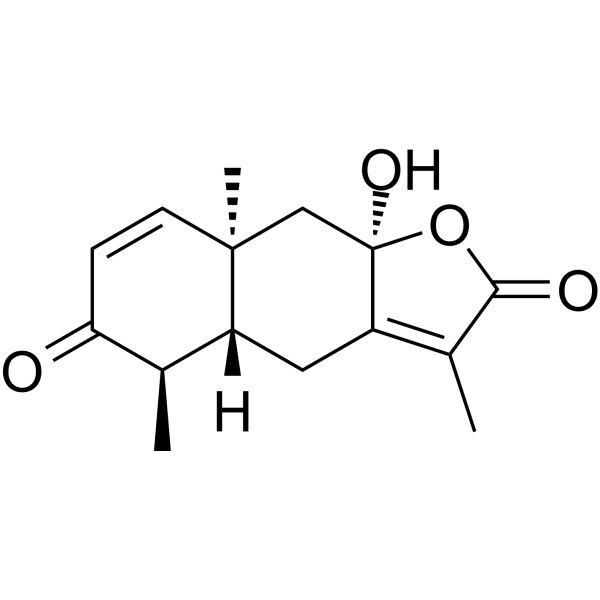
Eudebeiolide B
Eudebeiolide B is a compound that can be isolated from Salvia plebeia R. Br. Eudebeiolide B inhibits osteoclastogenesis by regulating RANKL-induced NF-κB, c-Fos and calcium signaling. Eudebeiolide B can be used for osteoclast-related diseases research.
Nur für Forschungszwecke. Wir verkaufen nicht an Patienten.
- CAS. Nr.: 1934299-51-0
- Formel: C15H18O4
- Molecular Weight:262.30
-
Speicherung:
Please store the product under the recommended conditions in the Certificate of Analysis.

To place orders, for customer services and technical support, please contact: MedChemExpress USA
Tel: 609-228-6898 E-mail: [email protected] [email protected]


-
 Biologische Aktivität
-
Chemical Information
- Protokoll
- Reinheit & Dokumentation
- Verweise
-
 Help & FAQs




Biologische Aktivität
Beschreibung
IC50 & Target
[1]|
Akt |
NF-κB |
Cellular Effect
|
Cell Line

|
Type | Value | Description | References |
|---|---|---|---|---|
| HepG2 | IC50 |
27.8 μM
Compound: 10
|
Down regulation of PCSK9 mRNA expression in human HepG2 cells incubated for 24 hrs by SYBR green dye-based qRT-PCR analysis
Down regulation of PCSK9 mRNA expression in human HepG2 cells incubated for 24 hrs by SYBR green dye-based qRT-PCR analysis
|
[PMID: 33567826] |
| RAW264.7 | IC50 |
68.9 μM
Compound: 18
|
Anti-inflammatory activity in mouse RAW264.7 cells assessed as reduction in LPS-induced NO production preincubated for 30 mins followed by LPS stimulation measured after 24 hrs by Griess assay
Anti-inflammatory activity in mouse RAW264.7 cells assessed as reduction in LPS-induced NO production preincubated for 30 mins followed by LPS stimulation measured after 24 hrs by Griess assay
|
[PMID: 28960981] |
In Vitro
Eudebeiolide B (1-30 μΜ, 1 hour) suppresses RANKL-induced osteoclast differentiation and function in mouse bone marrow macrophages (BMMs)[1].
Eudebeiolide B (1-30 μΜ, 1 hour) inhibits the expression of osteoclastogenesis-related marker genes and RANKL-mediated cellular signaling [1].
MedChemExpress (MCE) has not independently confirmed the accuracy of these methods. They are for reference only.
-
Cell Line:Bone marrow macrophages (BMMs)
-
Concentration:1-30 μΜ
-
Incubation Time:1 hours
-
Result:Inhibited RANKL-induced osteoclast differentiation of BMMs, bone resorption, and promotes osteoblast differentiation.
-
Cell Line:Bone marrow macrophages (BMMs), MC3T3-E1 cells
-
Concentration:10 μΜ
-
Incubation Time:1 hours
-
Result:Downregulated the expression of NFATc1 and c-fos, transcription factors induced by RANKL.
Attenuated the RANKL-induced expression of osteoclastogenesis-related genes, including Ctsk, MMP9 and DC-STAMP.
Induced the expression of alkaline phosphatase (ALP) and calcium accumulation during MC3T3-E1 osteoblast differentiation.
-
Cell Line:Bone marrow macrophages (BMMs)
-
Concentration:10 μΜ
-
Incubation Time:1 hours
-
Result:Inhibited the phosphorylation of Akt and NF-κB p65.
Downregulated the expression of CREB, Btk and phospholipase PLCγ2 in RANKL-induced calcium signaling.
In Vivo
MedChemExpress (MCE) has not independently confirmed the accuracy of these methods. They are for reference only.
-
Animal Model:Ovariectomized (OVX) mouse model[1]
-
Dosage:5 or 10 mg/kg
-
Administration:After 6 weeks of ovarian resection, intragastric injection (i.g.) once daily for 6 weeks.
-
Result:Prevented bone mineral density (BMD) loss and bone mineral content (BMC) loss compared to the OVX mice.


Chemical Information
-
CAS. Nr. 1934299-51-0
-
Molecular Weight 262.30
-
Formel C15H18O4
-
SMILES
O[C@]12C(C[C@@]3([H])[C@](C1)(C=CC([C@@H]3C)=O)C)=C(C(O2)=O)C
-
Synonyms
Plebeiolide D
-
Structure Classification
-
Initial Source
-
Versand
Room temperature in continental US; may vary elsewhere.
-
Speicherung
Please store the product under the recommended conditions in the Certificate of Analysis.


Reinheit & Dokumentation
Verweise

Calculators
Konzentration (Stammlösung) × Volumen (Stammlösung) = Konzentration (Ziellösung) × Volumen (Ziellösung)


Eudebeiolide B Related Classifications
HY-N11775 Related Classifications
 Powered by Bioz