



DS01080522
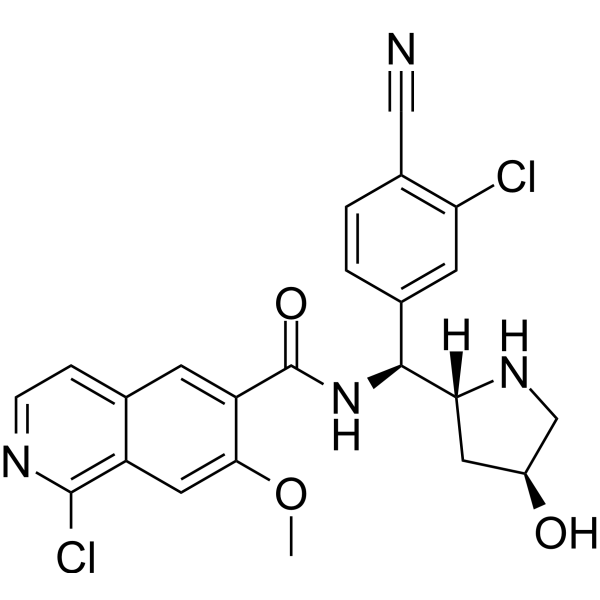
DS01080522 is a Protein Kinase cAMP-Activated Catalytic Subunit Alpha (PRKACA) inhibitor. DS01080522 inhibits PRKACA kinase activity and CREB phosphorylation with IC50s of 0.8 nM and 66 nM, respectively. DS01080522 can be used for the research of cancer.
For research use only. We do not sell to patients.
- CAS No.: 2832159-84-7
- Formula: C23H20Cl2N4O3
- Molecular Weight:471.34
-
Storage:
Please store the product under the recommended conditions in the Certificate of Analysis.

To place orders, for customer services and technical support, please contact: MedChemExpress USA
Tel: 609-228-6898 E-mail: [email protected] [email protected]


-
 Biological Activity
-
Chemical Information
- Protocols
- Purity & Documentation
- References
-
 Help & FAQs




Biological Activity
Description
IC50 & Target
IC50: 0.8 nM (PRKACA kinase), 66 nM (CREB phosphorylation)[1]
In Vitro
DS01080522 (1-10 μM; 30 min) affects phosphorylation of CREB[1].
MedChemExpress (MCE) has not independently confirmed the accuracy of these methods. They are for reference only.
-
Cell Line:NIH/3T3 cells
-
Concentration:1-10 μM
-
Incubation Time:30 min
-
Result:Dose-dependently decreased the phosphorylation level of CREB which is a marker of intracellular PRAKACA inhibitory activity in NIH/3T3 cells with an IC50 value of 66 nM.


Chemical Information
-
CAS No. 2832159-84-7
-
Molecular Weight 471.34
-
Formula C23H20Cl2N4O3
-
SMILES
O=C(N[C@H]([C@@]1([H])C[C@H](O)CN1)C2=CC(Cl)=C(C#N)C=C2)C3=CC4=CC=NC(Cl)=C4C=C3OC
-
Shipping
Room temperature in continental US; may vary elsewhere.
-
Storage
Please store the product under the recommended conditions in the Certificate of Analysis.


Purity & Documentation
References

Calculators
Concentration (start) × Volume (start) = Concentration (final) × Volume (final)


DS01080522 Related Classifications
HY-150073 Related Classifications
 Powered by Bioz