



Flipper-TR 5
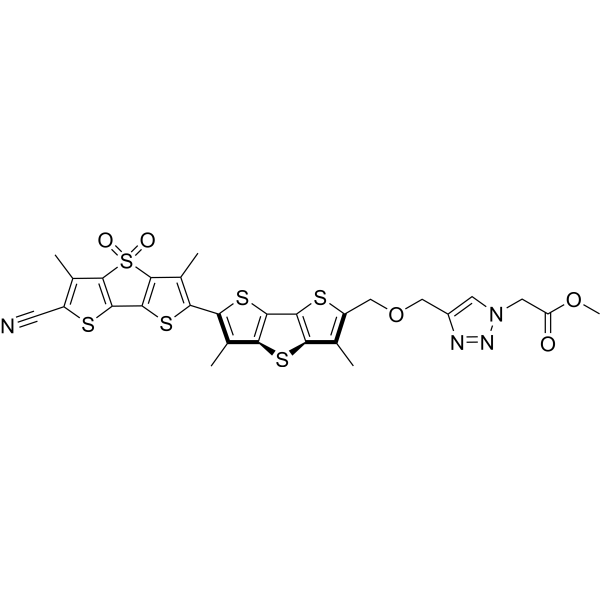
Flipper-TR 5 is a Flipper probe containing a terminal carboxylate for retention on the plasma membrane. Flipper-TR 5 selectively labels the cytoplasmic membrane, and exhibits excellent mechanical sensitivity, negligible cytotoxicity and controllable phototoxicity.
For research use only. We do not sell to patients.
- CAS No.: 2081888-04-0
- Formula: C27H20N4O5S6
- Molecular Weight:672.86
-
Storage:
Please store the product under the recommended conditions in the Certificate of Analysis.

To place orders, for customer services and technical support, please contact: MedChemExpress USA
Tel: 609-228-6898 E-mail: [email protected] [email protected]


-
 Biological Activity
-
Chemical Information
- Protocols
- Purity & Documentation
- References
-
 Help & FAQs




Biological Activity
Description
In Vitro
Flipper-TR 5 exhibits ground-state planarization-dependent fluorescence and spectral shifts in solution and lipid bilayer membranes, with increasing red shifts, fluorescence intensity, and vibrational finestructure in increasingly ordered membranes[1].
Flipper-TR 5 shows longer fluorescence lifetimes in more ordered Lo lipid bilayer membranes compared to Ld membranes in GUVs, with non-selective partitioning but phase-dependent fluorescence intensity[1].
Flipper-TR 5 reports on membrane tension and organization in living cells, with fluorescence lifetimes that shift in response to hyperosmotic stress in plasma membranes, ER, and Golgi apparatus, and baseline lifetime differences driven by membrane order[1].
MedChemExpress (MCE) has not independently confirmed the accuracy of these methods. They are for reference only.
In Vivo
MedChemExpress (MCE) has not independently confirmed the accuracy of these methods. They are for reference only.


Chemical Information
-
CAS No. 2081888-04-0
-
Molecular Weight 672.86
-
Formula C27H20N4O5S6
-
SMILES
CC1=C(C#N)SC(C2=C3C(C)=C(C4=C(C)C(SC5=C6SC(COCC7=CN(CC(O)=O)N=N7)=C5C)=C6S4)S2)=C1S3(=O)=O
-
Shipping
Room temperature in continental US; may vary elsewhere.
-
Storage
Please store the product under the recommended conditions in the Certificate of Analysis.


Purity & Documentation
References

Calculators
Concentration (start) × Volume (start) = Concentration (final) × Volume (final)


Flipper-TR 5 Related Classifications
HY-D2318 Related Classifications
 Powered by Bioz