



AzddMeC

Based on 1 Customer Validation
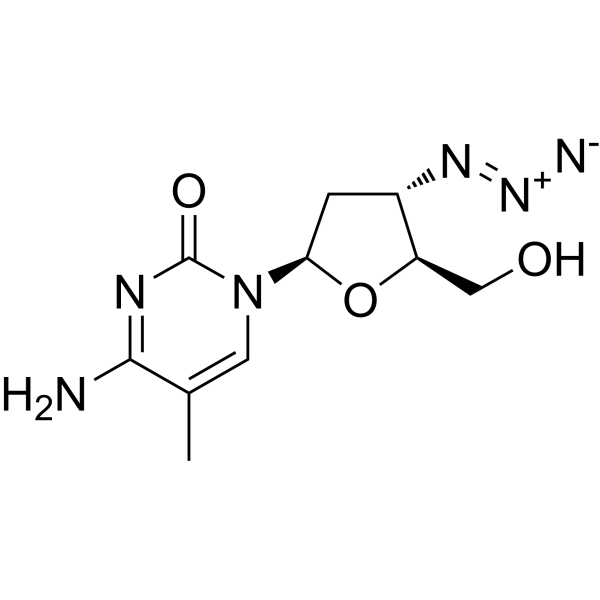
AzddMeC (CS-92) is an antiviral nucleoside analogue and a potent potent, selective and orally active HIV-1 reverse transcriptase and HIV-1 replication inhibitor. In HIV-1-infected human PBM cells and HIV-1-infected human macrophages, the EC50 values of AzddMeC are 9 nM and 6 nM, respectively. AzddMeC is a click chemistry reagent, it contains an Azide group and can undergo copper-catalyzed azide-alkyne cycloaddition reaction (CuAAc) with molecules containing Alkyne groups. It can also undergo strain-promoted alkyne-azide cycloaddition (SPAAC) reactions with molecules containing DBCO or BCN groups.
For research use only. We do not sell to patients.
- Purity : 99.86%
- CAS No.: 87190-79-2
- Formula: C10H14N6O3
- Molecular Weight:266.26
-
Storage:
4°C, sealed storage, away from moisture
* In solvent : -80°C, 6 months; -20°C, 1 month (sealed storage, away from moisture)

To place orders, for customer services and technical support, please contact: MedChemExpress USA
Tel: 609-228-6898 E-mail: [email protected] [email protected]


-
 Biological Activity
-
Chemical Information
-
Solvent & Solubility
- Protocols
- Purity & Documentation
- References
-
 Help & FAQs





Biological Activity
Description
IC50 & Target
[1]|
HIV-2 |
HIV-1 9 nM (EC50, Human PBM cells) |
HIV-1 6 nM (EC50, Human macrophages) |
Cellular Effect
|
Cell Line

|
Type | Value | Description | References |
|---|---|---|---|---|
| ATH-8 cell line | ED50 |
>100 μM
Compound: 1f
|
Protection of ATH8 cells against the cytopathic effect of HIV.
Protection of ATH8 cells against the cytopathic effect of HIV.
|
[PMID: 3497272] |
| MT4 | ED50 |
1.8 μM
Compound: 1h
|
Dose required to inhibit cytopathic effect of human immunodeficiency virus replication in MT-4 cells.
Dose required to inhibit cytopathic effect of human immunodeficiency virus replication in MT-4 cells.
|
[PMID: 3172142] |
In Vitro
AzddMeC (CS-92) is also effective against HIV-2 in lymphocytes. The replication of Friend murine virus is only weakly inhibited, and no effect is observed against HSV type 1 and type 2 and coxsackievirus B4. The interaction of the 5'-triphosphate of AzddMeC with HIV-1 reverse transcriptase indicated competitive inhibition (the inhibition constant, Kis, is 9.3 nM)[1].
MedChemExpress (MCE) has not independently confirmed the accuracy of these methods. They are for reference only. Further protocols information, click here.
In Vivo
MedChemExpress (MCE) has not independently confirmed the accuracy of these methods. They are for reference only.


Chemical Information
-
CAS No. 87190-79-2
-
Appearance Solid
-
Molecular Weight 266.26
-
Formula C10H14N6O3
-
Color White to off-white
-
SMILES
O=C1N([C@H]2C[C@H](N=[N+]=[N-])[C@@H](CO)O2)C=C(C)C(N)=N1
-
Synonyms
CS-92
-
Shipping
Room temperature in continental US; may vary elsewhere.
-
Storage
4°C, sealed storage, away from moisture
* In solvent : -80°C, 6 months; -20°C, 1 month (sealed storage, away from moisture)


Solvent & Solubility
In Vitro:
DMSO : 200 mg/mL (751.15 mM; Need ultrasonic; Hygroscopic DMSO has a significant impact on the solubility of product, please use newly opened DMSO)
Please refer to the solubility information to select the appropriate solvent. Once prepared, please aliquot and store the solution to prevent product inactivation from repeated freeze-thaw cycles.
Storage method and period of stock solution: -80°C, 6 months; -20°C, 1 month (sealed storage, away from moisture). When stored at -80°C, please use it within 6 months. When stored at -20°C, please use it within 1 month.
Please refer to the solubility information to select the appropriate solvent. Once prepared, please aliquot and store the solution to prevent product inactivation from repeated freeze-thaw cycles.
Storage method and period of stock solution: -80°C, 6 months; -20°C, 1 month (sealed storage, away from moisture). When stored at -80°C, please use it within 6 months. When stored at -20°C, please use it within 1 month.
Concentration (start) × Volume (start) = Concentration (final) × Volume (final)

Protocols
-
Research Protocol for Infectious Diseases
Infectious-disease experiments test how pathogens interact with host barriers, innate immune receptors, inflammatory signaling, pathogen replication, and tissue injury; pattern-recognition receptors such as TLRs, RIG-I-like receptors, NOD-like receptors, and inflammasomes detect microbial molecules and activate NF-κB, interferon, and cytokine responses. The central hypothesis is that infection severity reflects the balance between pathogen burden and host response: protective inflammation restricts pathogen growth, whereas excessive or mislocalized inflammation contributes to tissue damage and disease phenotype. Unresolved questions include which host pathways are protective versus pathogenic, why some infection models fail to translate to human disease, and which combined readouts best predict clinically relevant infection outcomes.
-
EdU Incorporation Assay (Click Chemistry-Based DNA Synthesis Measurement)
The EdU incorporation assay measures DNA synthesis by adding the thymidine analog 5-ethynyl-2′-deoxyuridine to cells or tissues, where it is incorporated into newly synthesized DNA during S phase. Incorporated EdU is detected by copper-catalyzed azide-alkyne cycloaddition, in which a fluorescent azide covalently reacts with the ethynyl group on EdU, allowing S-phase cells to be detected by fluorescence microscopy, flow cytometry, or high-content imaging. EdU detection does not require DNA denaturation or anti-BrdU antibody access, which preserves sample structure and improves compatibility with immunostaining and multiparameter cytometry compared with BrdU-based detection. EdU can be cytotoxic in a cell-type- and exposure-dependent manner, so pulse duration, concentration, and continuous-labeling designs should be validated for each cell type.


Purity & Documentation
-
Data Sheet (273 KB)
-
SDS (394 KB)
- English - EN (394 KB)
- Français - FR (394 KB)
- Deutsch - DE (394 KB)
- Norwegian - NO (394 KB)
- Español - ES (394 KB)
- Swedish - SV (394 KB)
- Italian - IT (394 KB)
- Korean - KR (394 KB)
- Portuguese - PT (394 KB)
-
Handling Instructions (2659 KB)
References
[1]. R F Schinazi, et al. Antiretroviral Activity, Biochemistry, and Pharmacokinetics of 3'-azido-2',3'-dideoxy-5-methylcytidine. Ann N Y Acad Sci. 1990;616:385-97. [Content Brief]
[2]. Boudinot FD, et al. Pharmacokinetics and metabolism of 3'-azido-2',3'-dideoxy-5-methylcytidine in rhesus monkeys. Drug Metab Dispos. 1993;21(5):855‐860. [Content Brief]


Complete Stock Solution Preparation Table
Please refer to the solubility information to select the appropriate solvent. Once prepared, please aliquot and store the solution to prevent product inactivation from repeated freeze-thaw cycles.
Storage method and period of stock solution: -80°C, 6 months; -20°C, 1 month (sealed storage, away from moisture). When stored at -80°C, please use it within 6 months. When stored at -20°C, please use it within 1 month.
| Optional Solvent | Concentration Solvent Mass | 1 mg | 5 mg | 10 mg | 25 mg |
|---|---|---|---|---|---|
| DMSO | 1 mM | 3.7557 mL | 18.7786 mL | 37.5573 mL | 93.8932 mL |
| 5 mM | 0.7511 mL | 3.7557 mL | 7.5115 mL | 18.7786 mL | |
| 10 mM | 0.3756 mL | 1.8779 mL | 3.7557 mL | 9.3893 mL | |
| 15 mM | 0.2504 mL | 1.2519 mL | 2.5038 mL | 6.2595 mL | |
| 20 mM | 0.1878 mL | 0.9389 mL | 1.8779 mL | 4.6947 mL | |
| 25 mM | 0.1502 mL | 0.7511 mL | 1.5023 mL | 3.7557 mL | |
| 30 mM | 0.1252 mL | 0.6260 mL | 1.2519 mL | 3.1298 mL | |
| 40 mM | 0.0939 mL | 0.4695 mL | 0.9389 mL | 2.3473 mL | |
| 50 mM | 0.0751 mL | 0.3756 mL | 0.7511 mL | 1.8779 mL | |
| 60 mM | 0.0626 mL | 0.3130 mL | 0.6260 mL | 1.5649 mL | |
| 80 mM | 0.0469 mL | 0.2347 mL | 0.4695 mL | 1.1737 mL | |
| 100 mM | 0.0376 mL | 0.1878 mL | 0.3756 mL | 0.9389 mL |


AzddMeC Related Classifications
HY-105268 Related Classifications
 Powered by Bioz