



AzGGK

Based on 1 Customer Validation
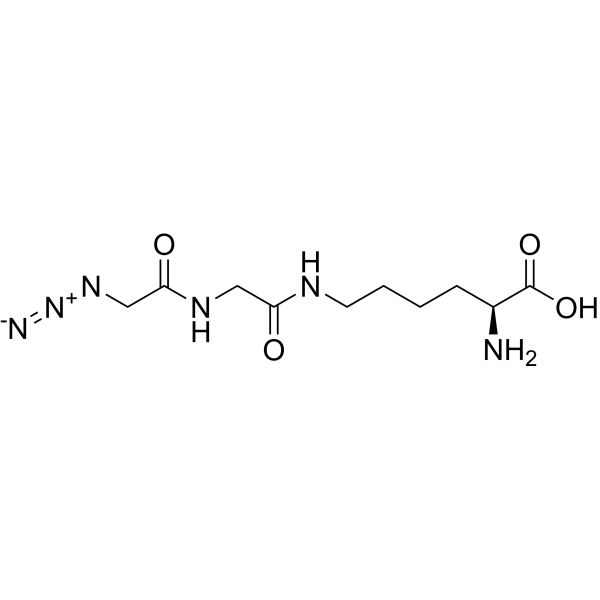
AzGGK is an unnatural amino acid. AzGGK is site-specifically incorporated into proteins via genetic-code expansion. AzGGK can be used as site-specific probe for ubiquitylation and SUMOylation. AzGGK is a click chemistry reagent, it contains an Azide group and can undergo copper-catalyzed azide-alkyne cycloaddition reaction (CuAAc) with molecules containing Alkyne groups. It can also undergo strain-promoted alkyne-azide cycloaddition (SPAAC) reactions with molecules containing DBCO or BCN groups.
For research use only. We do not sell to patients.
- Purity : 99.72%
- CAS No.: 2407768-11-8
- Formula: C10H18N6O4
- Molecular Weight:286.29
-
Storage:
Sealed storage, away from moisture.
Powder -80°C, 2 years , -20°C, 1 year* In solvent : -80°C, 6 months; -20°C, 1 month (sealed storage, away from moisture)

To place orders, for customer services and technical support, please contact: MedChemExpress USA
Tel: 609-228-6898 E-mail: [email protected] [email protected]


-
 Biological Activity
-
Chemical Information
-
Solvent & Solubility
- Protocols
- Purity & Documentation
- References
-
 Help & FAQs




Biological Activity
Description
In Vitro
Click chemistry is used to describe the selective, modular, wide range and high-yield chemical reactions that allow rapid synthesis of new compounds through heteroatom linking (C-X-C). Bertozzi developed click chemistry in a new dimension —Bioorthogonal chemistry. It is defined as a rapid and selective reaction that does not interfere with biological processes under physiological conditions. Common reaction structures of click chemistry, such as Azide, Alkyne, DBCO, BCN, TCO and Tetrazine.?
MedChemExpress (MCE) has not independently confirmed the accuracy of these methods. They are for reference only.


Chemical Information
-
CAS No. 2407768-11-8
-
Appearance Solid
-
Molecular Weight 286.29
-
Formula C10H18N6O4
-
Color White to off-white
-
SMILES
[N-]=[N+]=NCC(NCC(NCCCC[C@H](N)C(O)=O)=O)=O
-
Shipping
Room temperature in continental US; may vary elsewhere.
-
Storage
Sealed storage, away from moisture
Powder -80°C 2 years -20°C 1 year * In solvent : -80°C, 6 months; -20°C, 1 month (sealed storage, away from moisture)


Solvent & Solubility
In Vitro:
H2O : 50 mg/mL (174.65 mM; Need ultrasonic)
DMSO : 3.33 mg/mL (11.63 mM; ultrasonic and warming and heat to 60°C; Hygroscopic DMSO has a significant impact on the solubility of product, please use newly opened DMSO)
Please refer to the solubility information to select the appropriate solvent. Once prepared, please aliquot and store the solution to prevent product inactivation from repeated freeze-thaw cycles.
Storage method and period of stock solution: -80°C, 6 months; -20°C, 1 month (sealed storage, away from moisture). When stored at -80°C, please use it within 6 months. When stored at -20°C, please use it within 1 month.
* Note: If you choose water as the stock solution, please dilute it to the working solution, then filter and sterilize it with a 0.22 μm filter before use.
Please refer to the solubility information to select the appropriate solvent. Once prepared, please aliquot and store the solution to prevent product inactivation from repeated freeze-thaw cycles.
Storage method and period of stock solution: -80°C, 6 months; -20°C, 1 month (sealed storage, away from moisture). When stored at -80°C, please use it within 6 months. When stored at -20°C, please use it within 1 month.
* Note: If you choose water as the stock solution, please dilute it to the working solution, then filter and sterilize it with a 0.22 μm filter before use.
Concentration (start) × Volume (start) = Concentration (final) × Volume (final)


Purity & Documentation
-
Data Sheet (268 KB)
-
SDS (252 KB)
- English - EN (252 KB)
- Français - FR (252 KB)
- Deutsch - DE (252 KB)
- Norwegian - NO (252 KB)
- Español - ES (252 KB)
- Swedish - SV (252 KB)
- Italian - IT (252 KB)
- Korean - KR (252 KB)
- Portuguese - PT (252 KB)
-
Handling Instructions (2659 KB)
References


Complete Stock Solution Preparation Table
Please refer to the solubility information to select the appropriate solvent. Once prepared, please aliquot and store the solution to prevent product inactivation from repeated freeze-thaw cycles.
Storage method and period of stock solution: -80°C, 6 months; -20°C, 1 month (sealed storage, away from moisture). When stored at -80°C, please use it within 6 months. When stored at -20°C, please use it within 1 month.
| Optional Solvent | Concentration Solvent Mass | 1 mg | 5 mg | 10 mg | 25 mg |
|---|---|---|---|---|---|
| DMSO / H2O | 1 mM | 3.4930 mL | 17.4648 mL | 34.9296 mL | 87.3240 mL |
| 5 mM | 0.6986 mL | 3.4930 mL | 6.9859 mL | 17.4648 mL | |
| 10 mM | 0.3493 mL | 1.7465 mL | 3.4930 mL | 8.7324 mL | |
| H2O | 15 mM | 0.2329 mL | 1.1643 mL | 2.3286 mL | 5.8216 mL |
| 20 mM | 0.1746 mL | 0.8732 mL | 1.7465 mL | 4.3662 mL | |
| 25 mM | 0.1397 mL | 0.6986 mL | 1.3972 mL | 3.4930 mL | |
| 30 mM | 0.1164 mL | 0.5822 mL | 1.1643 mL | 2.9108 mL | |
| 40 mM | 0.0873 mL | 0.4366 mL | 0.8732 mL | 2.1831 mL | |
| 50 mM | 0.0699 mL | 0.3493 mL | 0.6986 mL | 1.7465 mL | |
| 60 mM | 0.0582 mL | 0.2911 mL | 0.5822 mL | 1.4554 mL | |
| 80 mM | 0.0437 mL | 0.2183 mL | 0.4366 mL | 1.0916 mL | |
| 100 mM | 0.0349 mL | 0.1746 mL | 0.3493 mL | 0.8732 mL |
* Note: If you choose water as the stock solution, please dilute it to the working solution, then filter and sterilize it with a 0.22 μm filter before use.


AzGGK Related Classifications
HY-148835 Related Classifications
 Powered by Bioz