



Bathocuproine

Based on 1 Customer Validation
Bathocuproine is a phenanthroline chelator that binds specifically to Cu+. Bathocuproine preferentially binds Cu+ over Cu2+ to form a chromogenic complex, which is used to detect the oxidation state of copper in biomolecules. Bathocuproine undergoes concentration-dependent self-association to form dimers, and it can engage in aromatic stacking interactions with aromatic residues of Aβ (Kd ≈ 1 mM). Bathocuproine is applicable to research related to Alzheimer's disease.
For research use only. We do not sell to patients.
- Purity : 98.01%
- CAS No.: 4733-39-5
- Formula: C26H20N2
- Molecular Weight:360.46
-
Storage:
Store at room temperature 3 years.
In solvent -80°C, 2 years , -20°C, 1 year


To place orders, for customer services and technical support, please contact: MedChemExpress USA
Tel: 609-228-6898 E-mail: [email protected] [email protected]


-
 Biological Activity
-
Chemical Information
- Protocols
- Purity & Documentation
- References
-
 Help & FAQs


-
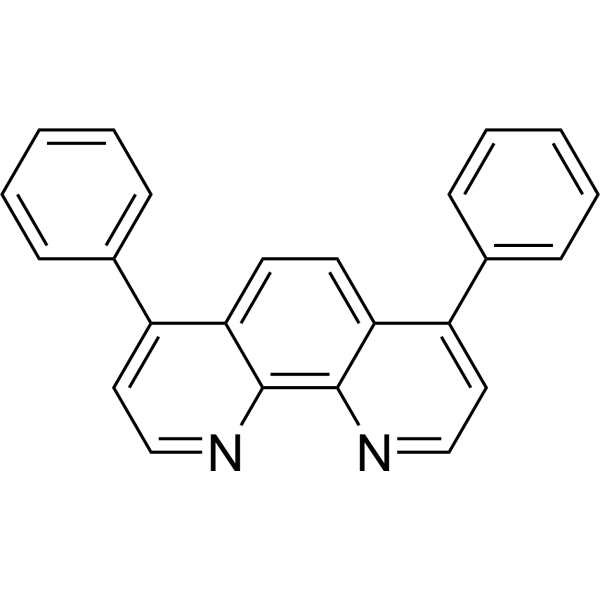
HY-D0006
BathophenanthrolineActive Compound -

HY-121310
PhthalocyaninePhotosensitizer -
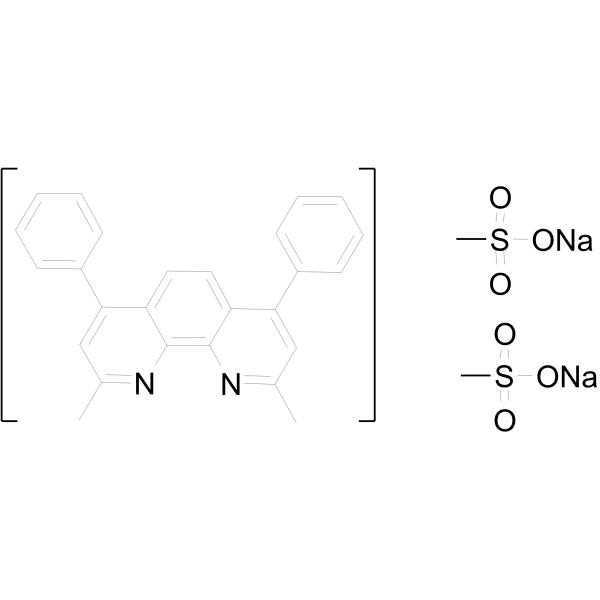
HY-W034953
Bathocuproine disulfonate disodiumBiochemical Assay Reagent -
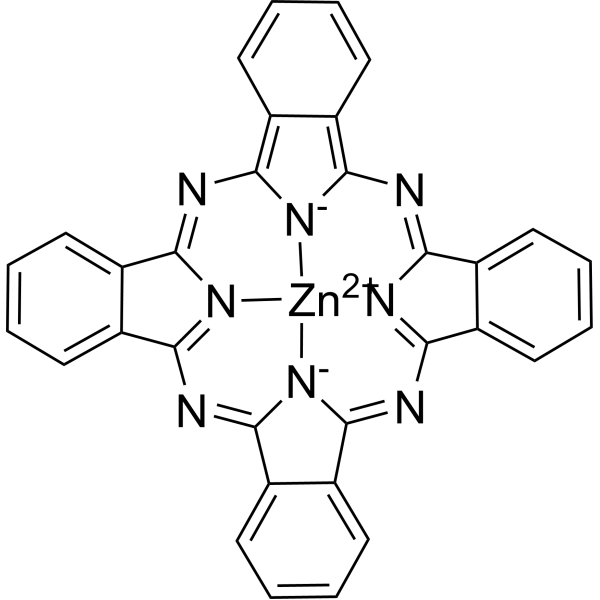
HY-19204
Zinc phthalocyaninePhotooxidant -

HY-W025445
Spiro-MeOTADHole Transport Layer Material -

HY-W073017
Copper(II) Phthalocyanine (purified by sublimation)Metal-organic Framework -

HY-W004583
2,9-Dichloro-1,10-phenanthrolineMetal-organic Framework -
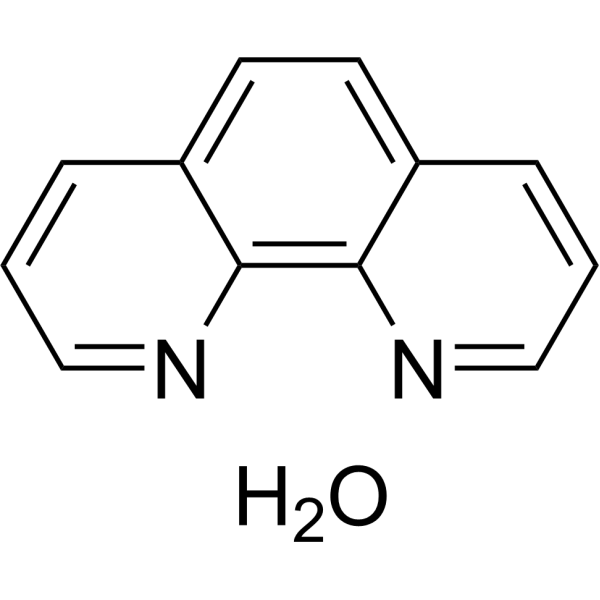
HY-Y1841
o-Phenanthroline monohydrateMMP Inhibitor -

HY-W116336B
Zinc oxide, 99.99% metals basisBiochemical Assay Reagents -

HY-W116336D
Zinc oxide, <100 nm particle sizeNitrate Reductase Activator -

HY-W008874
meso-Tetra(4-pyridyl)porphineTop1 Inhibitor -

HY-W035136
Meso-tetrakis(4-aminophenyl)porphyrinEndogenous Metabolite


Biological Activity
Description
Cellular Effect
|
Cell Line

|
Type | Value | Description | References |
|---|---|---|---|---|
| ScN2a | IC50 |
80 nM
Compound: Bathocuproine
|
Inhibition of PrP-res formation in mouse ScN2a cells relative to control
Inhibition of PrP-res formation in mouse ScN2a cells relative to control
|
[PMID: 16987659] |
In Vitro
Bathocuproine (0.32-3.16 mM) undergoes reversible monomer-dimer self-association in aqueous solution at 25 °C, with an association constant of 0.64 mM-1.
Bathocuproine (0.32-3.16 mM) binds to the Aβ40 peptide only in its dimeric form in aqueous solution at 25 °C, with a dissociation constant of approximately 1 mM under conditions where the dimer accounts for ≥ 40% of the total[2].
MedChemExpress (MCE) has not independently confirmed the accuracy of these methods. They are for reference only. Further protocols information, click here.


Chemical Information
-
CAS No. 4733-39-5
-
Appearance Solid
-
Molecular Weight 360.46
-
Formula C26H20N2
-
Color Light yellow to brown
-
SMILES
N=1C(=CC(C=2C=CC=CC2)=C3C=CC4=C(N=C(C=C4C=5C=CC=CC5)C)C13)C
-
Shipping
Room temperature in continental US; may vary elsewhere.
-
Storage
Store at room temperature 3 years
In solvent -80°C 2 years -20°C 1 year

Protocols
-
Alzheimer’s Disease Modeling
Alzheimer’s Disease (AD) is a neurodegenerative disorder characterized by a progressive decline in cognitive functions and loss of specific types of neurons and synapses. Alzheimer's symptoms can be simulated in mice by injecting drugs (such as Aβ) or genetically modified.


Purity & Documentation
-
Data Sheet (271 KB)
-
SDS (393 KB)
- English - EN (393 KB)
- Français - FR (393 KB)
- Deutsch - DE (393 KB)
- Norwegian - NO (393 KB)
- Español - ES (393 KB)
- Swedish - SV (393 KB)
- Italian - IT (393 KB)
- Korean - KR (393 KB)
- Portuguese - PT (393 KB)
-
Handling Instructions (2659 KB)
References
[1]. Chen D, et al. An improved Bathocuproine assay for accurate valence identification and quantification of copper bound by biomolecules. Anal Biochem. 2016;497:27-35. [Content Brief]
[2]. Yao S, et al. Characterizing bathocuproine self-association and subsequent binding to Alzheimer's disease amyloid beta-peptide by NMR. J Pept Sci. 2004;10(4):210-217. [Content Brief]

Calculators
Concentration (start) × Volume (start) = Concentration (final) × Volume (final)


Bathocuproine Related Classifications
HY-D0005 Related Classifications
 Powered by Bioz