



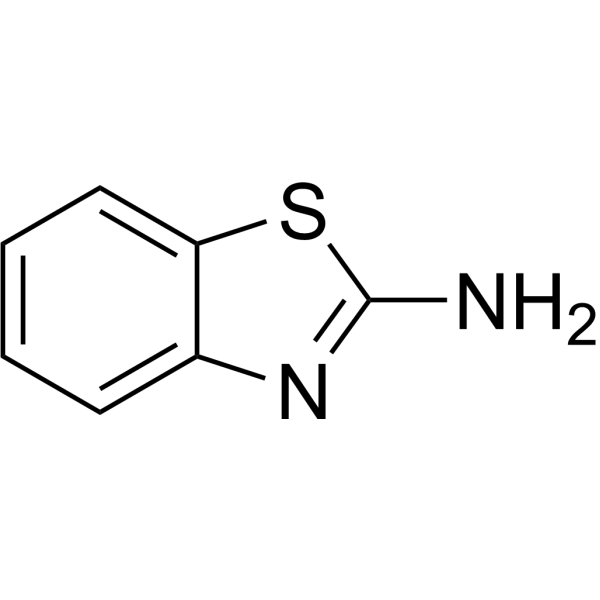
2-Aminobenzothiazole (Standard)
2-Aminobenzothiazole (Standard) is the analytical standard of 2-Aminobenzothiazole. This product is intended for research and analytical applications. 2-Aminobenzothiazole acts as a caspase 3/7 activator, an anticancer cytotoxic agent, and also exhibits neurotoxicity. 2-Aminobenzothiazole drives the apoptotic pathway by activating caspase 3/7, induces mitochondrial inner membrane depolarization, and triggers both early and late apoptosis via a caspase-dependent pathway. In zebrafish models, 2-Aminobenzothiazole induces oxidative damage in brain tissues and inhibits genes related to GABA and 5-HT synthesis pathways. Long-term exposure to 2-Aminobenzothiazole impairs motor ability, social behavior, anxiety-like state and cognitive function. 2-Aminobenzothiazole can be used in studies of human laryngeal carcinoma and related neurotoxicity.
For research use only. We do not sell to patients.
- Purity : 98%
- CAS No.: 136-95-8
- Formula: C7H6N2S
- Molecular Weight:150.20
-
Storage:
Please store the product under the recommended conditions in the Certificate of Analysis.


To place orders, for customer services and technical support, please contact: MedChemExpress USA
Tel: 609-228-6898 E-mail: [email protected] [email protected]


-
 Product Information
-
Chemical Information
- Purity & Documentation
-
 Help & FAQs


-
HY-W017424
2-AminobenzothiazoleCaspase 3/7 Activator -
HY-W012634
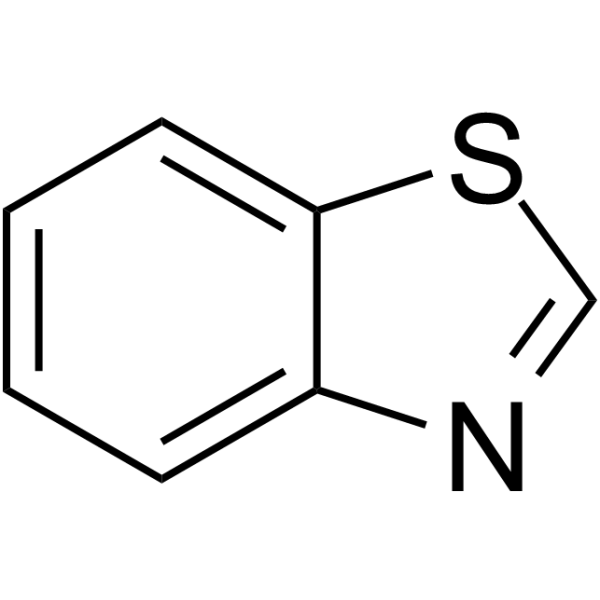
BenzothiazoleHeterocyclic Nuclei -
HY-59318
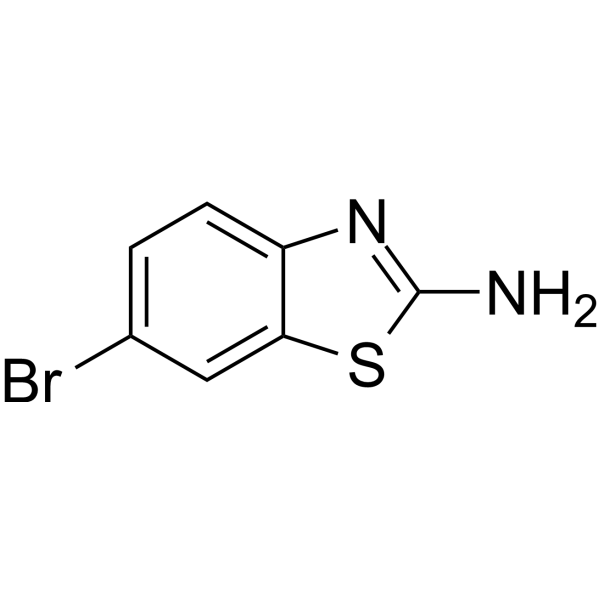
2-Amino-6-bromobenzothiazoleBiochemical Reagent -

HY-78699
2-HydrazinobenzothiazoleIDO1 Inhibitor -
HY-W040269
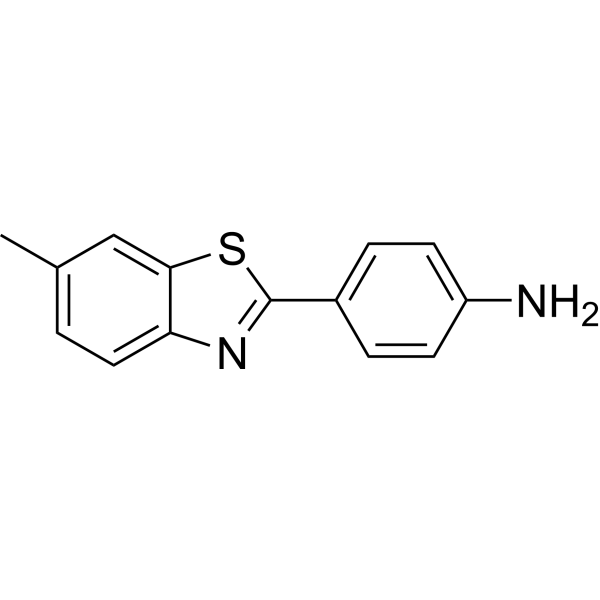
Dehydrothio-p-toluidineChemical Intermediate -
![6-Bromobenzo[d]thiazole](https://file.medchemexpress.com/product_pic/hy-w003182.gif)
HY-W003182
6-Bromobenzo[d]thiazoleBiochemical Reagent -

HY-W003372
Pramipexole impurity 9Pramipexole Impurity -

HY-W005799
E3 ligase Ligand 80E3 Ligase Ligand -

HY-W019633
Benzothiazole-5-boronic acid pinacol esterBiochemical Assay Reagents -
![Methyl 2-bromo-4-fluorobenzo[d]thiazole-6-carboxylate](https://file.medchemexpress.com/product_pic/hy-w021608.gif)
HY-W021608
Methyl 2-bromo-4-fluorobenzo[d]thiazole-6-carboxylateDrug Intermediate -

HY-W012634R
Benzothiazole (Standard)Heterocyclic Nuclei -
![(S)-4,5,6,7-Tetrahydrobenzo[d]thiazole-2,6-diamine (Standard)](https://file.medchemexpress.com/product_pic/hy-w003372r.gif)
HY-W003372R
(S)-4,5,6,7-Tetrahydrobenzo[d]thiazole-2,6-diamine (Standard)


Product Information
Information
Application
The compound is the grade of analytical standard, which is the reference standard supplied assay. It is commonly used in qualitative, quantitative and methodological research experiments in HPLC, GC and MS.


Chemical Information
-
CAS No. 136-95-8
-
Molecular Weight 150.20
-
Formula C7H6N2S
-
SMILES
NC1=NC2=CC=CC=C2S1
-
Shipping
Room temperature in continental US; may vary elsewhere.
-
Storage
Please store the product under the recommended conditions in the Certificate of Analysis.


Purity & Documentation
References
[1]. Haznedar B, et al. Investigation of proapoptotic and cytotoxic effects of 2-aminobenzothiazole on human laryngeal carcinoma cells. Eur Rev Med Pharmacol Sci. 2024;28(4):1585-1593. [Content Brief]
[2]. Gu J, et al. Neurobehavioral toxic effects and mechanisms of 2-aminobenzothiazole exposure on zebrafish. Sci Total Environ. 2024;913:169495. [Content Brief]

Calculators
Concentration (start) × Volume (start) = Concentration (final) × Volume (final)


2-Aminobenzothiazole (Standard) Related Classifications
HY-W017424R Related Classifications
 Powered by Bioz