



Bletilloside A

Based on 1 Customer Validation
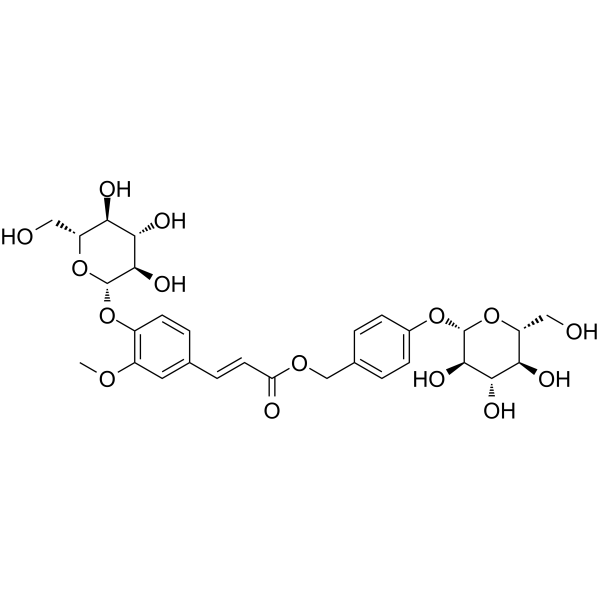
Bletilloside A is a glycoside. Bletilloside A can be isolated from the tubers of Bletilla striata. Bletilloside A inhibits the expression of the TCL1A protein. When evaluated for its inhibitory activity against LPS-induced NO, Bletilloside A shows an IC50 of >70 μM. Bletilloside A exhibits anticancer activity against acute myeloid leukemia. Bletilloside A can be used in studies related to acute myeloid leukemia.
For research use only. We do not sell to patients.
- Purity : 99.88%
- CAS No.: 2292159-89-6
- Formula: C29H36O15
- Molecular Weight:624.59
-
Storage:
4°C, protect from light
* In solvent : -80°C, 6 months; -20°C, 1 month (protect from light)

To place orders, for customer services and technical support, please contact: MedChemExpress USA
Tel: 609-228-6898 E-mail: [email protected] [email protected]


-
 Biological Activity
-
Chemical Information
- Protocols
- Purity & Documentation
- References
-
 Help & FAQs




Biological Activity
Description
In Vitro
Bletilloside A (1-128 μM; 48 h) inhibits the proliferation of three acute myeloid leukemia cell lines, SKNO-1, MV4-11 and HL-60[1].
Bletilloside A (30-60 μM) reduces the expression of TCL1A protein in SKNO-1 and HL-60 acute myeloid leukemia (AML) cell lines[1].
Bletilloside A (0-240 μM; 24 h) shows no cytotoxicity against RAW 264.7 macrophages, with a CC50 >240 μM[2].
Bletilloside A (1 h) exhibits an IC50 of >70 μM when evaluated for its LPS-induced NO inhibitory activity in RAW 264.7 macrophages[2].
MedChemExpress (MCE) has not independently confirmed the accuracy of these methods. They are for reference only.
-
Cell Line:human AML cell lines SKNO-1, MV4-11, HL-60
-
Concentration:1-128 μM
-
Incubation Time:48 h
-
Result:Significantly inhibited the proliferation of SKNO-1, MV4-11, and HL-60 AML cells, with IC60 values of 29.906 μM, 36.410 μM, and 89.395 μM, respectively.


Chemical Information
-
CAS No. 2292159-89-6
-
Appearance Solid
-
Molecular Weight 624.59
-
Formula C29H36O15
-
Color White to off-white
-
SMILES
COC1=C(C=CC(/C=C/C(OCC(C=C2)=CC=C2O[C@@H]([C@@H]([C@H]3O)O)O[C@@H]([C@H]3O)CO)=O)=C1)O[C@@H]([C@@H]([C@H]4O)O)O[C@@H]([C@H]4O)CO
-
Structure Classification
-
Shipping
Room temperature in continental US; may vary elsewhere.
-
Storage
4°C, protect from light
* In solvent : -80°C, 6 months; -20°C, 1 month (protect from light)


Purity & Documentation
-
Data Sheet (270 KB)
-
SDS (251 KB)
- English - EN (251 KB)
- Français - FR (251 KB)
- Deutsch - DE (251 KB)
- Norwegian - NO (251 KB)
- Español - ES (251 KB)
- Swedish - SV (251 KB)
- Italian - IT (251 KB)
- Korean - KR (251 KB)
- Portuguese - PT (251 KB)
-
Handling Instructions (2659 KB)
References
[1]. Hong Y, et al. New drug targets for acute myeloid leukemia identified through a comprehensive analysis of the plasma protein. BMC Cancer. 2025;26(1):91. Published 2025 Dec 10. [Content Brief]
[2]. Zhao Y, et al. Chemical constituents from Bletilla striata and their NO production suppression in RAW 264.7 macrophage cells. J Asian Nat Prod Res. 2018;20(4):385-390. [Content Brief]

Calculators
Concentration (start) × Volume (start) = Concentration (final) × Volume (final)


Bletilloside A Related Classifications
HY-N8177 Related Classifications
 Powered by Bioz