



BODIPY-X-Alkyne

Based on 1 Customer Validation
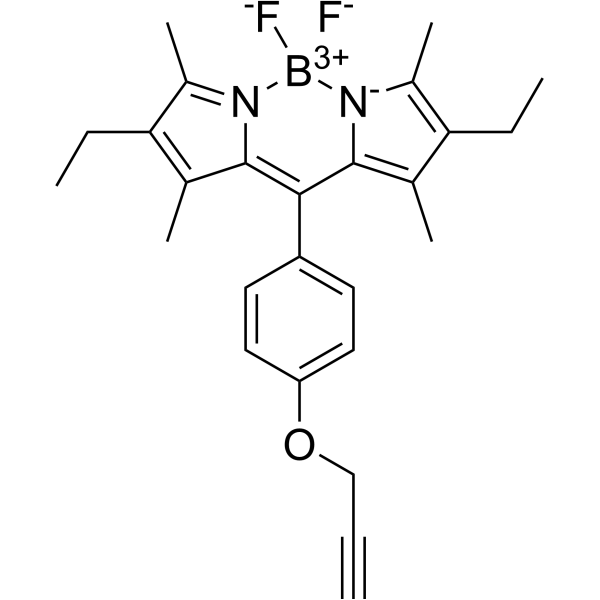
BODIPY-X-Alkyne is a BODIPY-derived fluorescent chromophore bearing a primary alkyne group, which serves as a click chemistry-compatible fluorescent label and maintains its excitation and emission properties in biological buffers. The absorption wavelength is 526 nm, and the emission wavelength is 540 nm.
For research use only. We do not sell to patients.
- Purity : 96.0%
- CAS No.: 1173281-82-7
- Formula: C26H29BF2N2O
- Molecular Weight:434.33
-
Storage:
-20°C, protect from light
* In solvent : -80°C, 6 months; -20°C, 1 month (protect from light)

To place orders, for customer services and technical support, please contact: MedChemExpress USA
Tel: 609-228-6898 E-mail: [email protected] [email protected]


-
 Biological Activity
-
Chemical Information
- Protocols
- Purity & Documentation
- References
-
 Help & FAQs




Biological Activity
Description
In Vitro
Propargyl-BODIPY dye 11 displays photophysical properties typical of BODIPY chromophores in dichloromethane, with absorption at 526 nm, emission at 540 nm, quantum yield of 0.72, and a fluorescence half-life of 6.67 ns[1].
MedChemExpress (MCE) has not independently confirmed the accuracy of these methods. They are for reference only. Further protocols information, click here.
Emission (Em)
540


Chemical Information
-
CAS No. 1173281-82-7
-
Appearance Solid
-
Molecular Weight 434.33
-
Formula C26H29BF2N2O
-
Color Orange to red
-
SMILES
[F-][B+3]1([N]2=C(C)C(CC)=C(C)C2=C(C3=C(C)C(CC)=C(C)[N-]31)C4=CC=C(C=C4)OCC#C)[F-]
-
Shipping
Room temperature in continental US; may vary elsewhere.
-
Storage
-20°C, protect from light
* In solvent : -80°C, 6 months; -20°C, 1 month (protect from light)

Protocols
-
EdU Incorporation Assay (Click Chemistry-Based DNA Synthesis Measurement)
The EdU incorporation assay measures DNA synthesis by adding the thymidine analog 5-ethynyl-2′-deoxyuridine to cells or tissues, where it is incorporated into newly synthesized DNA during S phase. Incorporated EdU is detected by copper-catalyzed azide-alkyne cycloaddition, in which a fluorescent azide covalently reacts with the ethynyl group on EdU, allowing S-phase cells to be detected by fluorescence microscopy, flow cytometry, or high-content imaging. EdU detection does not require DNA denaturation or anti-BrdU antibody access, which preserves sample structure and improves compatibility with immunostaining and multiparameter cytometry compared with BrdU-based detection. EdU can be cytotoxic in a cell-type- and exposure-dependent manner, so pulse duration, concentration, and continuous-labeling designs should be validated for each cell type.


Purity & Documentation
-
Data Sheet (270 KB)
-
SDS (393 KB)
- English - EN (393 KB)
- Français - FR (393 KB)
- Deutsch - DE (393 KB)
- Norwegian - NO (393 KB)
- Español - ES (393 KB)
- Swedish - SV (393 KB)
- Italian - IT (393 KB)
- Korean - KR (393 KB)
- Portuguese - PT (393 KB)
-
Handling Instructions (2659 KB)
References

Calculators
Concentration (start) × Volume (start) = Concentration (final) × Volume (final)


BODIPY-X-Alkyne Related Classifications
HY-D1588 Related Classifications
 Powered by Bioz