



c-ABL-IN-5
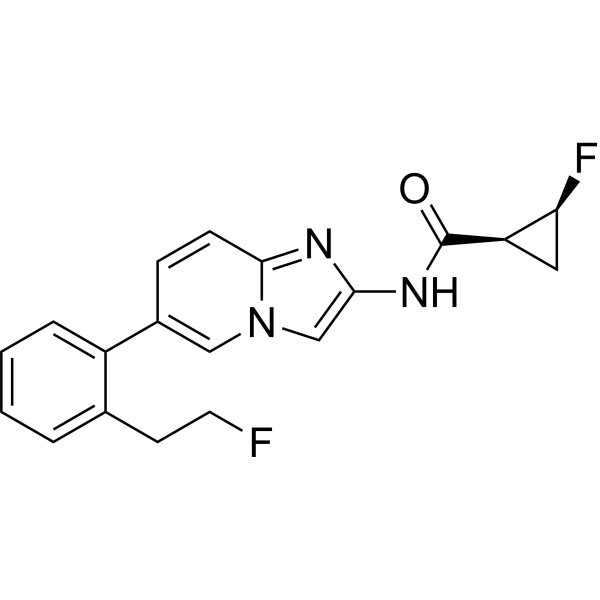
c-ABL-IN-5 is a selective c-Abl inhibitor with neuroprotective effects. c-ABL-IN-5 has blood-brain barrier penetrability, metabolic stability and good pharmacokinetic properties. When c-ABL-IN-5 is labeled with [18F] (compound [18F]3), it can be used as a tracer to evaluate disease-modifying efficacy by complementary positron emission tomography (PET). c-ABL-IN-5 can be used in the study of neurodegenerative diseases such as Parkinson's disease (PD).
For research use only. We do not sell to patients.
- CAS No.: 3056613-20-5
- Formula: C19H17F2N3O
- Molecular Weight:341.35
-
Storage:
Please store the product under the recommended conditions in the Certificate of Analysis.

To place orders, for customer services and technical support, please contact: MedChemExpress USA
Tel: 609-228-6898 E-mail: [email protected] [email protected]


-
 Biological Activity
-
Chemical Information
- Protocols
- Purity & Documentation
- References
-
 Help & FAQs




Biological Activity
Description
IC50 & Target
c-Abl[1]


Chemical Information
-
CAS No. 3056613-20-5
-
Molecular Weight 341.35
-
Formula C19H17F2N3O
-
SMILES
O=C(NC1=CN2C=C(C=CC2=N1)C3=CC=CC=C3CCF)[C@H]4[C@H](C4)F
-
Shipping
Room temperature in continental US; may vary elsewhere.
-
Storage
Please store the product under the recommended conditions in the Certificate of Analysis.

Protocols
-
Human pluripotent stem cell midbrain dopaminergic neuron differentiation
Human pluripotent stem cells are directed toward midbrain dopaminergic neurons by first inducing a neural floor-plate-like progenitor state, then patterning cells with ventralizing SHH signaling and midbrain/WNT-FGF cues, and finally maturing progenitors into neurons expressing dopaminergic markers such as TH, NURR1/NR4A2, PITX3, DAT/SLC6A3, VMAT2/SLC18A2, GIRK2/KCNJ6, FOXA2, LMX1A, and EN1. The main readouts are loss of pluripotency, acquisition of FOXA2+/LMX1A+ midbrain floor-plate progenitors, emergence of βIII-tubulin+/MAP2+ neurons, and production of TH+ dopaminergic neurons with molecular, dopamine-release, and electrophysiological features of midbrain dopaminergic identity.


Purity & Documentation
References

Calculators
Concentration (start) × Volume (start) = Concentration (final) × Volume (final)


c-ABL-IN-5 Related Classifications
HY-156102 Related Classifications
 Powered by Bioz