



RhlR antagonist 1
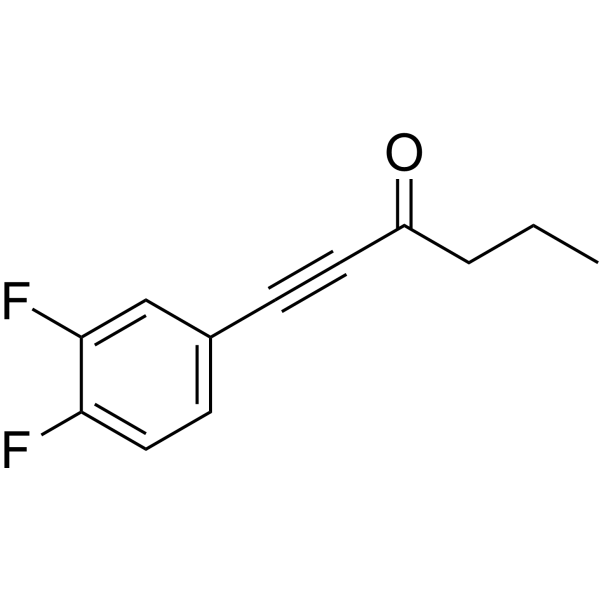
RhlR antagonist 1 is a potent RhlR antagonist with an IC50 of 26 μM. RhlR antagonist 1 displays selective RhlR antagonism over LasR and PqsR, strong inhibition of biofilm formation in static and dynamic settings, and reduces production of virulence factors such as rhamnolipid and pyocyanin in P. aeruginosa. RhlR antagonist 1 can be utilized for developing QS-modulating molecules in the control of P. aeruginosa infections. RhlR antagonist 1 is a click chemistry reagent, it contains an Alkyne group and can undergo copper-catalyzed azide-alkyne cycloaddition (CuAAc) with molecules containing Azide groups.
For research use only. We do not sell to patients.
- CAS No.: 2614320-29-3
- Formula: C12H10F2O
- Molecular Weight:208.20
-
Storage:
Please store the product under the recommended conditions in the Certificate of Analysis.

To place orders, for customer services and technical support, please contact: MedChemExpress USA
Tel: 609-228-6898 E-mail: [email protected] [email protected]


-
 Biological Activity
-
Chemical Information
- Protocols
- Purity & Documentation
- References
-
 Help & FAQs




Biological Activity
Description
In Vitro
RhlR antagonist 1 (compound 30) (10 μM) inhibits P. aeruginosa biofilm formation by 74% and decreases the amount of carbohydrate and protein by 39 and 72%, respectively. RhlR antagonist 1 reduces significantly rhamnolipid production by P. aeruginosa at 10 and 100 μM concentrations. RhlR antagonist 1 (0-10 μM; 24 hours) down-regulates rhlA expression of biofilm cells. RhlR antagonist 1 could inhibit P. aeruginosa biofilm formation and virulence factor production by down-regulating the rhlA expression of PP. aeruginosa[1].
MedChemExpress (MCE) has not independently confirmed the accuracy of these methods. They are for reference only. Further protocols information, click here.
In Vivo
MedChemExpress (MCE) has not independently confirmed the accuracy of these methods. They are for reference only.


Chemical Information
-
CAS No. 2614320-29-3
-
Molecular Weight 208.20
-
Formula C12H10F2O
-
SMILES
CCCC(C#CC1=CC=C(F)C(F)=C1)=O
-
Shipping
Room temperature in continental US; may vary elsewhere.
-
Storage
Please store the product under the recommended conditions in the Certificate of Analysis.

Protocols
-
EdU Incorporation Assay (Click Chemistry-Based DNA Synthesis Measurement)
The EdU incorporation assay measures DNA synthesis by adding the thymidine analog 5-ethynyl-2′-deoxyuridine to cells or tissues, where it is incorporated into newly synthesized DNA during S phase. Incorporated EdU is detected by copper-catalyzed azide-alkyne cycloaddition, in which a fluorescent azide covalently reacts with the ethynyl group on EdU, allowing S-phase cells to be detected by fluorescence microscopy, flow cytometry, or high-content imaging. EdU detection does not require DNA denaturation or anti-BrdU antibody access, which preserves sample structure and improves compatibility with immunostaining and multiparameter cytometry compared with BrdU-based detection. EdU can be cytotoxic in a cell-type- and exposure-dependent manner, so pulse duration, concentration, and continuous-labeling designs should be validated for each cell type.
-
Cell Cytotoxicity Assay
Cytotoxicity assays are usually based on the assessment of cell membrane damage, which can also be indirectly detected by measuring cell viability. Detection methods include MTT assay, CKK-8 assay, LDH assay and ATP assay, etc.
-
Fungal Biofilm Culture
Fungal biofilm culture is an in vitro method for growing surface-attached fungal communities, most commonly Candida albicans, on abiotic substrates such as polystyrene wells, silicone elastomer, or polymethylmethacrylate; the assay models adhesion, proliferation, filamentation, extracellular-matrix-associated maturation, and dispersion. Biofilm output can be read by optical density at 600 nm for adherent biomass, XTT reduction for metabolic activity, CFU recovery for viable attached or dispersed cells, and microscopy for architecture.


Purity & Documentation
References

Calculators
Concentration (start) × Volume (start) = Concentration (final) × Volume (final)


RhlR antagonist 1 Related Classifications
HY-131337 Related Classifications
 Powered by Bioz