



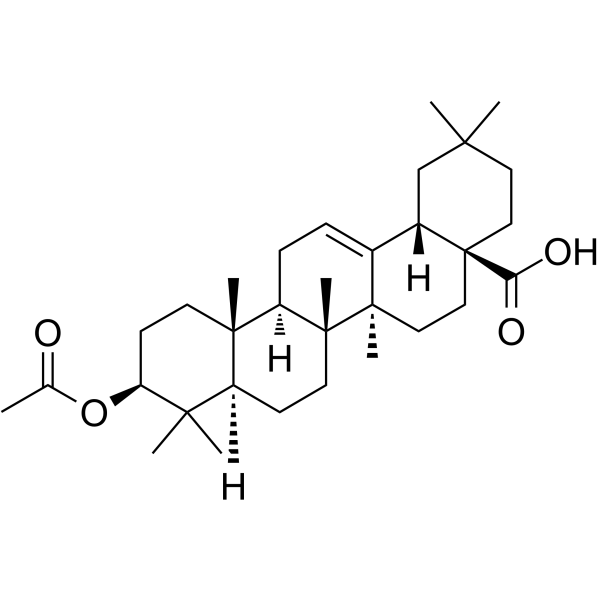
3-O-Acetyloleanolic acid

Based on 1 Customer Validation
3-O-Acetyloleanolic acid (3AOA), an oleanolic acid derivative isolated from the seeds of Vigna sinensis K., induces in cancer and also exhibits anti-angiogenesis activity.
Nos produits utilisent uniquement pour la recherche. Nous ne vendons pas aux patients.
- Pureté : 99.84%
- CAS No.: 4339-72-4
- Formule: C32H50O4
- Masse moléculaire:498.74
-
Stockage:
4°C, protect from light
* In solvent : -80°C, 6 months; -20°C, 1 month (protect from light)

To place orders, for customer services and technical support, please contact: MedChemExpress USA
Tel: 609-228-6898 E-mail: [email protected] [email protected]


-
 Activité biologique
-
Chemical Information
-
Solvant et solubilité
- Protocole
- Pureté et documentation
- Références
-
 Help & FAQs




Activité biologique
Description
IC50 & Target
Apoptosis[1].
Cellular Effect
|
Cell Line

|
Type | Value | Description | References |
|---|---|---|---|---|
| A549 | IC50 |
5.8 μM
Compound: 1
|
Antiproliferative activity against human A549 cells harbouring wild type EGFR incubated for 72 hrs by SRB assay
Antiproliferative activity against human A549 cells harbouring wild type EGFR incubated for 72 hrs by SRB assay
|
[PMID: 31718182] |
| B16-F10 | IC50 |
64.7 μM
Compound: 5
|
Cytotoxicity against mouse B16F10 cells after 72 hrs by MTT assay
Cytotoxicity against mouse B16F10 cells after 72 hrs by MTT assay
|
[PMID: 24480359] |
| B16-F10 | IC50 |
64.7 μM
Compound: V; OA-Ac
|
Cytotoxicity against mouse B16F10 cells assessed as growth inhibition after 72 hrs by MTT assay
Cytotoxicity against mouse B16F10 cells assessed as growth inhibition after 72 hrs by MTT assay
|
[PMID: 27128174] |
| HepG2 | IC50 |
>100 μM
Compound: 10
|
Anticancer activity against human HepG2 cells assessed as cell viability after 48 hrs by MTT assay
Anticancer activity against human HepG2 cells assessed as cell viability after 48 hrs by MTT assay
|
[PMID: 24974349] |
| HepG2 | IC50 |
103.67 μM
Compound: V; OA-Ac
|
Cytotoxicity against human HepG2 cells assessed as growth inhibition after 72 hrs by MTT assay
Cytotoxicity against human HepG2 cells assessed as growth inhibition after 72 hrs by MTT assay
|
[PMID: 27128174] |
| HT-29 | IC50 |
148.48 μM
Compound: V; OA-Ac
|
Cytotoxicity against human HT-29 cells assessed as growth inhibition after 72 hrs by MTT assay
Cytotoxicity against human HT-29 cells assessed as growth inhibition after 72 hrs by MTT assay
|
[PMID: 27128174] |
| J774.A1 | IC50 |
16.8 μM
Compound: 2
|
Inhibition of LPS-induced NO production in mouse J774A1 cells compound preincubated for 1 hr before LPS treatment by Griess reaction
Inhibition of LPS-induced NO production in mouse J774A1 cells compound preincubated for 1 hr before LPS treatment by Griess reaction
|
[PMID: 25113933] |
| J774.A1 | IC50 |
80.34 μM
Compound: 2
|
Cytotoxicity against mouse J774A1 cells assessed as cell viability by MTT assay relative to control
Cytotoxicity against mouse J774A1 cells assessed as cell viability by MTT assay relative to control
|
[PMID: 25113933] |
| KB | IC50 |
7.6 μM
Compound: 1
|
Antiproliferative activity against human KB cells incubated for 72 hrs by SRB assay
Antiproliferative activity against human KB cells incubated for 72 hrs by SRB assay
|
[PMID: 31718182] |
| MCF7 | IC50 |
>10 μM
Compound: 1
|
Antiproliferative activity against human MCF7 cells incubated for 72 hrs by SRB assay
Antiproliferative activity against human MCF7 cells incubated for 72 hrs by SRB assay
|
[PMID: 31718182] |
| MDA-MB-231 | IC50 |
>10 μM
Compound: 1
|
Antiproliferative activity against human MDA-MB-231 cells incubated for 72 hrs by SRB assay
Antiproliferative activity against human MDA-MB-231 cells incubated for 72 hrs by SRB assay
|
[PMID: 31718182] |
| Neutrophil | IC50 |
>10 μg/mL
Compound: Table 3, R21C1
|
Anti-inflammatory activity in human neutrophils assessed as inhibition of fMLP/CB-induced elastase release pre-incubated for 5 mins before fMLP/CB stimulation using MeO-Suc-Ala-Ala-Pro-Val-pnitroanilide as substrate
Anti-inflammatory activity in human neutrophils assessed as inhibition of fMLP/CB-induced elastase release pre-incubated for 5 mins before fMLP/CB stimulation using MeO-Suc-Ala-Ala-Pro-Val-pnitroanilide as substrate
|
[PMID: 28218000] |
| Neutrophil | IC50 |
>10 μg/mL
Compound: Table 3, R21C1
|
Anti-inflammatory activity in human neutrophils assessed as inhibition of fMLP/CB-induced superoxide anion generation by measuring superoxide dismutase SOD-inhibitable ferricytochrome c reduction incubated for 5 mins before fMLP/CB stimulation for 3 mins
Anti-inflammatory activity in human neutrophils assessed as inhibition of fMLP/CB-induced superoxide anion generation by measuring superoxide dismutase SOD-inhibitable ferricytochrome c reduction incubated for 5 mins before fMLP/CB stimulation for 3 mins
|
[PMID: 28218000] |
| RAW264.7 | IC50 |
13.8 μM
Compound: 2
|
Inhibition of LPS-induced NO production in mouse RAW264.7 cells compound preincubated for 1 hr before LPS treatment by Griess reaction
Inhibition of LPS-induced NO production in mouse RAW264.7 cells compound preincubated for 1 hr before LPS treatment by Griess reaction
|
[PMID: 25113933] |
| RAW264.7 | IC50 |
79.23 μM
Compound: 2
|
Cytotoxicity mouse RAW264.7 cells assessed as cell viability by MTT assay relative to control
Cytotoxicity mouse RAW264.7 cells assessed as cell viability by MTT assay relative to control
|
[PMID: 25113933] |


Chemical Information
-
CAS No. 4339-72-4
-
Appearance Solid
-
Masse moléculaire 498.74
-
Formule C32H50O4
-
Color White to off-white
-
SMILES
C[C@]12[C@]3(C([C@@]4([H])[C@](C(O)=O)(CCC(C)(C)C4)CC3)=CC[C@]1([H])[C@@]5([C@@](C(C)([C@@H](OC(C)=O)CC5)C)([H])CC2)C)C
-
Structure Classification
-
Initial Source
-
Livraison
Room temperature in continental US; may vary elsewhere.
-
Stockage
4°C, protect from light
* In solvent : -80°C, 6 months; -20°C, 1 month (protect from light)


Solvant et solubilité
In Vitro:
DMSO : 2 mg/mL (4.01 mM; ultrasonic and warming and heat to 60°C; Hygroscopic DMSO has a significant impact on the solubility of product, please use newly opened DMSO)
Please refer to the solubility information to select the appropriate solvent. Once prepared, please aliquot and store the solution to prevent product inactivation from repeated freeze-thaw cycles.
Storage method and period of stock solution: -80°C, 6 months; -20°C, 1 month (protect from light). When stored at -80°C, please use it within 6 months. When stored at -20°C, please use it within 1 month.
Please refer to the solubility information to select the appropriate solvent. Once prepared, please aliquot and store the solution to prevent product inactivation from repeated freeze-thaw cycles.
Storage method and period of stock solution: -80°C, 6 months; -20°C, 1 month (protect from light). When stored at -80°C, please use it within 6 months. When stored at -20°C, please use it within 1 month.
Concentration (start) × Volume (start) = Concentration (final) × Volume (final)


Pureté et documentation
-
Fiche technique (273 KB)
-
SDS (393 KB)
- English - EN (393 KB)
- Français - FR (393 KB)
- Deutsch - DE (393 KB)
- Norwegian - NO (393 KB)
- Español - ES (393 KB)
- Swedish - SV (393 KB)
- Italian - IT (393 KB)
- Korean - KR (393 KB)
- Portuguese - PT (393 KB)
-
Instruction de manipulation (2659 KB)
Références
[1]. Yoo KH, et al. 3-O-acetyloleanolic acid induces apoptosis in human colon carcinoma HCT-116 cells. Phytother Res. 2012 Oct;26(10):1541-6. [Content Brief]
[2]. Hwang-Bo J, et al. 3-O-Acetyloleanolic acid inhibits VEGF-A-induced lymphangiogenesis and lymph node metastasis in an oral cancer sentinel lymph node animal model. BMC Cancer. 2018 Jul 5;18(1):714. [Content Brief]


Complete Stock Solution Preparation Table
Please refer to the solubility information to select the appropriate solvent. Once prepared, please aliquot and store the solution to prevent product inactivation from repeated freeze-thaw cycles.
Storage method and period of stock solution: -80°C, 6 months; -20°C, 1 month (protect from light). When stored at -80°C, please use it within 6 months. When stored at -20°C, please use it within 1 month.
| Optional Solvent | Concentration Solvent Mass | 1 mg | 5 mg | 10 mg | 25 mg |
|---|---|---|---|---|---|
| DMSO | 1 mM | 2.0051 mL | 10.0253 mL | 20.0505 mL | 50.1263 mL |


3-O-Acetyloleanolic acid Related Classifications
HY-N2618 Related Classifications
 Powered by Bioz