



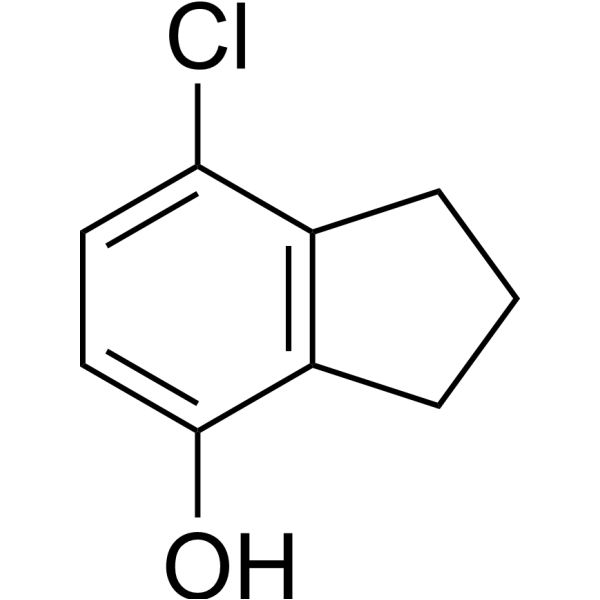
Chlorindanol

Based on 1 Customer Validation
Chlorindanol (Clorindanol) is a disinfectant. Chlorindanol inhibits Gram-negative and Gram-positive multiplying bacteria, dermatophytes, fungi, and viral RNA replication/translation. Chlorindanol immobilizes and kills sperm. Chlorindanol is used in the research of flavivirus infection and trichomoniasis.
Nos produits utilisent uniquement pour la recherche. Nous ne vendons pas aux patients.
- Pureté : 98.02%
- CAS No.: 145-94-8
- Formule: C9H9ClO
- Masse moléculaire:168.62
-
Stockage:
-20°C, stored under nitrogen
* In solvent : -80°C, 6 months; -20°C, 1 month (stored under nitrogen)

To place orders, for customer services and technical support, please contact: MedChemExpress USA
Tel: 609-228-6898 E-mail: [email protected] [email protected]


-
 Activité biologique
-
Chemical Information
-
Solvant et solubilité
- Protocole
- Pureté et documentation
- Références
-
 Help & FAQs




Activité biologique
Description
In Vitro
Chlorindanol (0.0025-1.0 mg/mL) exhibits broad-spectrum antimicrobial activity against Gram-negative bacteria, Gram-positive bacteria, and fungi, with minimum inhibitory concentrations and bactericidal concentrations typically ranging from 0.0125 to 0.4 mg/mL[1].
Chlorindanol exhibits amoebicidal activity against Endamoeba histolytica, with dilutions reaching 1:10,000 for trophozoites and 1:2,500 for cysts[1].
Chlorindanol exhibits rapid bactericidal activity against various bacteria and fungi at room temperature, with killing times ranging from less than 5 minutes to 60 minutes, depending on the microbial species and dilution[1].
Chlorindanol exhibits trichomonacidal activity, rapidly immobilizing and killing Trichomonas species at dilutions ranging from 1:2,000 to 1:8,000[1].
Chlorindanol exhibits potent spermicidal activity, immobilizing sperm immediately at dilutions of 1:2,000 and 1:3,000[1].
Chlorindanol inhibits ZIKV infection in Huh-7.5 cells[2].
MedChemExpress (MCE) has not independently confirmed the accuracy of these methods. They are for reference only.
In Vivo
In a three-week oral toxicity test in rats, chlorindanol (200-800 mg/Kg; p.o.; daily; 21 days) at 200 mg/Kg/day is completely tolerated, while 400 and 800 mg/Kg/day cause dose-related retardation of weight gain without deaths[1].
MedChemExpress (MCE) has not independently confirmed the accuracy of these methods. They are for reference only.
-
Animal Model:Swiss (Webster) albino (male, weighing 22 ± 2.0 Gm)[1]
-
Dosage:48 mg/Kg (i.v.); 96 mg/Kg (i.p., 7 days); 920 mg/Kg (p.o., 7 days)
-
Administration:p.o. (stomach tube); i.v. (tail vein); i.p.
-
Result:Achieved LD50 of 48 mg/Kg at 24 hrs and 48 mg/Kg at 7 days intravenously.
Achieved LD50 of 188 mg/Kg at 24 hrs and 96 mg/Kg at 7 days intraperitoneally.
Achieved LD50 of 960 mg/Kg at 24 hrs and 920 mg/Kg at 7 days orally.
-
Animal Model:Sprague-Dawley (male albino)[1]
-
Dosage:200-800 mg/Kg
-
Administration:p.o. (stomach tube); daily; 21 days
-
Result:Resulted in complete tolerance at 200 mg/Kg/day.
Caused body weight depression of 11.3% at 400 mg/Kg and 38% at 800 mg/Kg compared to controls.
Showed no deaths at 400 and 800 mg/Kg.


Chemical Information
-
CAS No. 145-94-8
-
Appearance Solid
-
Masse moléculaire 168.62
-
Formule C9H9ClO
-
Color White to off-white
-
SMILES
OC1=CC=C(Cl)C2=C1CCC2
-
Synonyms
Clorindanol; 7-Chloro-4-indanol
-
Livraison
Room temperature in continental US; may vary elsewhere.
-
Stockage
-20°C, stored under nitrogen
* In solvent : -80°C, 6 months; -20°C, 1 month (stored under nitrogen)


Solvant et solubilité
In Vitro:
DMSO : 100 mg/mL (593.05 mM; Need ultrasonic; Hygroscopic DMSO has a significant impact on the solubility of product, please use newly opened DMSO)
Please refer to the solubility information to select the appropriate solvent. Once prepared, please aliquot and store the solution to prevent product inactivation from repeated freeze-thaw cycles.
Storage method and period of stock solution: -80°C, 6 months; -20°C, 1 month (stored under nitrogen). When stored at -80°C, please use it within 6 months. When stored at -20°C, please use it within 1 month.
Please refer to the solubility information to select the appropriate solvent. Once prepared, please aliquot and store the solution to prevent product inactivation from repeated freeze-thaw cycles.
Storage method and period of stock solution: -80°C, 6 months; -20°C, 1 month (stored under nitrogen). When stored at -80°C, please use it within 6 months. When stored at -20°C, please use it within 1 month.
Concentration (start) × Volume (start) = Concentration (final) × Volume (final)
In Vivo:
Select the appropriate dissolution method based on your experimental animal and administration route.
- For the following dissolution methods, please ensure to first prepare a clear stock solution using an In Vitro approach and then sequentially add co-solvents:
- To ensure reliable experimental results, the clarified stock solution can be appropriately stored based on storage conditions. As for the working solution for In Vivo experiments, it is recommended to prepare freshly and use it on the same day.
- The percentages shown for the solvents indicate their volumetric ratio in the final prepared solution. If precipitation or phase separation occurs during preparation, heat and/or sonication can be used to aid dissolution.
Add each solvent one by one: 10% DMSO 40% PEG300 5% Tween-80 45% Saline
Solubility: ≥ 2.5 mg/mL (14.83 mM); Clear solution
This protocol yields a clear solution of ≥ 2.5 mg/mL (saturation unknown).
Taking 1 mL working solution as an example, add 100 μL DMSO stock solution (25.0 mg/mL) to 400 μL PEG300, and mix evenly; then add 50 μL Tween-80 and mix evenly; then add 450 μL Saline to adjust the volume to 1 mL.
Preparation of Saline: Dissolve 0.9 g sodium chloride in ddH₂O and dilute to 100 mL to obtain a clear Saline solution.
In Vivo Dissolution Calculator
Please enter the basic information of animal experiments:
-
-
-
-
Recommended: Prepare an additional quantity of animals to account for potential losses during experiments.
Please enter your animal formula composition:
-
%DMSO +
Recommended: Keep the proportion of DMSO in working solution below 2% if your animal is weak.
-
%+
-
+%Tween-80 + +
-
%Saline +
The co-solvents required include: DMSO, . All of co-solvents are available by MedChemExpress (MCE). , Tween 80. All of co-solvents are available by MedChemExpress (MCE).
Working solution concentration: 0.22 mg/mL
Method for preparing stock solution: mg drug dissolved in μL DMSO. Stock solution concentration: mg/mL. * In solvent : -80°C, 6 months; -20°C, 1 month (stored under nitrogen)
1. Take μL DMSO stock solution;
2. Add μL .
μL , mix evenly;
3. Then add μL Tween 80, mix evenly;
4. Then add μL
Please ensure that the stock solution in the first step is dissolved to a clear state, and add co-solvents in sequence. You can use ultrasonic heating (ultrasonic cleaner, recommended frequency 20-40 kHz), vortexing, etc. to assist dissolution.


Pureté et documentation
-
Fiche technique (289 KB)
-
SDS (394 KB)
- English - EN (394 KB)
- Français - FR (394 KB)
- Deutsch - DE (394 KB)
- Norwegian - NO (394 KB)
- Español - ES (394 KB)
- Swedish - SV (394 KB)
- Italian - IT (394 KB)
- Korean - KR (394 KB)
- Portuguese - PT (394 KB)
-
Instruction de manipulation (2659 KB)
Références


Complete Stock Solution Preparation Table
Please refer to the solubility information to select the appropriate solvent. Once prepared, please aliquot and store the solution to prevent product inactivation from repeated freeze-thaw cycles.
Storage method and period of stock solution: -80°C, 6 months; -20°C, 1 month (stored under nitrogen). When stored at -80°C, please use it within 6 months. When stored at -20°C, please use it within 1 month.
| Optional Solvent | Concentration Solvent Mass | 1 mg | 5 mg | 10 mg | 25 mg |
|---|---|---|---|---|---|
| DMSO | 1 mM | 5.9305 mL | 29.6525 mL | 59.3049 mL | 148.2624 mL |
| 5 mM | 1.1861 mL | 5.9305 mL | 11.8610 mL | 29.6525 mL | |
| 10 mM | 0.5930 mL | 2.9652 mL | 5.9305 mL | 14.8262 mL | |
| 15 mM | 0.3954 mL | 1.9768 mL | 3.9537 mL | 9.8842 mL | |
| 20 mM | 0.2965 mL | 1.4826 mL | 2.9652 mL | 7.4131 mL | |
| 25 mM | 0.2372 mL | 1.1861 mL | 2.3722 mL | 5.9305 mL | |
| 30 mM | 0.1977 mL | 0.9884 mL | 1.9768 mL | 4.9421 mL | |
| 40 mM | 0.1483 mL | 0.7413 mL | 1.4826 mL | 3.7066 mL | |
| 50 mM | 0.1186 mL | 0.5930 mL | 1.1861 mL | 2.9652 mL | |
| 60 mM | 0.0988 mL | 0.4942 mL | 0.9884 mL | 2.4710 mL | |
| 80 mM | 0.0741 mL | 0.3707 mL | 0.7413 mL | 1.8533 mL | |
| 100 mM | 0.0593 mL | 0.2965 mL | 0.5930 mL | 1.4826 mL |


Chlorindanol Related Classifications
HY-B0999 Related Classifications
 Powered by Bioz