



CMX990

Based on 1 Customer Validation
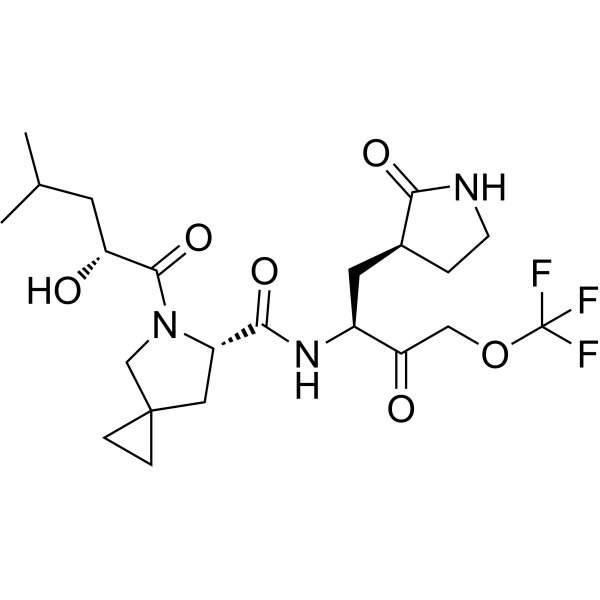
CMX990 is a SARS-CoV-2 3CL protease inhibitor. The EC90s for inhibiting SARS-CoV-2 were 9.6 nM and 101 nM in human bronchial epithelial cells (HBECs) and HeLa-ACE2 cells, respectively. CMX990 has good ADME and pharmacokinetic properties.
Nos produits utilisent uniquement pour la recherche. Nous ne vendons pas aux patients.
- Pureté : 96.63%
- CAS No.: 2882934-64-5
- Formule: C22H32F3N3O6
- Masse moléculaire:491.50
-
Stockage:Powder -20°C, 3 years , 4°C, 2 years ; In solvent -80°C, 6 months , -20°C, 1 month

To place orders, for customer services and technical support, please contact: MedChemExpress USA
Tel: 609-228-6898 E-mail: [email protected] [email protected]


-
 Activité biologique
-
Chemical Information
- Protocole
- Pureté et documentation
- Références
-
 Help & FAQs




Activité biologique
Description
IC50 & Target
SARS-CoV-2[1]
Cellular Effect
|
Cell Line

|
Type | Value | Description | References |
|---|---|---|---|---|
| Epithelial cell | EC50 |
5.3 nM
Compound: CMX990
|
Antiviral activity against SARS-CoV-2 infected in human Primary bronchial epithelial cell assessed as inhibition of viral growth
Antiviral activity against SARS-CoV-2 infected in human Primary bronchial epithelial cell assessed as inhibition of viral growth
|
[PMID: 38335279] |
| HCT-8 | CC50 |
>30 μM
Compound: CMX990
|
Cytotoxicity against human HCT-8 cells incubated for 120 hrs by Cell-Titer Glo assay
Cytotoxicity against human HCT-8 cells incubated for 120 hrs by Cell-Titer Glo assay
|
[PMID: 38335279] |
| HeLa | CC50 |
>40 μM
Compound: CMX990
|
Cytotoxicity against human HeLa cells expressing ACE2 incubated for 120 hrs by Cell-Titer Glo assay
Cytotoxicity against human HeLa cells expressing ACE2 incubated for 120 hrs by Cell-Titer Glo assay
|
[PMID: 38335279] |
| MRC5 | CC50 |
>30 μM
Compound: CMX990
|
Cytotoxicity against human MRC5 cells incubated for 120 hrs by Cell-Titer Glo assay
Cytotoxicity against human MRC5 cells incubated for 120 hrs by Cell-Titer Glo assay
|
[PMID: 38335279] |


Chemical Information
-
CAS No. 2882934-64-5
-
Appearance Solid
-
Masse moléculaire 491.50
-
Formule C22H32F3N3O6
-
Color White to off-white
-
SMILES
O=C(N[C@H](C(COC(F)(F)F)=O)C[C@@H]1CCNC1=O)[C@@H]2CC3(CC3)CN2C([C@H](O)CC(C)C)=O
-
Livraison
Room temperature in continental US; may vary elsewhere.
-
Stockage
Powder -20°C 3 years 4°C 2 years In solvent -80°C 6 months -20°C 1 month

Protocole
-
Protocol for Pharmacokinetic Study
Pharmacokinetic studies quantify how an organism handles a drug over time through absorption, distribution, metabolism, and excretion, and the core experimental readout is the concentration-time profile of parent drug and, when relevant, metabolites in biological matrices such as plasma, whole blood, urine, bile, or tissue. Pharmacokinetic analysis links dose, route, exposure, clearance, half-life, distribution, bioavailability, and systemic exposure to drug efficacy and toxicity hypotheses rather than measuring a signaling pathway directly. The literature links pharmacokinetics to drug-development phenotypes by showing that drug metabolism and pharmacokinetics influence compound progression, exposure-response interpretation, safety margins, dosing strategy, and failure risk during discovery and development. DMPK science contributes to compound optimization by integrating physicochemical properties, in vitro metabolism, transporter behavior, in vivo exposure, and pharmacodynamic contex


Pureté et documentation
-
Fiche technique (270 KB)
-
SDS (252 KB)
- English - EN (252 KB)
- Français - FR (252 KB)
- Deutsch - DE (252 KB)
- Norwegian - NO (252 KB)
- Español - ES (252 KB)
- Swedish - SV (252 KB)
- Italian - IT (252 KB)
- Korean - KR (252 KB)
- Portuguese - PT (252 KB)
-
Instruction de manipulation (2659 KB)
Références

Calculators
Concentration (start) × Volume (start) = Concentration (final) × Volume (final)


CMX990 Related Classifications
HY-149767 Related Classifications
 Powered by Bioz