



CPF-7
CPF-7 (Caerulein precursor fragment) is an insulin-releasing peptide that stimulates the release of insulin. CPF-7 can induce epithelial-mesenchymal transition by upregulating Snai1 expression in PANC-1 ductal cells. CPF-7 also induces exocrine plasticity by upregulating Ngn3 expression. CPF-7 can be used in the research of type 2 diabetes.
Nos produits utilisent uniquement pour la recherche. Nous ne vendons pas aux patients.
- CAS No.: 103238-06-8
- Formule: C118H193N33O32
- Masse moléculaire:2586.00
-
Stockage:
Please store the product under the recommended conditions in the Certificate of Analysis.

To place orders, for customer services and technical support, please contact: MedChemExpress USA
Tel: 609-228-6898 E-mail: [email protected] [email protected]


-
 Activité biologique
-
Chemical Information
- Protocole
- Pureté et documentation
- Références
-
 Help & FAQs




Activité biologique
Description
In Vitro
CPF-7 (50 nM; 7 days) converts PANC-1 exocrine cells into pancreatic endocrine precursor cells[1].
CPF-7 (3 µM; 20 min) produces the stimulation of insulin release in BRIN-BD11 rat clonal β-cells[2].
MedChemExpress (MCE) has not independently confirmed the accuracy of these methods. They are for reference only.
-
Cell Line:PANC1 cells
-
Concentration:50 nM
-
Incubation Time:7 days (change medium every 24 h)
-
Result:Increased Ngn3 (the principal determinant of endocrine precursor cells) expression level.
-
Cell Line:BRIN-BD11 rat clonal β-cells
-
Concentration:3 µM
-
Incubation Time:20 min
-
Result:Stimulated insulin release.


Chemical Information
-
CAS No. 103238-06-8
-
Masse moléculaire 2586.00
-
Formule C118H193N33O32
-
Synonyms
Caerulein precursor fragment
-
Sequence
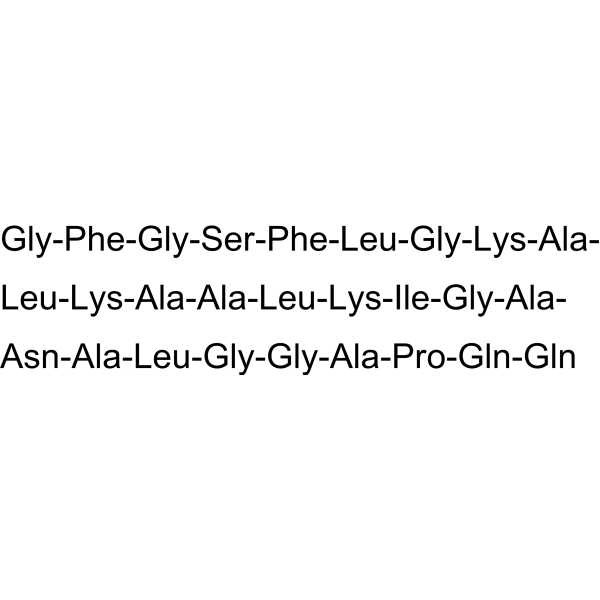
Gly-Phe-Gly-Ser-Phe-Leu-Gly-Lys-Ala-Leu-Lys-Ala-Ala-Leu-Lys-Ile-Gly-Ala-Asn-Ala-Leu-Gly-Gly-Ala-Pro-Gln-Gln
-
Sequence Shortening
GFGSFLGKALKAALKIGANALGGAPQQ
-
Livraison
Room temperature in continental US; may vary elsewhere.
-
Stockage
Please store the product under the recommended conditions in the Certificate of Analysis.


Pureté et documentation
Références
[1]. Heydari M, et al. Differentiation of PANC-1 ductal cells to β-like cells via cellular GABA modulation by Magainin and CPF-7 peptides. Biochem Biophys Res Commun. 2022 Feb 1;597:128-133. [Content Brief]
[2]. Srinivasan D, et al. Caerulein precursor fragment (CPF) peptides from the skin secretions of Xenopus laevis and Silurana epitropicalis are potent insulin-releasing agents. Biochimie. 2013 Feb;95(2):429-35. [Content Brief]

Calculators
Concentration (start) × Volume (start) = Concentration (final) × Volume (final)


CPF-7 Related Classifications
HY-P5291 Related Classifications
 Powered by Bioz