



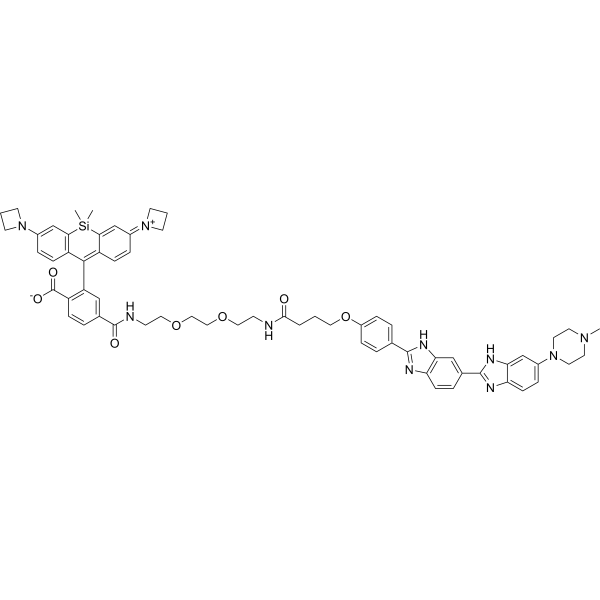
JF646-Hoechst

Based on 1 Customer Validation
JF646-Hoechst is a fluorescent red DNA probe that is an ideal substitute for large oligonucleotide-coupled antibodies used in PAINT experiments, especially for bacterial studies. JF646-Hoechst excitation/emission maximum =655/670 nm.
Nos produits utilisent uniquement pour la recherche. Nous ne vendons pas aux patients.
- CAS No.: 2462011-60-3
- Formule: C64H70N10O7Si
- Masse moléculaire:1119.39
-
Stockage:
-20°C, protect from light, stored under nitrogen
* In solvent : -80°C, 6 months; -20°C, 1 month (protect from light, stored under nitrogen)

To place orders, for customer services and technical support, please contact: MedChemExpress USA
Tel: 609-228-6898 E-mail: [email protected] [email protected]


-
 Activité biologique
-
Chemical Information
-
Solvant et solubilité
- Protocole
- Pureté et documentation
- Références
-
 Help & FAQs




Activité biologique
Description


Chemical Information
-
CAS No. 2462011-60-3
-
Appearance Solid
-
Masse moléculaire 1119.39
-
Formule C64H70N10O7Si
-
Color White to off-white
-
SMILES
CN1CCN(C2=CC=C3C(NC(C4=CC(NC(C5=CC=C(OCCCC(NCCOCCOCCNC(C6=CC(C7=C(C=C/8)C([Si](C)(C9=C7C=CC(N%10CCC%10)=C9)C)=CC8=[N+]%11CCC/%11)=C(C([O-])=O)C=C6)=O)=O)C=C5)=N%12)=C%12C=C4)=N3)=C2)CC1
-
Livraison
Room temperature in continental US; may vary elsewhere.
-
Stockage
-20°C, protect from light, stored under nitrogen
* In solvent : -80°C, 6 months; -20°C, 1 month (protect from light, stored under nitrogen)


Solvant et solubilité
In Vitro:
DMSO : 10 mg/mL (8.93 mM; Need ultrasonic and warming; Hygroscopic DMSO has a significant impact on the solubility of product, please use newly opened DMSO)
Please refer to the solubility information to select the appropriate solvent. Once prepared, please aliquot and store the solution to prevent product inactivation from repeated freeze-thaw cycles.
Storage method and period of stock solution: -80°C, 6 months; -20°C, 1 month (protect from light, stored under nitrogen). When stored at -80°C, please use it within 6 months. When stored at -20°C, please use it within 1 month.
Please refer to the solubility information to select the appropriate solvent. Once prepared, please aliquot and store the solution to prevent product inactivation from repeated freeze-thaw cycles.
Storage method and period of stock solution: -80°C, 6 months; -20°C, 1 month (protect from light, stored under nitrogen). When stored at -80°C, please use it within 6 months. When stored at -20°C, please use it within 1 month.
Concentration (start) × Volume (start) = Concentration (final) × Volume (final)

Protocole
-
Nuclear DNA counterstaining and nuclear morphology staining
Nuclear DNA counterstaining uses DNA-binding fluorescent dyes to visualize nuclei and chromatin so that nuclei can be located, counted, segmented, and evaluated for morphology; Hoechst 33342, DAPI, propidium iodide, and DRAQ5 are commonly reported nuclear stains, while live-cell DNA labeling is better supported for Hoechst dyes and DRAQ5 than for propidium iodide in intact viable cells. Nuclear morphology staining can detect apoptosis-associated nuclear changes, including chromatin condensation, nuclear shrinkage, nuclear fragmentation, reduced nuclear area/perimeter/axis length, and increased nuclear fluorescence intensity; these morphology readouts have been compared with apoptosis markers such as TUNEL and caspase-3 immunofluorescence.


Pureté et documentation
-
Fiche technique (266 KB)
-
SDS (252 KB)
- English - EN (252 KB)
- Français - FR (252 KB)
- Deutsch - DE (252 KB)
- Norwegian - NO (252 KB)
- Español - ES (252 KB)
- Swedish - SV (252 KB)
- Italian - IT (252 KB)
- Korean - KR (252 KB)
- Portuguese - PT (252 KB)
-
Instruction de manipulation (2659 KB)
Références


Complete Stock Solution Preparation Table
Please refer to the solubility information to select the appropriate solvent. Once prepared, please aliquot and store the solution to prevent product inactivation from repeated freeze-thaw cycles.
Storage method and period of stock solution: -80°C, 6 months; -20°C, 1 month (protect from light, stored under nitrogen). When stored at -80°C, please use it within 6 months. When stored at -20°C, please use it within 1 month.
| Optional Solvent | Concentration Solvent Mass | 1 mg | 5 mg | 10 mg | 25 mg |
|---|---|---|---|---|---|
| DMSO | 1 mM | 0.8933 mL | 4.4667 mL | 8.9334 mL | 22.3336 mL |
| 5 mM | 0.1787 mL | 0.8933 mL | 1.7867 mL | 4.4667 mL |


JF646-Hoechst Related Classifications
HY-D2267 Related Classifications
 Powered by Bioz