



STING agonist-13
Based on 1 publication(s) in Google Scholar
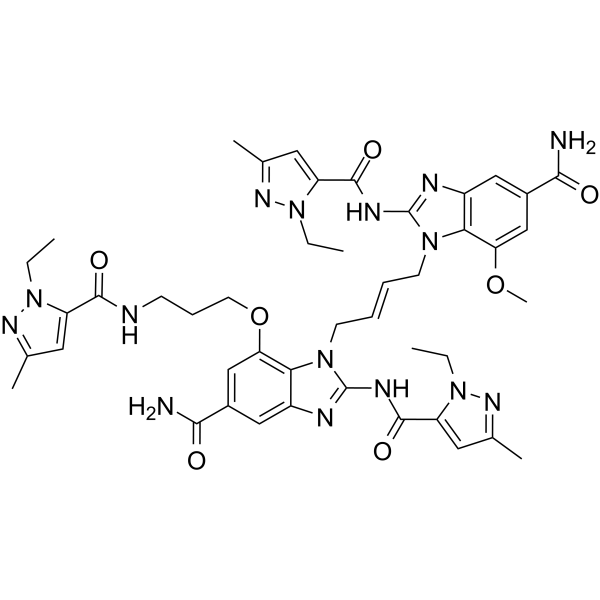
STING agonist-13 is a stimulator of interferon genes (STING) agonist, for cancer immunity via STING-mediated immune activation. STING agonist-13 can stimulate STING downstream signaling and promoting type I interferon immune responses. STING agonist-13 significantly decreases tumor volume and shows immunological memory-derived cancer inhibition.
Nos produits utilisent uniquement pour la recherche. Nous ne vendons pas aux patients.
- CAS No.: 2816929-48-1
- Formule: C45H53N15O7
- Masse moléculaire:916.00
-
Stockage:
Please store the product under the recommended conditions in the Certificate of Analysis.

To place orders, for customer services and technical support, please contact: MedChemExpress USA
Tel: 609-228-6898 E-mail: [email protected] [email protected]


-
 Activité biologique
-
Chemical Information
- Protocole
- Pureté et documentation
- Références
-
 Help & FAQs


Publications Citing Use of MedChemExpress (MCE) STING agonist-13
More

Activité biologique
Description
IC50 & Target
EC50: 7.471 nM (PBMCs), 2.442 nM (RAW264.7)[1]
In Vitro
STING agonist-13 (compound 4c) induces the secretion of IFN-β with an EC50 of 7.471 nM in human primary PBMCs cells[1].
STING agonist-13 (2 μM; 24 hours) induces IP-10 with an EC50 of 2.442 nM and other proinflammatory cytokines such as IL-6 and TNF-α release in RAW264.7 cells[1].
MedChemExpress (MCE) has not independently confirmed the accuracy of these methods. They are for reference only. Further protocols information, click here.
-
Cell Line:PBMCs, RAW264.7
-
Concentration:2 μM
-
Incubation Time:24 hours
-
Result:Showed broad reactivity in PBMCs and RAW264.7 cells.
In Vivo
MedChemExpress (MCE) has not independently confirmed the accuracy of these methods. They are for reference only.
-
Animal Model:8 week-old female BALB/c mice(CT26 tumor mouse models)[1]
-
Dosage:1.5 mg/kg
-
Administration:Intravenous injection; once a day for 8 days.
-
Result:Showed activity of cancer immunity via STING-mediated immune activation.


Chemical Information
-
CAS No. 2816929-48-1
-
Masse moléculaire 916.00
-
Formule C45H53N15O7
-
SMILES
CCN1N=C(C=C1C(NC2=NC3=C(N2C/C=C/CN4C(NC(C5=CC(C)=NN5CC)=O)=NC6=CC(C(N)=O)=CC(OCCCNC(C7=CC(C)=NN7CC)=O)=C64)C(OC)=CC(C(N)=O)=C3)=O)C
-
Livraison
Room temperature in continental US; may vary elsewhere.
-
Stockage
Please store the product under the recommended conditions in the Certificate of Analysis.


Publications (1)
-
Journal Impact Factor
-
Most Recent
-
Signal Transduct Target Ther
Arginase 1 drives mitochondrial cristae remodeling and PANoptosis in ischemia/hypoxia-induced vascular dysfunction. [Abstract]2025 May 28;10(1):167. PMID: 40425583

Protocole
-
Research Protocol for Cancer Immunology
Cancer immunology studies how the immune system recognizes, suppresses, edits, or fails to eliminate malignant cells through tumor antigen release, antigen presentation, T-cell priming, immune trafficking, tumor-cell killing, and feedback inhibition in the tumor microenvironment. The cancer-immunity cycle links tumor antigenicity, dendritic-cell priming, CD8+ T-cell infiltration, cytotoxic function, and immune-checkpoint regulation to tumor rejection or immune escape. Immune-checkpoint pathways such as PD-1/PD-L1 and CTLA-4 suppress antitumor T-cell activity and can be therapeutically blocked, but many tumors remain resistant because of poor antigen presentation, weak T-cell infiltration, suppressive myeloid cells, regulatory T cells, and tumor-intrinsic immune-exclusion programs. Unresolved questions include which immune-cell states predict response, how tumor-intrinsic pathways exclude immune cells, how myeloid suppression limits checkpoint blockade, and which combination strategies


Pureté et documentation
Références

Calculators
Concentration (start) × Volume (start) = Concentration (final) × Volume (final)


STING agonist-13 Related Classifications
HY-143321 Related Classifications
 Powered by Bioz