



Thunalbene
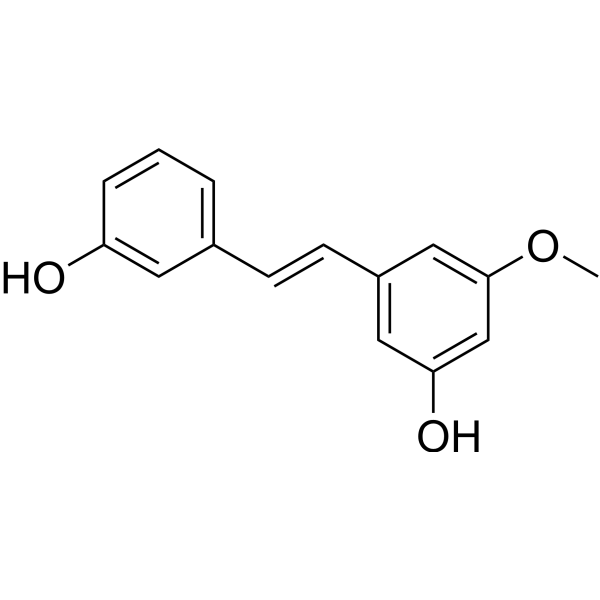
Thunalbene is a stilbene derivative isolated from Thunia alba. Thunalbene has a weak inhibitory effect on nitric oxide production and is not cytotoxic.
Nos produits utilisent uniquement pour la recherche. Nous ne vendons pas aux patients.
- CAS No.: 220862-05-5
- Formule: C15H14O3
- Masse moléculaire:242.27
-
Stockage:
Please store the product under the recommended conditions in the Certificate of Analysis.

To place orders, for customer services and technical support, please contact: MedChemExpress USA
Tel: 609-228-6898 E-mail: [email protected] [email protected]


-
 Activité biologique
-
Chemical Information
- Protocole
- Pureté et documentation
- Références
-
 Help & FAQs




Activité biologique
Description
In Vitro
Thunalbene (1 or 10 μM) produces a value of 92.92 for NO at a concentration of 1μM and 75.08 for NO at a concentration of 10 μM with no cytotoxicity in lipopolysaccharide (LPS)-stimulated RAW 264.7 macrophages[1].
MedChemExpress (MCE) has not independently confirmed the accuracy of these methods. They are for reference only. Further protocols information, click here.


Chemical Information
-
CAS No. 220862-05-5
-
Masse moléculaire 242.27
-
Formule C15H14O3
-
SMILES
OC1=CC(OC)=CC(/C=C/C2=CC=CC(O)=C2)=C1
-
Structure Classification
-
Initial Source
-
Livraison
Room temperature in continental US; may vary elsewhere.
-
Stockage
Please store the product under the recommended conditions in the Certificate of Analysis.

Protocole
-
Cell Viability Determination by MTT Colorimetric Assay
The following protocol uses the MTT colorimetric assay as a classic literature-established method for assessing cell viability/metabolic activity in cultured mammalian cells. MTT[3-(4,5-dimethylthiazol-2-yl)-2,5-diphenyltetrazolium bromide] is reduced by metabolically active cells to a colored formazan product; the amount of formazan is quantified spectrophotometrically and provides an indirect measure of metabolically active viable cells. Importantly, MTT reduction reflects cellular oxidoreductase/metabolic activity rather than an absolute direct count of living cells, so changes in cellular metabolism can alter the signal independently of cell number.


Pureté et documentation
Références

Calculators
Concentration (start) × Volume (start) = Concentration (final) × Volume (final)


Thunalbene Related Classifications
HY-116885 Related Classifications
 Powered by Bioz