



117690-79-6
117690-79-6
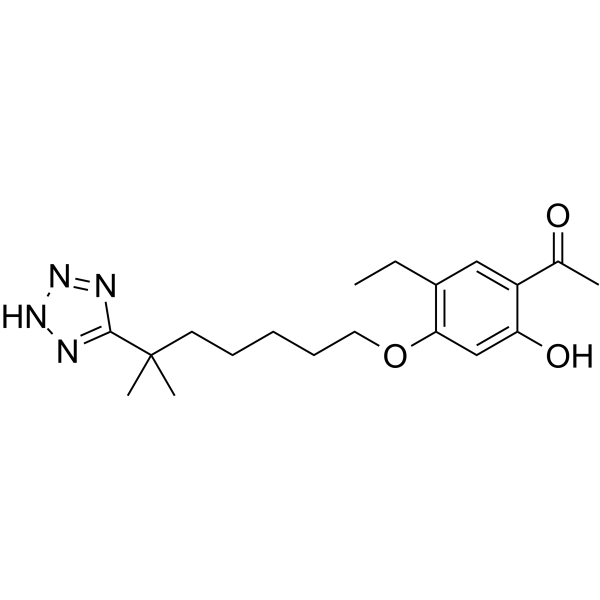
Chemical Structure
LY255283
- CAS. Nr.: 117690-79-6
- Formula:C19H28N4O3
- Molecular Weight:360.45
IUPAC Name: 1-(5-ethyl-2-hydroxy-4-((6-methyl-6-(2H-tetrazol-5-yl)heptyl)oxy)phenyl)ethan-1-one
InChIKey: WCGXJPFHTHQNJL-UHFFFAOYSA-N
SMILES: CC(C1=CC(CC)=C(OCCCCCC(C2=NNN=N2)(C)C)C=C1O)=O
Biological Activity: LY255283 is a LTB4 receptor (BLT2) antagonist, with an IC50 of ~100 nM for [3H]LTB4 binding to guinea pig lung membranes[1][2][3][4].
| Art. -Nr. | Produktname | Reinheit | Beschreibung | Pricing | |||||||||||||||||||
|---|---|---|---|---|---|---|---|---|---|---|---|---|---|---|---|---|---|---|---|---|---|---|---|
|
|
LY255283 | 98.04% | LY255283 is a LTB4 receptor (BLT2) antagonist, with an IC50 of ~100 nM for [3H]LTB4 binding to guinea pig lung membranes. | ||||||||||||||||||||
|
loading...
/
|
|||||||||||||||||||||||
Structural Analogs
-
Similarity Score 0.62
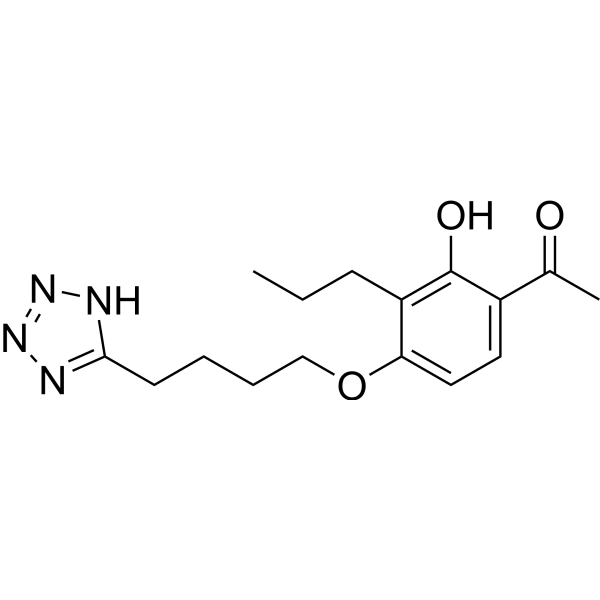 HY-111212Tomelukast
-
Similarity Score 0.61
 HY-135613LY280748
-
Similarity Score 0.59
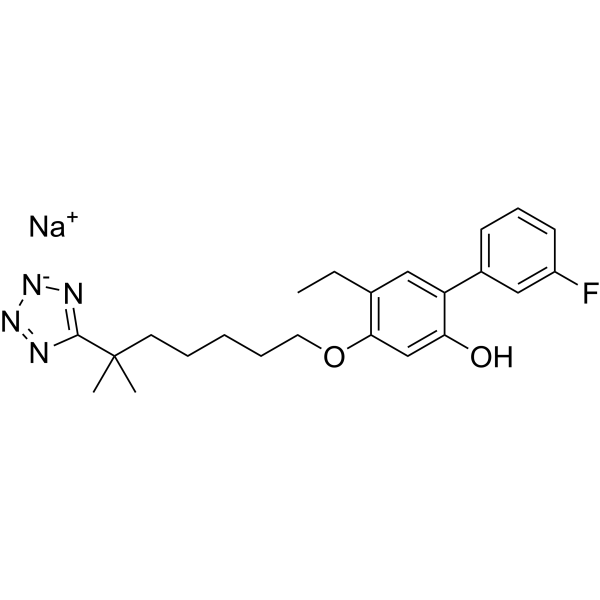 HY-117557LY306669
-
Similarity Score 0.53
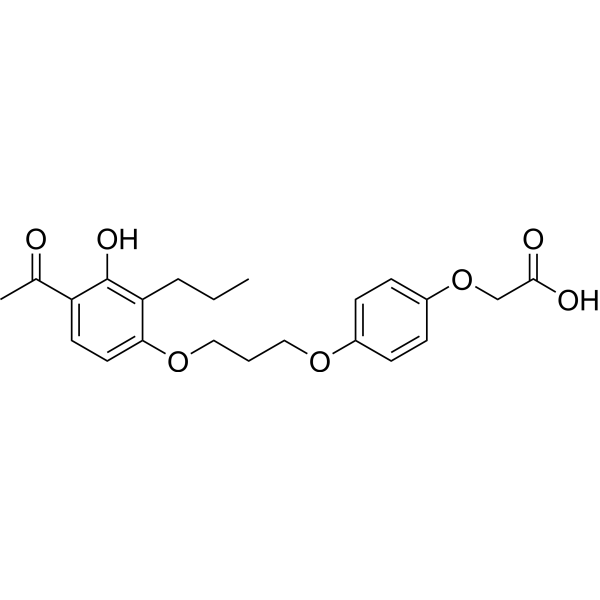 HY-20019L-165041
-
Similarity Score 0.51
 HY-120486LY203647
-
Similarity Score 0.50
 HY-B17122-Hydroxy-4-(octyloxy)benzophenone
-
Similarity Score 0.49
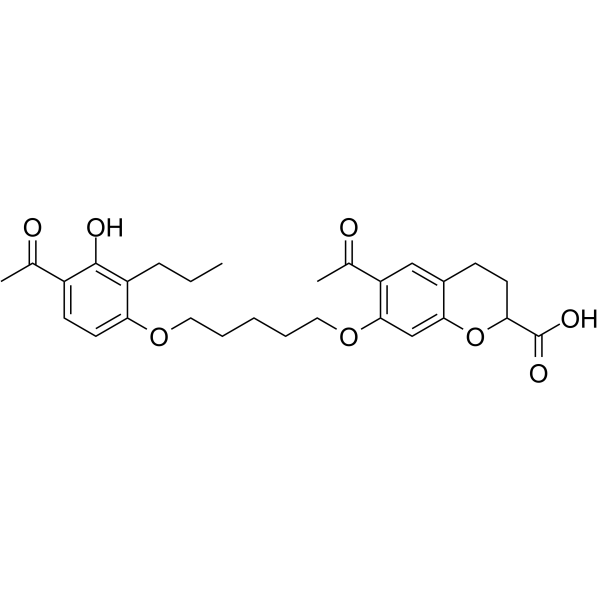 HY-118958Ablukast
-
Similarity Score 0.48
 HY-135288L-649923
-
Similarity Score 0.48
 HY-108963LY 170198
-

Explore the MedChemAI to find more analogs


References
- [1]. R M Schultz, et al. Effects of two leukotriene B4 (LTB4) receptor antagonists (LY255283 and SC-41930) on LTB4-induced human neutrophil adhesion and superoxide production. Prostaglandins Leukot Essent Fatty Acids. 1991 Aug;43(4):267-71. [Content Brief]
- [2]. S A Silbaugh, et al. Pulmonary actions of LY255283, a leukotriene B4 receptor antagonist. Eur J Pharmacol. 1992 Nov 13;223(1):57-64. [Content Brief]
- [3]. P S Wollert, et al. LY255283, a novel leukotriene B4 receptor antagonist, limits activation of neutrophils and prevents acute lung injury induced by endotoxin in pigs. Surgery. 1993 Aug;114(2):191-8. [Content Brief]
- [4]. Eun-Young Kim, et al. BLT2 promotes the invasion and metastasis of aggressive bladder cancer cells through a reactive oxygen species-linked pathway. Free Radic Biol Med. 2010 Sep 15;49(6):1072-81. [Content Brief]



