



4727-31-5
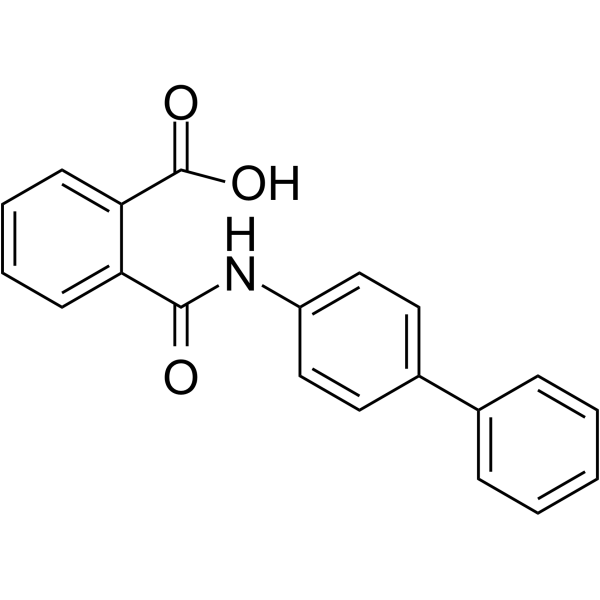
Chemical Structure
Kartogenin
Synonym(s): KGN
- CAS No.: 4727-31-5
- Formula:C20H15NO3
- Molecular Weight:317.34
IUPAC Name: 2-([1,1'-biphenyl]-4-ylcarbamoyl)benzoic acid
InChIKey: SLUINPGXGFUMLL-UHFFFAOYSA-N
SMILES: O=C(O)C1=CC=CC=C1C(NC2=CC=C(C3=CC=CC=C3)C=C2)=O
Biological Activity: Kartogenin (KGN) is an inducer of chondrogenic tissue formation (EC50: 100 nM). Kartogenin induces chondrogenesis by binding to fibrin A, disrupting its interaction with the transcription factor core binding factor beta subunit (CBFβ), and by modulating the CBFβ-RUNX1 transcriptional program. Kartogenin also promotes tendon-bone junction (TBJ) wound healing by stimulating collagen synthesis. Kartogenin is widely used in cell-free therapy in the field of regeneration for cartilage regeneration and protection, tendon-bone healing, wound healing and limb development. Kartogenin promotes cartilage repair, coordinates limb development, and is also used in osteoarthritis (OA) research[1][2][3][4].
| Cat. No. | Product Name | Purity | Description | Pricing | |||||||||||||||||||
|---|---|---|---|---|---|---|---|---|---|---|---|---|---|---|---|---|---|---|---|---|---|---|---|
|
|
Kartogenin | 99.05% | Kartogenin (KGN) is an inducer of chondrogenic tissue formation (EC50: 100 nM). Kartogenin induces chondrogenesis by binding to fibrin A, disrupting its interaction with the transcription factor core binding factor beta subunit (CBFβ), and by modulating the CBFβ-RUNX1 transcriptional program. Kartogenin also promotes tendon-bone junction (TBJ) wound healing by stimulating collagen synthesis. Kartogenin is widely used in cell-free therapy in the field of regeneration for cartilage regeneration and protection, tendon-bone healing, wound healing and limb development. Kartogenin promotes cartilage repair, coordinates limb development, and is also used in osteoarthritis (OA) research. | ||||||||||||||||||||
|
loading...
/
|
|||||||||||||||||||||||
-
Similarity Score 0.88
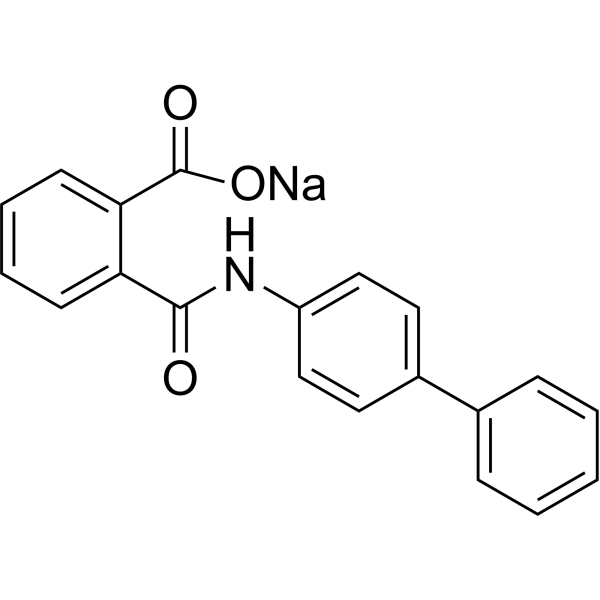 HY-16268AKartogenin sodium
-
Similarity Score 0.79
 HY-116425RN-1-Naphthylphthalamic acid (Standard)
-
Similarity Score 0.77
 HY-183887PD-L1-IN-11
-
Similarity Score 0.71
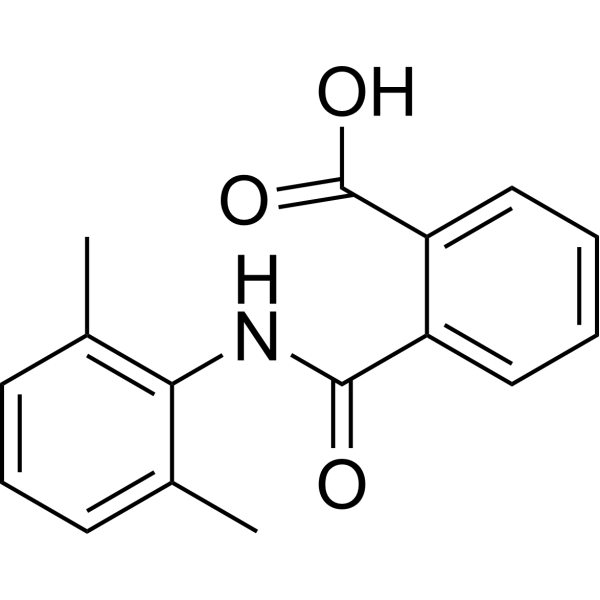 HY-B1040Ftaxilide
-
Similarity Score 0.69
 HY-W543287[1,1':4',1''-Terphenyl]-3,5-dicarboxylicacid
-
Similarity Score 0.69
 HY-W543282[1,1':4',1''-Terphenyl]-3,3''-dicarboxylicacid
-
Similarity Score 0.68
 HY-W1515152,5-Diphenylterephthalic acid
-
Similarity Score 0.68
 HY-W075037[1,1':3',1''-Terphenyl]-4,4''-dicarboxylic acid
-
Similarity Score 0.68
 HY-W1049906[1,1':3',1''-Terphenyl]-4',6'-dicarboxylic acid
-

Explore the MedChemAI to find more analogs


References
- [1]. Johnson K, et, al. A stem cell-based approach to cartilage repair. Science. 2012 May 11;336(6082):717-21. [Content Brief]
- [2]. Liu F, et, al. A novel kartogenin-platelet-rich plasma gel enhances chondrogenesis of bone marrow mesenchymal stem cells in vitro and promotes wounded meniscus healing in vivo. Stem Cell Res Ther. 2019 Jul 8;10(1):201. [Content Brief]
- [3]. Cai J, Zhang L, Chen J, et al. Kartogenin and its application in regenerative medicine[J]. Current medical science, 2019, 39(1): 16-20.
- [4]. Zhang J, Wang J H C. Kartogenin induces cartilage-like tissue formation in tendon–bone junction[J]. Bone research, 2014, 2(1): 1-10.



